
(+)- 松萝酸及其盐类,通过计算机模拟方法和体外检测鉴定出的 SARS-CoV-2 抑制剂。
(+)-Usnic acid and its salts, inhibitors of SARS-CoV-2, identified by using in silico methods and in vitro assay.
机构信息
Laboratory of Marine Drugs, School of Earth and Environmental Sciences, Seoul National University, NS-80, Seoul, 08826, Korea.
Research Institute of Oceanography, Seoul National University, NS-80, Seoul, 08826, Korea.
出版信息
Sci Rep. 2022 Jul 30;12(1):13118. doi: 10.1038/s41598-022-17506-3.
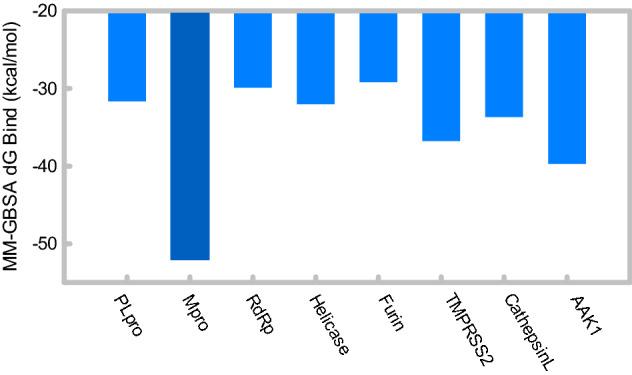
The pandemic caused by severe acute respiratory Coronavirus-2 (SARS-CoV-2) has been ongoing for over two years, and treatment for COVID-19, other than monoclonal antibodies, is urgently required. Accordingly, we have investigated the inhibitors of SARS-CoV-2 protein targets by high-throughput virtual screening using a marine natural products database. Considering the calculated molecular properties and availability of the compounds, (+)-usnic acid was selected as a suitable hit. In the in vitro antiviral assay of (+)-usnic acid by the immunofluorescence method, IC was 7.99 μM, which is similar to that of remdesivir used as a positive control. The generalized Born and surface area continuum solvation (MM/GBSA) method was performed to find the potent target of (+)-usnic acid, and the Mpro protein showed the most prominent value, -52.05 kcal/mol, among other SARS-CoV-2 protein targets. Thereafter, RMSD and protein-ligand interactions were profiled using molecular dynamics (MD) simulations. Sodium usnate (NaU) improved in vitro assay results with an IC of 5.33 μM and a selectivity index (SI) of 9.38. Additionally, when (+)-usnic acid was assayed against SARS-CoV-2 variants, it showed enhanced efficacy toward beta variants with an IC of 2.92 μM and SI of 11.1. We report the in vitro anti-SARS-CoV-2 efficacy of (+)-usnic acid in this study and propose that it has the potential to be developed as a COVID-19 treatment if its in vivo efficacy has been confirmed.
由严重急性呼吸系统综合征冠状病毒 2(SARS-CoV-2)引起的大流行已经持续了两年多,除了单克隆抗体之外,还急需治疗 COVID-19 的方法。因此,我们使用海洋天然产物数据库通过高通量虚拟筛选研究了 SARS-CoV-2 蛋白靶标的抑制剂。考虑到计算出的分子特性和化合物的可用性,选择了 (+)-usnic 酸作为合适的命中物。在 (+)-usnic 酸通过免疫荧光法的体外抗病毒测定中,IC 为 7.99 μM,与用作阳性对照的瑞德西韦相似。采用广义 Born 和表面面积连续体溶剂化(MM/GBSA)方法寻找 (+)-usnic 酸的有效靶标,Mpro 蛋白在其他 SARS-CoV-2 蛋白靶标中表现出最显著的价值,为-52.05 kcal/mol。此后,使用分子动力学(MD)模拟对 RMSD 和蛋白-配体相互作用进行了分析。Sodium usnate(NaU)提高了 IC 为 5.33 μM 和选择性指数(SI)为 9.38 的体外测定结果。此外,当 (+)-usnic 酸对 SARS-CoV-2 变体进行测定时,其对 beta 变体的功效增强,IC 为 2.92 μM,SI 为 11.1。本研究报告了 (+)-usnic 酸体外抗 SARS-CoV-2 的功效,并提出如果其体内功效得到证实,它有可能被开发为 COVID-19 治疗方法。


 Zotero 插件