
炎症性肠病非侵入性检查的诊断效用:一项伞状综述。
Diagnostic Utility of Non-invasive Tests for Inflammatory Bowel Disease: An Umbrella Review.
作者信息
Shi Jin-Tong, Zhang Yuexin, She Yuehan, Goyal Hemant, Wu Zhi-Qi, Xu Hua-Guo
机构信息
Department of Laboratory Medicine, The First Affiliated Hospital of Nanjing Medical University, Nanjing, China.
Branch of National Clinical Research Center for Laboratory Medicine, Nanjing, China.
出版信息
Front Med (Lausanne). 2022 Jul 11;9:920732. doi: 10.3389/fmed.2022.920732. eCollection 2022.
BACKGROUND
This study aims to consolidate evidence from published systematic reviews and meta-analyses evaluating the diagnostic performances of non-invasive tests for inflammatory bowel disease (IBD) in various clinical conditions and age groups.
METHODS
Two independent reviewers systematically identified and appraised systematic reviews and meta-analyses assessing the diagnostic utility of non-invasive tests for IBD. Each association was categorized as adults, children, and mixed population, based on the age ranges of patients included in the primary studies. We classified clinical scenarios into diagnosis, activity assessment, and predicting recurrence.
RESULTS
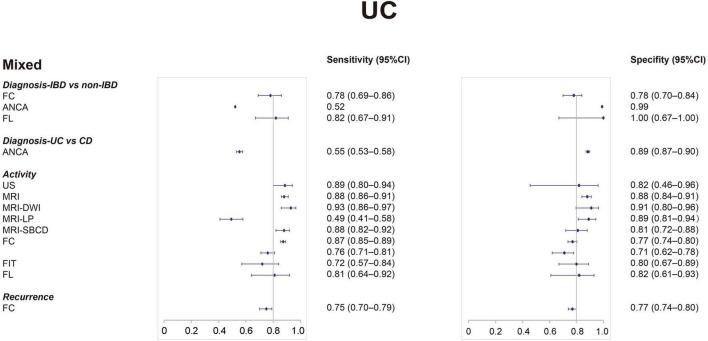
In total, 106 assessments from 43 reviews were included, with 17 non-invasive tests. Fecal calprotectin (FC) and fecal lactoferrin (FL) were the most sensitive for distinguishing IBD from non-IBD. However, anti-neutrophil cytoplasmic antibodies (ANCA) and FL were the most specific for it. FC and FL were the most sensitive and specific tests, respectively, to distinguish IBD from irritable bowel syndrome (IBS). Anti- antibodies (ASCA), IgA, were the best test to distinguish Crohn's disease (CD) from ulcerative colitis (UC). Interferon-γ release assay was the best test to distinguish CD from intestinal tuberculosis (ITB). Ultrasound (US) and magnetic resonance enterography (MRE) were both sensitive and specific for disease activity, along with the high sensitivity of FC. Small intestine contrast ultrasonography (SICUS) had the highest sensitivity, and FC had the highest specificity for operative CD recurrence.
CONCLUSION
In this umbrella review, we summarized the diagnostic performance of non-invasive tests for IBD in various clinical conditions and age groups. Clinicians can use the suggested non-invasive test depending on the appropriate clinical situation in IBD patients.
背景
本研究旨在整合已发表的系统评价和荟萃分析中的证据,以评估非侵入性检测在各种临床情况和年龄组中对炎症性肠病(IBD)的诊断性能。
方法
两名独立的评审员系统地识别和评估了评估IBD非侵入性检测诊断效用的系统评价和荟萃分析。根据纳入的原始研究中患者的年龄范围,将每个关联分为成人、儿童和混合人群。我们将临床情况分为诊断、活动评估和预测复发。
结果
总共纳入了43篇综述中的106项评估,涉及17种非侵入性检测。粪便钙卫蛋白(FC)和粪便乳铁蛋白(FL)在区分IBD与非IBD方面最敏感。然而,抗中性粒细胞胞浆抗体(ANCA)和FL在这方面最具特异性。FC和FL分别是区分IBD与肠易激综合征(IBS)最敏感和最具特异性的检测。抗酿酒酵母抗体(ASCA)IgA是区分克罗恩病(CD)与溃疡性结肠炎(UC)的最佳检测。干扰素-γ释放试验是区分CD与肠结核(ITB)的最佳检测。超声(US)和磁共振肠造影(MRE)对疾病活动均敏感且特异,FC也具有高敏感性。小肠对比超声检查(SICUS)对手术治疗的CD复发敏感性最高,FC特异性最高。
结论
在本伞状综述中,我们总结了非侵入性检测在各种临床情况和年龄组中对IBD的诊断性能。临床医生可根据IBD患者的适当临床情况使用建议的非侵入性检测。


 Zotero 插件