
非洲猪瘟防控:疫苗研发进展更新。
African swine fever control and prevention: an update on vaccine development.
机构信息
CIISA - Centre for Interdisciplinary Research in Animal Health, Faculty of Veterinary Medicine, University of Lisbon, Lisboa, Portugal.
Associate Laboratory for Animal and Veterinary Sciences (AL4AnimalS), Lisboa, Portugal.
出版信息
Emerg Microbes Infect. 2022 Dec;11(1):2021-2033. doi: 10.1080/22221751.2022.2108342.
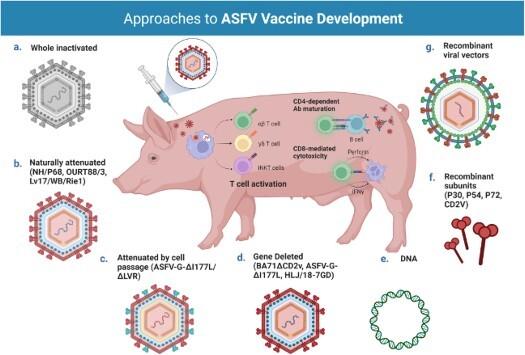
African swine fever (ASF) is a lethal and highly contagious viral disease of domestic and wild pigs, listed as a notifiable disease reported to the World Organization for Animal Health (OIE). Despite its limited host range and absent zoonotic potential, the socio-economic and environmental impact of ASF is very high, representing a serious threat to the global swine industry and the many stakeholders involved. Currently, only control and eradication measures based mainly on early detection and strict stamping-out policies are available, however, the rapid spread of the disease in new countries, and in new regions in countries already affected, show these strategies to be lacking. In this review, we discuss approaches to ASF vaccinology, with emphasis on the advances made over the last decade, including the development of virulence-associated gene deleted strains such as the very promising ASFV-G-ΔI177L/ΔLVR, that replicates efficiently in a stable porcine epithelial cell line, and the cross-protecting BA71ΔCD2 capable of stably growing in the commercial COS-1 cell line, or the naturally attenuated Lv17/WB/Rie1 which shows solid protection in wild boar. We also consider the key constraints involved in the scale-up and commercialization of promising live attenuated and virus-vectored vaccine candidates, namely cross-protection, safety, lack of suitable animal models, compatibility with wildlife immunization, availability of established and licensed cell lines, and differentiating infected from vaccinated animals (DIVA) strategy.
非洲猪瘟(ASF)是一种致命的、高度传染性的猪病毒病,被列为向世界动物卫生组织(OIE)报告的法定报告疾病。尽管其宿主范围有限且不存在人畜共患潜力,但 ASF 的社会经济和环境影响非常高,对全球养猪业和许多相关利益方构成严重威胁。目前,仅可采用基于早期检测和严格扑杀政策的控制和根除措施,但该疾病在新国家的迅速传播,以及在已受影响的国家的新地区的传播,表明这些策略存在不足。在这篇综述中,我们讨论了 ASF 疫苗学的方法,重点介绍了过去十年取得的进展,包括开发与毒力相关的基因缺失株,例如非常有前途的 ASFV-G-ΔI177L/ΔLVR,该基因在稳定的猪上皮细胞系中高效复制,以及具有交叉保护作用的 BA71ΔCD2 能够在商业 COS-1 细胞系中稳定生长,或自然减毒的 Lv17/WB/Rie1 在野猪中表现出稳定的保护作用。我们还考虑了有前途的活疫苗和病毒载体候选疫苗在扩大规模和商业化方面所涉及的关键限制因素,包括交叉保护、安全性、缺乏合适的动物模型、与野生动物免疫的兼容性、现有的已获许可的细胞系的可用性,以及区分感染动物和接种疫苗动物(DIVA)的策略。

 Zotero 插件