
社会资本 I:测量及其与经济流动性的关联。
Social capital I: measurement and associations with economic mobility.
机构信息
Department of Economics, Harvard University, Cambridge, MA, USA.
Department of Economics, Stanford University, Stanford, CA, USA.
出版信息
Nature. 2022 Aug;608(7921):108-121. doi: 10.1038/s41586-022-04996-4. Epub 2022 Aug 1.
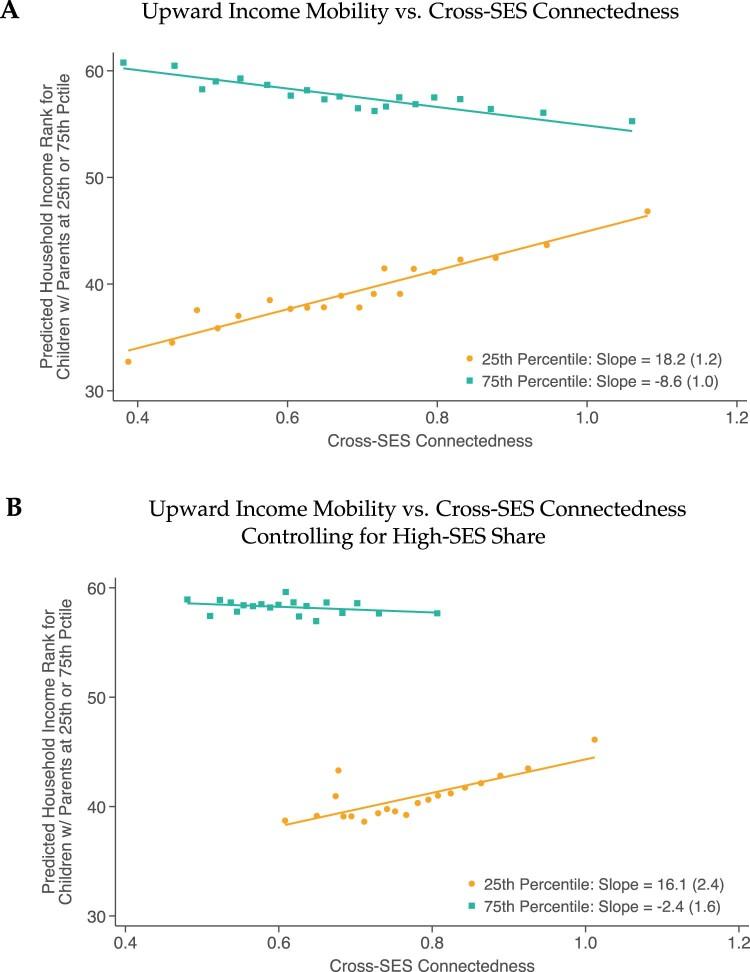
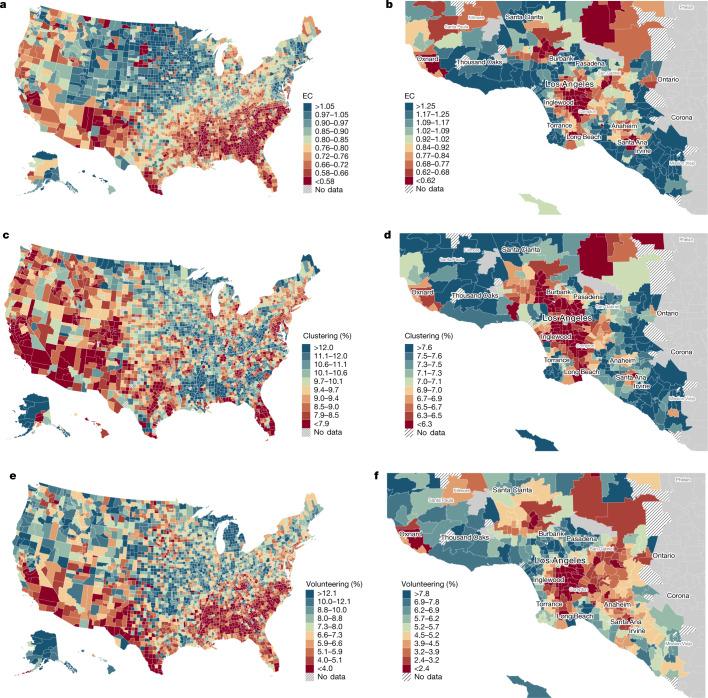
Social capital-the strength of an individual's social network and community-has been identified as a potential determinant of outcomes ranging from education to health. However, efforts to understand what types of social capital matter for these outcomes have been hindered by a lack of social network data. Here, in the first of a pair of papers, we use data on 21 billion friendships from Facebook to study social capital. We measure and analyse three types of social capital by ZIP (postal) code in the United States: (1) connectedness between different types of people, such as those with low versus high socioeconomic status (SES); (2) social cohesion, such as the extent of cliques in friendship networks; and (3) civic engagement, such as rates of volunteering. These measures vary substantially across areas, but are not highly correlated with each other. We demonstrate the importance of distinguishing these forms of social capital by analysing their associations with economic mobility across areas. The share of high-SES friends among individuals with low SES-which we term economic connectedness-is among the strongest predictors of upward income mobility identified to date. Other social capital measures are not strongly associated with economic mobility. If children with low-SES parents were to grow up in counties with economic connectedness comparable to that of the average child with high-SES parents, their incomes in adulthood would increase by 20% on average. Differences in economic connectedness can explain well-known relationships between upward income mobility and racial segregation, poverty rates, and inequality. To support further research and policy interventions, we publicly release privacy-protected statistics on social capital by ZIP code at https://www.socialcapital.org .
社会资本——个体的社会网络和社区的实力——已被确定为从教育到健康等各种结果的潜在决定因素。然而,由于缺乏社交网络数据,人们努力理解哪些类型的社会资本对这些结果很重要,但却受到了阻碍。在这对论文的第一篇中,我们使用来自 Facebook 的 210 亿好友关系数据来研究社会资本。我们按邮政编码(ZIP 码)衡量和分析美国的三种社会资本:(1)不同类型的人之间的联系,例如社会经济地位(SES)高的人与 SES 低的人之间的联系;(2)社会凝聚力,例如友谊网络中派系的程度;(3)公民参与度,例如志愿服务的比率。这些指标在不同地区差异很大,但彼此之间相关性不高。我们通过分析这些指标与不同地区经济流动性的关系,证明了区分这些形式的社会资本的重要性。SES 低的个体与 SES 高的个体之间的高 SES 朋友的比例——我们称之为经济联系——是迄今为止确定的与向上收入流动性最相关的指标之一。其他社会资本指标与经济流动性没有很强的关联。如果 SES 低的父母的孩子能够在经济联系程度与 SES 高的父母的孩子相当的县中长大,那么他们成年后的收入平均会增加 20%。经济联系程度的差异可以很好地解释向上收入流动性与种族隔离、贫困率和不平等之间的已知关系。为了支持进一步的研究和政策干预,我们在 https://www.socialcapital.org 上公开发布了按邮政编码划分的受隐私保护的社会资本统计数据。

 Zotero 插件