
南非 2020-2021 年成人艾滋病毒感染者和非感染者严重急性呼吸综合征冠状病毒 2 家庭传播:一项病例确定、前瞻性、观察性家庭传播研究。
Household Transmission of Severe Acute Respiratory Syndrome Coronavirus 2 From Adult Index Cases With and Without Human Immunodeficiency Virus in South Africa, 2020-2021: A Case-Ascertained, Prospective, Observational Household Transmission Study.
机构信息
Centre for Respiratory Diseases and Meningitis, National Institute for Communicable Diseases of the National Health Laboratory Service, Johannesburg, South Africa.
School of Public Health, Faculty of Health Sciences, University of the Witwatersrand, Johannesburg, South Africa.
出版信息
Clin Infect Dis. 2023 Feb 8;76(3):e71-e81. doi: 10.1093/cid/ciac640.
BACKGROUND
In South Africa, 19% of adults are living with human immunodeficiency virus (HIV; LWH). Few data on the influence of HIV on severe acute respiratory syndrome coronavirus 2 (SARS-CoV-2) household transmission are available.
METHODS
We performed a case-ascertained, prospective household transmission study of symptomatic adult index SARS-CoV-2 cases LWH and not living with HIV (NLWH) and their contacts from October 2020 to September 2021. Households were followed up 3 times a week for 6 weeks to collect nasal swabs for SARS-CoV-2 testing. We estimated household cumulative infection risk (HCIR) and duration of SARS-CoV-2 positivity (at a cycle threshold value <30 as proxy for high viral load).
RESULTS
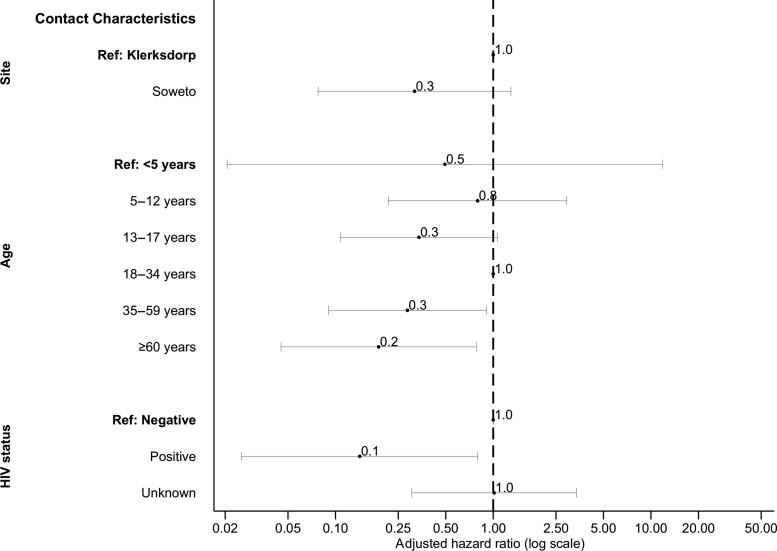
HCIR was 59% (220 of 373), not differing by index HIV status (60% LWH vs 58% NLWH). HCIR increased with index case age (35-59 years: adjusted OR [aOR], 3.4; 95% CI, 1.5-7.8 and ≥60 years: aOR, 3.1; 95% CI, 1.0-10.1) compared with 18-34 years and with contacts' age, 13-17 years (aOR, 7.1; 95% CI, 1.5-33.9) and 18-34 years (aOR, 4.4; 95% CI, 1.0-18.4) compared with <5 years. Mean positivity was longer in cases LWH (adjusted hazard ratio, 0.4; 95% CI, .1-.9).
CONCLUSIONS
Index HIV status was not associated with higher HCIR, but cases LWH had longer positivity duration. Adults aged >35 years were more likely to transmit and individuals aged 13-34 to be infected SARS-CoV-2 in the household. As HIV infection may increase transmission, health services must maintain HIV testing and antiretroviral therapy initiation.
背景
在南非,19%的成年人携带人类免疫缺陷病毒(HIV;LWH)。关于 HIV 对严重急性呼吸综合征冠状病毒 2(SARS-CoV-2)家庭传播影响的数据很少。
方法
我们进行了一项病例确定的前瞻性家庭传播研究,研究对象为 2020 年 10 月至 2021 年 9 月期间有症状的成年 SARS-CoV-2 指数病例 LWH 和未携带 HIV(NLWH)及其接触者。每周对家庭进行 3 次随访,以收集用于 SARS-CoV-2 检测的鼻腔拭子。我们估计了家庭累积感染风险(HCIR)和 SARS-CoV-2 阳性持续时间(以循环阈值值 <30 作为高病毒载量的代理)。
结果
HCIR 为 59%(220/373),与指数 HIV 状态无关(LWH 为 60%,NLWH 为 58%)。HCIR 随指数病例年龄增加而增加(35-59 岁:调整后的比值比[aOR],3.4;95%置信区间[CI],1.5-7.8 和≥60 岁:aOR,3.1;95%CI,1.0-10.1),与 18-34 岁相比,与接触者年龄,13-17 岁(aOR,7.1;95%CI,1.5-33.9)和 18-34 岁(aOR,4.4;95%CI,1.0-18.4)相比,<5 岁的年龄更低。LWH 病例的平均阳性时间较长(调整后的危害比,0.4;95%CI,.1-.9)。
结论
指数 HIV 状态与更高的 HCIR 无关,但 LWH 病例的阳性持续时间更长。年龄>35 岁的成年人更有可能传播,年龄在 13-34 岁的个体更有可能在家庭中感染 SARS-CoV-2。由于 HIV 感染可能增加传播,卫生服务部门必须保持 HIV 检测和抗逆转录病毒治疗的启动。


 Zotero 插件