
食管骨外肿瘤尤因肉瘤:病例报告
Esophageal extraskeletal neoplasm Ewing's sarcoma: Case report.
作者信息
Khalid Hina, Hussain Niaz, Shamshad Rafay
机构信息
Dow University of Health Sciences, Karachi, Pakistan.
Department of Thoracic Surgery, Ojha Institute of Chest Disease, Pakistan.
出版信息
Int J Surg Case Rep. 2022 Aug;97:107399. doi: 10.1016/j.ijscr.2022.107399. Epub 2022 Jul 9.
INTRODUCTION AND IMPORTANCE
Ewing sarcomas are a group of small round cell tumors that occur predominantly in the long bones as well as in extraosseous locations such as the extremities, trunk, and retroperitoneum (Gier, 1997) [2]. Extraosseous Ewing sarcoma (EES) is a type of small round cell tumor that occurs in soft tissues. I rare cases, EES occurs in the esophagus (Maesawa et al., 2002; Johnson et al., 2010) [1,3]. Ewing's sarcoma is a rare and highly aggressive cancer most frequently arising in people under 20 years of age. We report an uncommon case of primary paraesophageal Ewing's sarcoma in a 25-year-old female.
CASE PRESENTATION
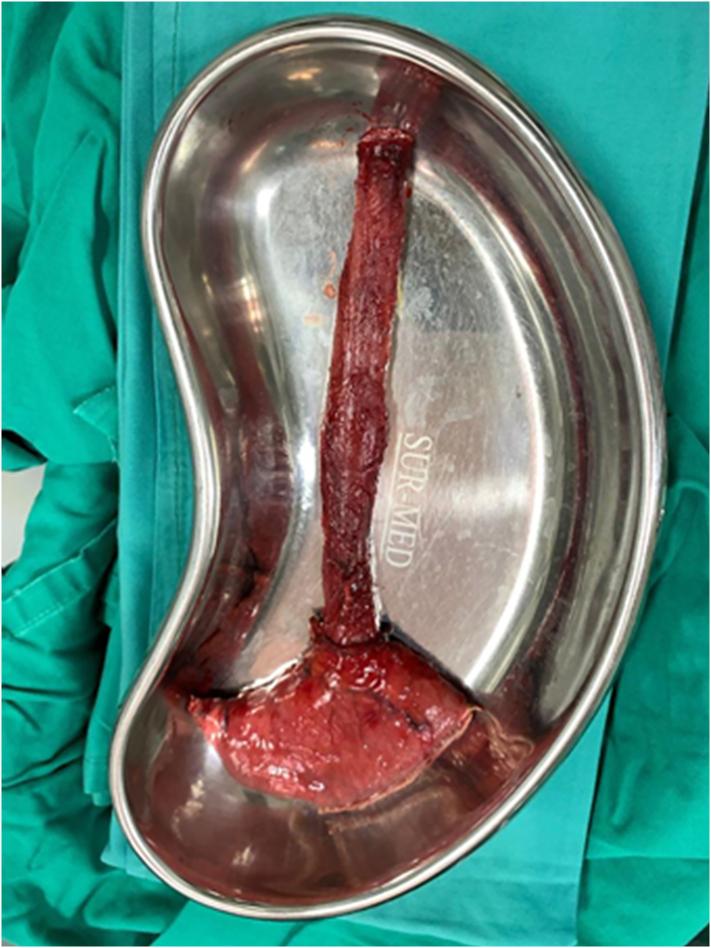
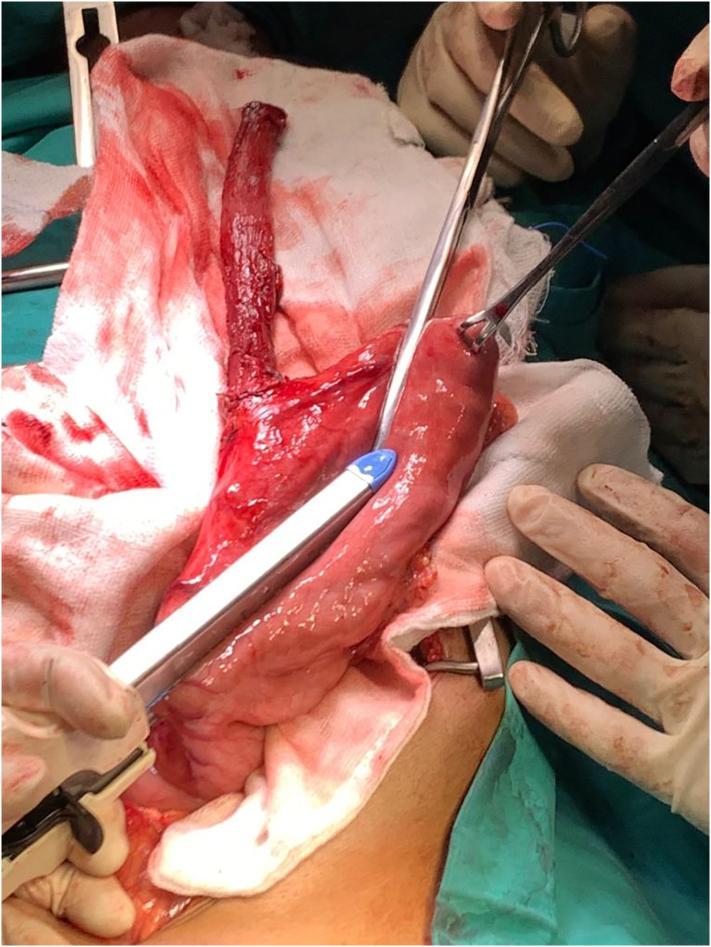
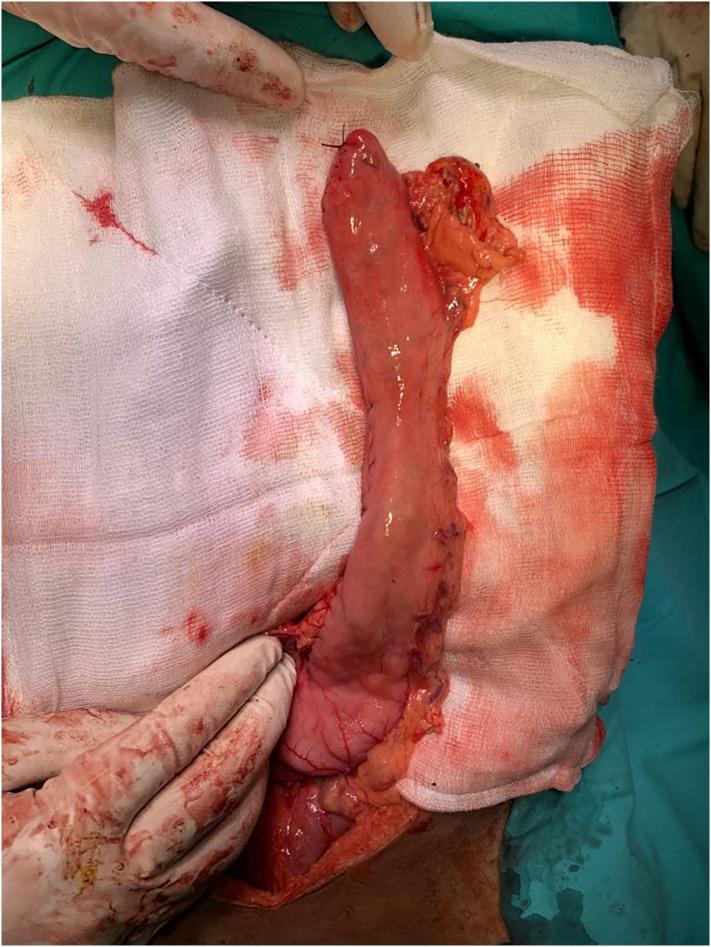
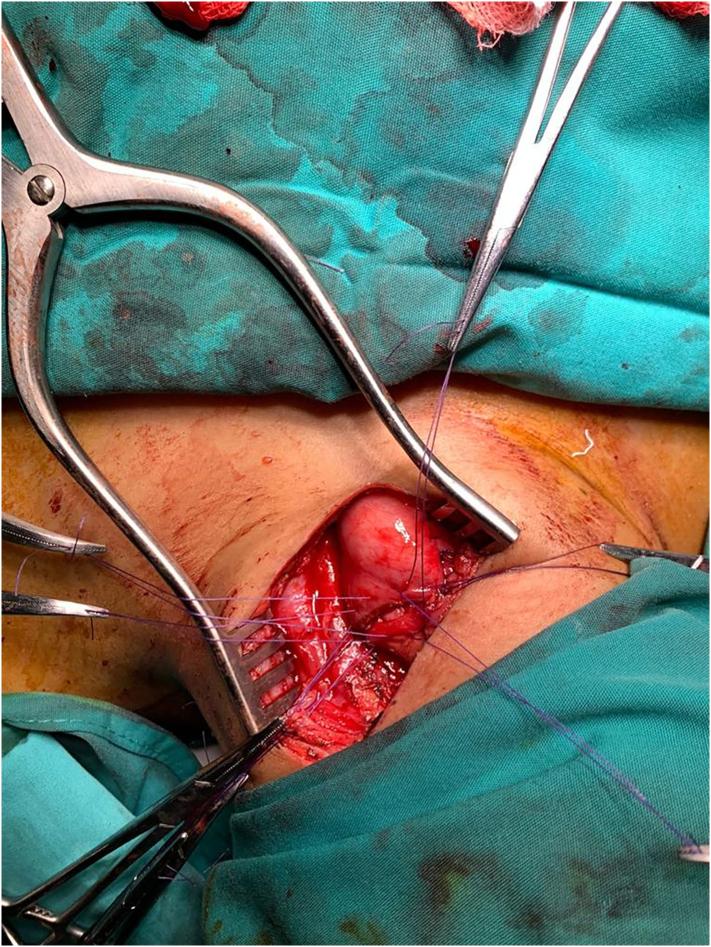
A 26 years old Asian female referred primarily for surgical treatment due to esophageal cancer detected on her diagnostic investigations and revealed a primary tumor located near the gastroesophageal junction. Based on the results of diagnostic investigations which confirmed the possibility of the tumor Ewing sarcoma of esophagus, which was biopsy and immune histochemical stain proven the patient was qualified for surgical treatment. She underwent Mckewon esophagectomy on October 2021 for Ewing sarcoma of esophagus. She was first followed with neoadjuvant intravenous chemotherapy, after taking three cycles of neoadjuvant chemo showed good response in CT scan the patient underwent Mckewon esophagectomy, post op recovery was smooth she underwent 2 cycles of adjuvant chemotherapy after four months of surgery. Her followup visit was uneventful.
CLINICAL DISCUSSION
Ewing's sarcoma is the second most frequent primary malignant bone cancer, after osteosarcoma. It was first described by James Ewing in 1921, as an undifferentiated tumor developing in the diaphysis of the ulna of a young female patient (Ushigome et al., 2002) [6]. Ewing sarcoma/primitive neuroectodermal tumor (ES/PNET), previously thought to be separate tumors, is now treated as the same tumor; both have similar immunohistochemical characteristics and chromosomal translocation (Maesawa et al., 2002) [1]. They are malignant tumors composed of undifferentiated small round cells, usually affecting children, adolescents, and young adults (Kondo et al., 2005) [7]. Generally ES/PNET affects the bones and deep soft tissues (Soulard et al., 2005) [8], although other organs such as the pancreas, small bowel, esophagus, kidneys, prostate, ovaries, vagina and rectovaginal septum have been reported; this is termed as extraskeletal ES/PNET (Bloom et al., 1995) [9]. To the best of our knowledge, only 5 cases of gastric ES/PNET have been reported in the English language literature. Extraskeletal Ewing's sarcoma is a very rare disease, accounting for 6 %-47 % of all cases of Ewing's sarcoma. It is mainly diagnosed in the trunk, extremities, retroperitoneum, and head and neck region. Patients with extraosseous Ewing's sarcoma are more likely to be older, female, and not of Caucasian origin. An extraskeletal origin of the disease is correlated to poor prognosis (Siegel et al., 1988; Granowetter and West, 1997; Ushigome et al., 2002) [4-6]. We present an uncommon case of extraskeletal Ewing's sarcoma, and discuss its rare presentation and evolution. To our knowledge, this is the first reported case of paraesophageal primary Ewing's sarcoma and primitive neuroectodermal tumor. Adenocarcinoma and squamous cell carcinoma account for the vast majority of esophageal malignancies. Other malignancies known to occur in the esophagus include melanoma, sarcoma, and lymphoma. Among the sarcomas, carcinosarcoma is the commonest with both carcinomatous and sarcomatous elements followed by leiomyosarcoma of mesenchymal origin. Other sarcomas reported in the literature are liposarcoma, synovial sarcoma, myxofibrosarcoma, Ewing's sarcoma, granulocytic sarcoma, histiocytic sarcoma, schwannoma rhabdomyosarcoma, and epithelioid sarcoma.
CONCLUSION
Ewing sarcoma is a rare entity among all esophageal malignancies. It presents as an exophytic mass, and in this case, it has presented as a mass occluding the lumen of esophagus. Most of these tumors present in locally advanced and disseminated condition, one of the reasons being difficulty and hence delay in diagnosis. In spite of best efforts, a group among them remains to be histologically uncharacterized.
引言与重要性
尤因肉瘤是一组小圆细胞肿瘤,主要发生于长骨以及四肢、躯干和腹膜后等骨外部位(吉尔,1997年)[2]。骨外尤因肉瘤(EES)是一种发生于软组织的小圆细胞肿瘤。在罕见情况下,EES可发生于食管(前泽等,2002年;约翰逊等,2010年)[1,3]。尤因肉瘤是一种罕见且侵袭性很强的癌症,最常发生于20岁以下人群。我们报告一例25岁女性原发性食管旁尤因肉瘤的罕见病例。
病例介绍
一名26岁亚洲女性因诊断检查发现食管癌而主要转诊接受手术治疗,结果显示原发肿瘤位于胃食管交界处附近。根据诊断检查结果证实肿瘤为食管尤因肉瘤的可能性,经活检和免疫组化染色证实该患者符合手术治疗条件。她于2021年10月因食管尤因肉瘤接受了麦克尤恩食管切除术。她首先接受了新辅助静脉化疗,在进行三个周期的新辅助化疗后,CT扫描显示有良好反应,随后患者接受了麦克尤恩食管切除术,术后恢复顺利,术后四个月接受了2个周期的辅助化疗。她的随访情况良好。
临床讨论
尤因肉瘤是仅次于骨肉瘤的第二常见原发性恶性骨癌。它于1921年由詹姆斯·尤因首次描述,是一名年轻女性患者尺骨干中发生的未分化肿瘤(潮见等,2002年)[6]。尤因肉瘤/原始神经外胚层肿瘤(ES/PNET),以前被认为是不同的肿瘤,现在被视为同一肿瘤;两者具有相似的免疫组化特征和染色体易位(前泽等,2002年)[1]。它们是由未分化的小圆细胞组成的恶性肿瘤,通常影响儿童、青少年和年轻人(近藤等,2005年)[7]。一般来说,ES/PNET影响骨骼和深部软组织(苏拉尔等,2005年)[8],尽管也有报道称其发生于其他器官,如胰腺、小肠、食管、肾脏、前列腺、卵巢、阴道和直肠阴道隔;这被称为骨外ES/PNET(布鲁姆等,1995年)[9]。据我们所知,英文文献中仅报道了5例胃ES/PNET。骨外尤因肉瘤是一种非常罕见的疾病,占所有尤因肉瘤病例的6% - 47%。它主要在躯干、四肢、腹膜后以及头颈部区域被诊断出来。骨外尤因肉瘤患者更可能年龄较大、为女性且非白种人。该疾病的骨外起源与预后不良相关(西格尔等,1988年;格拉诺维特和韦斯特,1997年;潮见等,2002年)[4 - 6]。我们展示了一例罕见的骨外尤因肉瘤病例,并讨论其罕见的表现及进展。据我们所知,这是首例报道的食管旁原发性尤因肉瘤和原始神经外胚层肿瘤病例。腺癌和鳞状细胞癌占食管恶性肿瘤的绝大多数。已知发生于食管的其他恶性肿瘤包括黑色素瘤、肉瘤和淋巴瘤。在肉瘤中,癌肉瘤最常见,兼具癌性和肉瘤性成分,其次是间叶源性平滑肌肉瘤。文献中报道的其他肉瘤有脂肪肉瘤、滑膜肉瘤、黏液纤维肉瘤、尤因肉瘤、粒细胞肉瘤、组织细胞肉瘤、神经鞘瘤、横纹肌肉瘤和上皮样肉瘤。
结论
尤因肉瘤在所有食管恶性肿瘤中是一种罕见实体。它表现为外生性肿块,在本病例中,它表现为阻塞食管腔的肿块。这些肿瘤大多呈现局部晚期和播散状态,原因之一是诊断困难从而导致延迟诊断。尽管已尽最大努力,但其中一部分肿瘤在组织学上仍未明确特征。

 Zotero 插件