
万古霉素使用趋势变化对耐万古霉素金黄色葡萄球菌流行率的影响:一项 14 年回顾性研究。
Impact of vancomycin use trend change due to the availability of alternative antibiotics on the prevalence of Staphylococcus aureus with reduced vancomycin susceptibility: a 14-year retrospective study.
机构信息
Division of Infectious Diseases, Department of Internal Medicine, Samsung Medical Center, Sungkyunkwan University School of Medicine, 81 Irwon-ro, Gangnam-gu, Seoul, 06351, Republic of Korea.
Asia Pacific Foundation for Infectious Diseases, Seoul, Republic of Korea.
出版信息
Antimicrob Resist Infect Control. 2022 Aug 5;11(1):101. doi: 10.1186/s13756-022-01140-9.
BACKGROUND
We investigated the trend change in vancomycin-intermediate Staphylococcus aureus (VISA)/heterogeneous VISA (hVISA) prevalence among methicillin-resistant S. aureus (MRSA) bacteremia strains and antistaphylococcal antibiotic use together with mutation studies of vancomycin resistance-related gene loci to evaluate the impact of changes in antibiotic use after new antistaphylococcal antibiotics became available.
METHODS
Among 850 healthcare-associated MRSA isolates from 2006 to 2019 at a tertiary hospital in South Korea, hVISA/VISA was determined by modified PAP/AUC analysis, and the identified hVISA/VISA strains were genotyped. Gene mutations at vraSR, graSR, walKR, and rpoB were studied by full-length sequencing. Antistaphylococcal antibiotic use in 2005-2018 was analyzed.
RESULTS
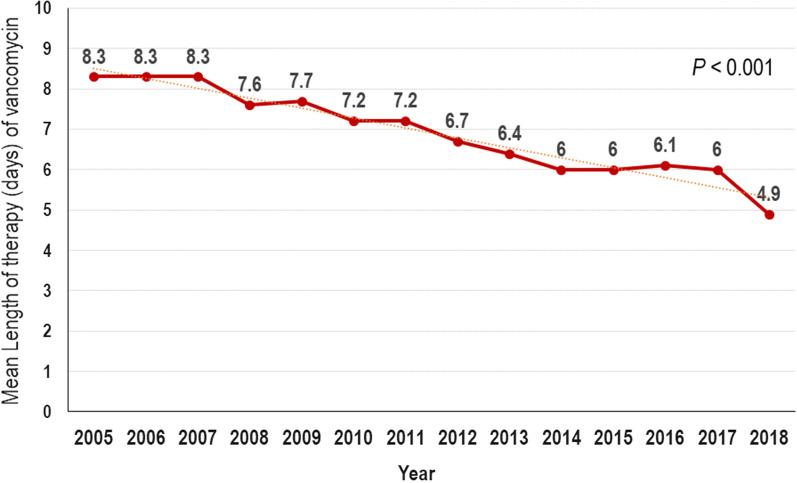
Two VISA and 23 hVISA strains were identified. The prevalence rate ratio of hVISA/VISA carrying mutations at the two-component regulatory systems among MRSA was 0.668 (95% CI 0.531-0.841; P = 0.001), and the prevalence rate ratio of hVISA/VISA carrying rpoB gene mutations was 1.293 (95% CI 0.981-1.702; 174 P = 0.068). Annual vancomycin use density analyzed by days of therapy (DOT) per 1,000 patient-days did not decrease significantly, however the annual average length of time analyzed by the number of days vancomycin was administered for each case showed a significantly decreasing trend.
CONCLUSIONS
During the 14-year period when the average length of vancomycin therapy decreased every year with the availability of alternative antibiotics, the prevalence of hVISA/VISA did not decrease significantly. This seems to be because the resistant strains carrying the rpoB mutations increased despite the decrease in the strains carrying the mutations at the two-component regulatory systems.
背景
我们调查了耐甲氧西林金黄色葡萄球菌(MRSA)菌血症菌株中万古霉素中介金黄色葡萄球菌(VISA)/异质性 VISA(hVISA)流行率的趋势变化,以及抗葡萄球菌抗生素的使用情况,并结合万古霉素耐药相关基因座的突变研究,以评估新型抗葡萄球菌抗生素上市后抗生素使用变化的影响。
方法
在韩国一家三级医院的 2006 年至 2019 年期间的 850 株医疗保健相关的 MRSA 分离株中,通过改良的 PAP/AUC 分析来确定 hVISA/VISA,并对鉴定出的 hVISA/VISA 菌株进行基因分型。通过全长测序研究了 vraSR、graSR、walKR 和 rpoB 基因的突变。分析了 2005-2018 年抗葡萄球菌抗生素的使用情况。
结果
鉴定出 2 株 VISA 和 23 株 hVISA 菌株。在携带两个成分调节系统基因突变的 MRSA 中,hVISA/VISA 的携带率比为 0.668(95%CI 0.531-0.841;P=0.001),携带 rpoB 基因突变的 hVISA/VISA 的携带率比为 1.293(95%CI 0.981-1.702;P=0.068)。每千名患者天的治疗天数(DOT)分析的万古霉素使用密度没有显著下降,然而,每例万古霉素给药天数分析的年平均时间呈显著下降趋势。
结论
在可替代抗生素每年平均减少万古霉素治疗时间的 14 年期间,hVISA/VISA 的流行率没有显著下降。这似乎是因为尽管携带两个成分调节系统基因突变的菌株减少,但携带 rpoB 基因突变的耐药菌株增加了。


 Zotero 插件