
急诊行气管插管的肺动脉高压患者的结局和预后因素。
Outcomes and Prognostic Factors of Pulmonary Hypertension Patients Undergoing Emergent Endotracheal Intubation.
机构信息
David Geffen School of Medicine at UCLA, Los Angeles, CA, USA.
Department of Medicine, 8783University of California, Los Angeles, CA, USA.
出版信息
J Intensive Care Med. 2023 Mar;38(3):280-289. doi: 10.1177/08850666221118839. Epub 2022 Aug 8.
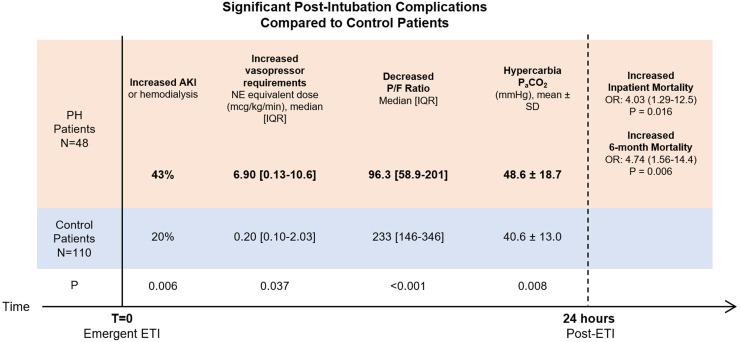
Emergent endotracheal intubations (ETI) in pulmonary hypertension (PH) patients are associated with increased mortality. Post-intubation interventions that could increase survivability in this population have not been explored. We evaluate early clinical characteristics and complications following emergent endotracheal intubation and seek predictors of adverse outcomes during this post-intubation period. Retrospective cohort analysis of adult patients with groups 1 and 3 PH who underwent emergent intubation between 2005-2021 in medical and liver transplant ICUs at a tertiary medical center. PH patients were compared to non-PH patients, matched by Charlson Comorbidity Index. Primary outcomes were 24-h post-intubation and inpatient mortalities. Various 24-h post-intubation secondary outcomes were compared between PH and control cohorts. We identified 48 PH and 110 non-PH patients. Pulmonary hypertension was not associated with increased 24-h mortality (OR 1.32, 95%CI 0.35-4.94, = .18), but was associated with inpatient mortality (OR 4.03, 95%CI 1.29-12.5, = .016) after intubation. Within 24 h post-intubation, PH patients experienced more frequent acute kidney injury (43.5% vs. 19.8%, = .006) and required higher norepinephrine dosing equivalents (6.90 [0.13-10.6] mcg/kg/min, vs. 0.20 [0.10-2.03] mcg/kg/min, = .037). Additionally, the median P/F ratio (PaO/FiO) was lower in PH patients (96.3 [58.9-201] vs. 233 [146-346] in non-PH, = .001). Finally, a post-intubation increase in PaCO was associated with mortality in the PH cohort (post-intubation change in PaCO +5.14 ± 16.1 in non-survivors vs. -18.7 ± 28.0 in survivors, = .007). Pulmonary hypertension was associated with worse outcomes after emergent endotracheal intubation than similar patients without PH. More importantly, our data suggest that the first 24 hours following intubation in the PH group represent a particularly vulnerable period that may determine long-term outcomes. Early post-intubation interventions may be key to improving survival in this population.
肺动脉高压(PH)患者行紧急气管插管(ETI)与死亡率增加相关。尚未探索可能增加该人群存活率的插管后干预措施。我们评估了在三级医疗中心的内科和肝移植 ICU 中,于 2005 年至 2021 年间接受紧急插管的 PH 患者的早期临床特征和并发症,并寻找此插管后期间不良结局的预测因素。
对在三级医疗中心的内科和肝移植 ICU 中,于 2005 年至 2021 年间接受紧急插管的 PH 患者(组 1 和 3)和非 PH 患者进行回顾性队列分析。将 PH 患者与 Charlson 合并症指数相匹配的非 PH 患者进行比较。主要结局为插管后 24 小时和住院期间的死亡率。比较 PH 组和对照组之间各种插管后 24 小时的次要结局。
我们确定了 48 名 PH 患者和 110 名非 PH 患者。PH 患者的 24 小时死亡率并未增加(OR 1.32,95%CI 0.35-4.94, = .18),但在插管后与住院死亡率相关(OR 4.03,95%CI 1.29-12.5, = .016)。在插管后 24 小时内,PH 患者更频繁地发生急性肾损伤(43.5% vs. 19.8%, = .006),需要更高的去甲肾上腺素剂量当量(6.90 [0.13-10.6] mcg/kg/min,vs. 0.20 [0.10-2.03] mcg/kg/min, = .037)。此外,PH 患者的 PaO/FiO 比值中位数较低(96.3 [58.9-201] vs. 233 [146-346],非 PH 患者, = .001)。最后,PH 队列中插管后 PaCO 的增加与死亡率相关(非幸存者的插管后 PaCO 变化+5.14 ± 16.1,幸存者为-18.7 ± 28.0, = .007)。
与没有 PH 的相似患者相比,PH 患者在行紧急气管插管后结局更差。更重要的是,我们的数据表明,PH 组在插管后 24 小时内代表一个特别脆弱的时期,可能决定长期结局。早期插管后干预可能是改善该人群存活率的关键。
 Zotero 插件