
接受无创高频振荡通气的早产儿的长期预后。
The long-term outcomes of preterm infants receiving non-invasive high-frequency oscillatory ventilation.
作者信息
Li Yan, Mo Yan, Yao Liping, Wei Qiufen, Meng Danhua, Tan Wei, Pan Xinnian
机构信息
Maternal and Child Health Hospital of Guangxi Zhuang Autonomous Region, Nanning, China.
Guangxi Clinical Research Center for Pediatric Disease, Nanning, China.
出版信息
Front Pediatr. 2022 Jul 22;10:865057. doi: 10.3389/fped.2022.865057. eCollection 2022.
OBJECTIVE
To investigate the clinical outcomes of preterm infants who received non-invasive high-frequency oscillatory ventilation following extubation in a neonatal intensive care unit.
METHODS
Infants born between 25 and 34 weeks of gestation with a birth weight of <1,500 g, who were admitted into the neonatal intensive care unit of Guangxi Maternal and Child Health Hospital, Nanning, Guangxi, China, requiring mechanical ventilation on admission were randomized to the non-invasive high-frequency ventilation group, nasal intermittent positive pressure ventilation group, or nasal continuous positive airway pressure group following extubation. Their respiratory and neurodevelopmental outcomes were assessed at 12 and 24 months of corrected age.
RESULTS
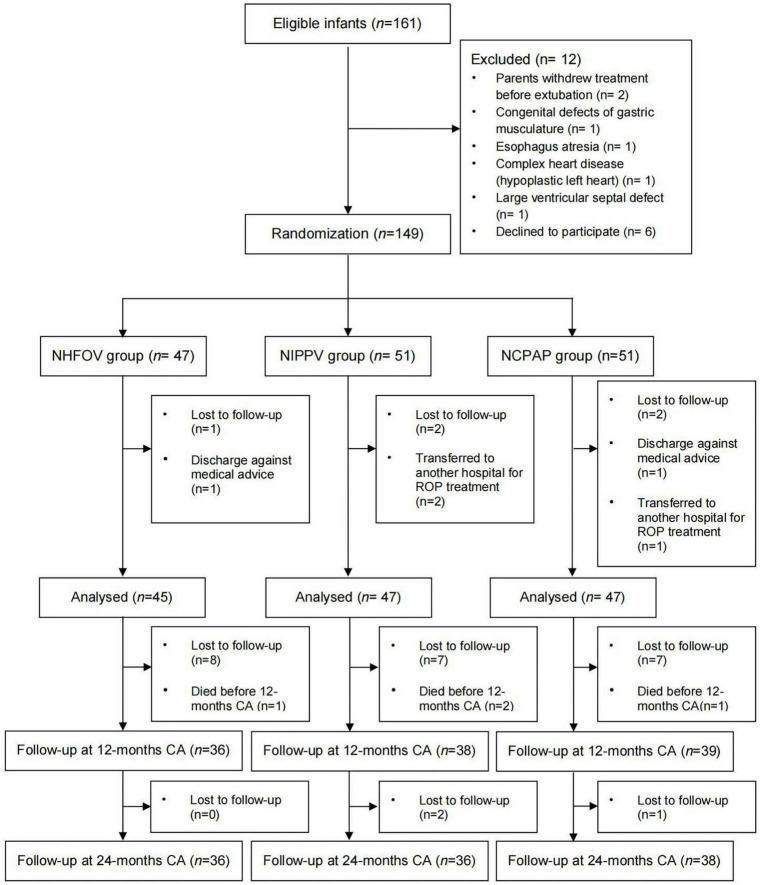
Among 149 preterm infants who underwent randomization, 139 completed their treatment in the neonatal intensive care unit (45, 47, 47 in the non-invasive high-frequency ventilation group, nasal intermittent positive pressure ventilation group, or nasal continuous positive airway pressure group, respectively), 113 were assessed at 12-month corrected age, and 110 of 113 were assessed again at 24-month corrected age. There were no differences in the number of times bronchitis, pneumonia, wheezing episodes, and re-hospitalization rates appeared due to respiratory diseases among the three groups ( > 0.05); the pulmonary function tests at 12-month corrected age showed respiratory rate, tidal volume, inspiratory time/expiratory time, time to peak expiratory flow/expiratory time, volume at peak expiratory flow/expiratory volume, expiratory flow at 25, 50, and 75% tidal volume were all similar among infants from the 3 groups ( > 0.05). There were no differences in the rates of neurodevelopmental impairment among the three groups at 24-month corrected age ( > 0.05).
CONCLUSION
As post-extubation respiratory support in preterm infants, non-invasive high-frequency ventilation did not increase the rates of long-term respiratory morbidities and neurodevelopmental impairment compared with nasal intermittent positive pressure ventilation and nasal continuous positive airway pressure.
目的
探讨新生儿重症监护病房中拔管后接受无创高频振荡通气的早产儿的临床结局。
方法
将广西南宁广西壮族自治区妇幼保健院新生儿重症监护病房收治的、胎龄在25至34周之间、出生体重<1500 g、入院时需要机械通气的婴儿,随机分为拔管后无创高频通气组、鼻间歇正压通气组或鼻持续气道正压通气组。在矫正年龄12个月和24个月时评估他们的呼吸和神经发育结局。
结果
在149例接受随机分组的早产儿中,139例在新生儿重症监护病房完成治疗(无创高频通气组、鼻间歇正压通气组、鼻持续气道正压通气组分别为45例、47例、47例),113例在矫正年龄12个月时接受评估,其中110例在矫正年龄24个月时再次接受评估。三组因呼吸系统疾病出现支气管炎、肺炎、喘息发作的次数以及再次住院率无差异(P>0.05);矫正年龄12个月时的肺功能测试显示,三组婴儿的呼吸频率、潮气量、吸气时间/呼气时间、呼气流量峰值时间/呼气时间、呼气流量峰值时的容积/呼气容积、25%、50%和75%潮气量时的呼气流量均相似(P>0.05)。三组在矫正年龄24个月时的神经发育障碍发生率无差异(P>0.05)。
结论
作为早产儿拔管后的呼吸支持,与鼻间歇正压通气和鼻持续气道正压通气相比,无创高频通气并未增加长期呼吸系统疾病的发生率和神经发育障碍。
 Zotero 插件