
预测新冠疫情期间的父母心理健康:经济压力、新冠疫情应激及应对策略
Predicting Parental Mental Health During COVID-19: Economic Pressure, COVID-19 Stress, and Coping Strategies.
作者信息
Morgan Derek Daniel, Higgins Connað Dael, Ingram Paul B, Rogers Christy Rae
机构信息
Department of Human Development and Family Sciences, Texas Tech University, Lubbock, TX, United States.
Department of Psychological Sciences, Texas Tech University, Lubbock, TX, United States.
出版信息
Front Psychol. 2022 Jul 22;13:909978. doi: 10.3389/fpsyg.2022.909978. eCollection 2022.
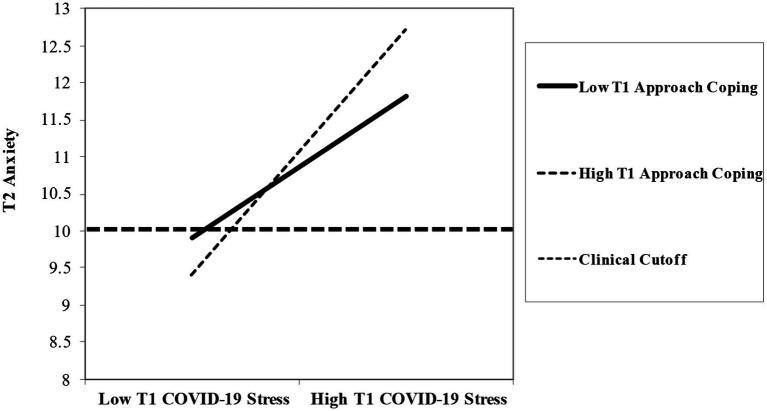
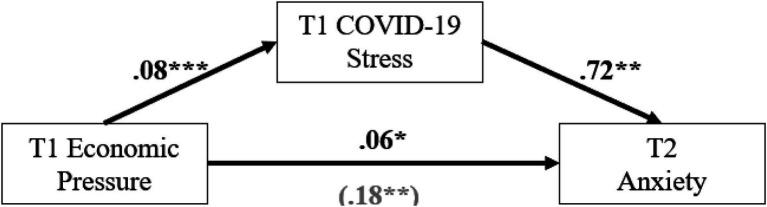
As the COVID-19 pandemic continues, understanding connections between economic pressures and mental health experiences is critical in comprehending how stressful global events can affect families. Although economic pressures and stress can negatively impact mental health, approach coping strategies may provide reductions in negative mental health experiences for parents compared to avoidant coping strategies. Despite recent work showing that stress resulting from the pandemic can have negative implications for the mental health of parents with young children, there is little known about the mental health of parents with adolescents. This study utilized a longitudinal sample of 198 parents (194 biological parents; 103 Fathers, and 91 Mothers) of adolescents and examined the mediating impact of COVID-19 stress on the relationship between economic pressure and subsequent depressive and anxious symptoms. Additionally, approach and avoidant coping strategies were examined as potential moderators between COVID-19 stress and later mental health. Results indicated that parents who experienced economic pressure reported worsening mental health across the school semester, with COVID-19 stress mediating this pathway. Further, approach coping strategies moderated the association between COVID-19 stress and later anxiety symptoms such that higher levels of coping associated with greater rates of later anxiety symptoms, while lower levels of coping associated with less anxiety symptoms later. Avoidant coping strategies also moderated these associations, such that greater use associated with greater depressive and anxious symptomology later. These findings emphasize that parents are experiencing worsening mental health following the onset of the pandemic and that there is an urgent need for increased mental health services to assist families during this time.
随着新冠疫情的持续,了解经济压力与心理健康状况之间的联系对于理解全球性压力事件如何影响家庭至关重要。尽管经济压力和应激会对心理健康产生负面影响,但与回避型应对策略相比,积极应对策略可能会减少父母的负面心理健康体验。尽管最近的研究表明,疫情引发的压力会对有幼儿的父母的心理健康产生负面影响,但对于有青少年的父母的心理健康却知之甚少。本研究采用了一个包含198名青少年父母(194名亲生父母;103名父亲和91名母亲)的纵向样本,考察了新冠疫情压力在经济压力与随后的抑郁和焦虑症状之间关系中的中介作用。此外,还考察了积极应对策略和回避型应对策略作为新冠疫情压力与后期心理健康之间潜在调节因素的情况。结果表明,经历经济压力的父母在整个学期中报告心理健康状况恶化,新冠疫情压力在这一过程中起中介作用。此外,积极应对策略调节了新冠疫情压力与后期焦虑症状之间的关联,即较高水平的应对与更高的后期焦虑症状发生率相关,而较低水平的应对与后期较少的焦虑症状相关。回避型应对策略也调节了这些关联,即更多地使用回避型应对策略与后期更严重的抑郁和焦虑症状相关。这些发现强调,疫情爆发后父母的心理健康状况正在恶化,在此期间迫切需要增加心理健康服务以帮助家庭。
 Zotero 插件