
宿主植物选择沿土壤-根系连续体印记真菌群落的结构和组装。
Host Plant Selection Imprints Structure and Assembly of Fungal Community along the Soil-Root Continuum.
机构信息
College of Biology and the Environment, Nanjing Forestry University, Nanjing, China.
Yongzhou Tobacco Company of Hunan Province, Yongzhou, Hunan, China.
出版信息
mSystems. 2022 Aug 30;7(4):e0036122. doi: 10.1128/msystems.00361-22. Epub 2022 Aug 9.
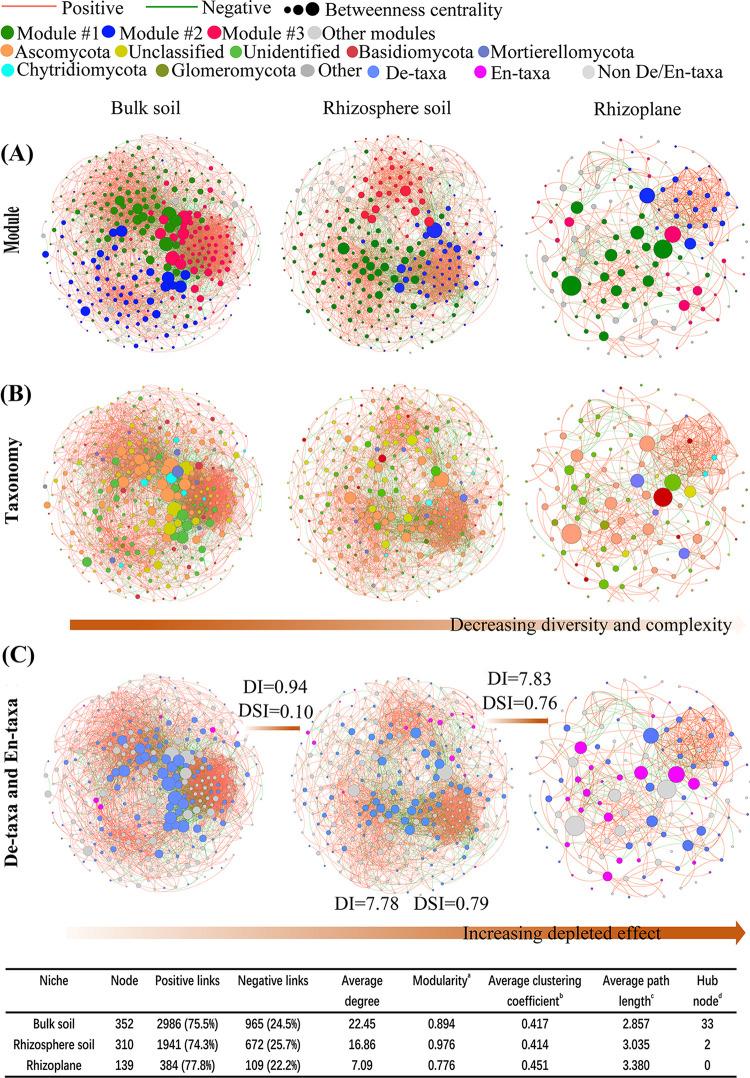
The soil fungal community plays pivotal roles in soil nutrient cycling and plant health and productivity in agricultural ecosystems. However, the differential adaptability of soil fungi to different microenvironments (niches) is a bottleneck limiting their application in agriculture. Hence, the understanding of ecological processes that drive fungal microbiome assembly along the soil-root continuum is fundamental to harnessing the plant-associated microbiome for sustainable agriculture. Here, we investigated the factors that shape fungal community structure and assembly in three compartment niches (the bulk soil, rhizosphere, and rhizoplane) associated with tobacco (Nicotiana tabacum L.), with four soil types tested under controlled greenhouse conditions. Our results demonstrate that fungal community assembly along the soil-root continuum is governed by host plant rather than soil type and that soil chemical properties exert a negligible effect on the fungal community assembly in the rhizoplane. Fungal diversity and network complexity decreased in the order bulk soil > rhizosphere > rhizoplane, with a dramatic decrease in Ascomycota species number and abundance along the soil-root continuum. However, facilitations (positive interactions) were enhanced among fungal taxa in the rhizoplane niche. The rhizoplane supported species specialization with enrichment of some rare species, contributing to assimilative community assembly in the rhizoplane in all soil types. and were identified as important indicator genera of the soil-root microbiome continuum and good predictors of plant agronomic traits. The findings provide empirical evidence for host plant selection and enrichment/depletion processes of fungal microbiome assembly along the soil-root continuum. Fungal community assembly along the soil-root continuum is shaped largely by the host plant rather than the soil type. This finding facilitates the implementations of fungi-associated biocontrol and growth-promoting for specific plants in agriculture practice, regardless of the impacts from variations in geographical environments. Furthermore, the depletion of complex ecological associations in the fungal community along the soil-root continuum and the enhancement of facilitations among rhizoplane-associated fungal taxa provide empirical evidence for the potential of community simplification as an approach to target the plant rhizoplane for specific applications. The identified indicators and along the soil-root microbiome continuum are good predictors of tobacco plant agronomic traits, which should be given attention when manipulating the root-associated microbiome.
土壤真菌群落对农业生态系统中土壤养分循环、植物健康和生产力起着关键作用。然而,真菌对不同微环境(小生境)的差异适应性是限制其在农业中应用的瓶颈。因此,了解驱动土壤-根连续体中真菌微生物组组装的生态过程对于利用植物相关微生物组实现可持续农业至关重要。在这里,我们在受控温室条件下,用四种土壤类型测试,研究了影响与烟草(Nicotiana tabacum L.)相关的三个隔室小生境(土壤、根际和根面)中真菌群落结构和组装的因素。我们的结果表明,土壤-根连续体中的真菌群落组装受宿主植物而非土壤类型控制,土壤化学性质对根面真菌群落组装的影响可以忽略不计。真菌多样性和网络复杂性按土壤>根际>根面的顺序递减,随着土壤-根连续体的进行,子囊菌种类和数量显著减少。然而,在根面小生境中,真菌分类群之间的促进作用(正相互作用)增强。根面支持物种特化,一些稀有物种富集,有助于在所有土壤类型中根面同化群落的组装。和被确定为土壤-根微生物组连续体的重要指示属,是植物农艺性状的良好预测因子。这些发现为宿主植物选择和真菌微生物组组装沿着土壤-根连续体的富集/耗尽过程提供了经验证据。土壤-根连续体中的真菌群落组装主要由宿主植物决定,而不是土壤类型。这一发现有助于在农业实践中针对特定植物实施真菌相关的生物防治和促生措施,而无需考虑地理环境变化的影响。此外,随着土壤-根连续体中真菌群落复杂生态关联的枯竭和根面相关真菌分类群之间促进作用的增强,为简化群落作为一种针对特定应用目标植物根面的方法提供了经验证据。土壤-根微生物组连续体中的鉴定指标和是烟草植物农艺性状的良好预测因子,在操纵根相关微生物组时应予以关注。


 Zotero 插件