
局部分子和整体连接组学对跨疾病皮质异常的贡献。
Local molecular and global connectomic contributions to cross-disorder cortical abnormalities.
机构信息
McConnell Brain Imaging Centre, Montréal Neurological Institute, McGill University, Montréal, QC, Canada.
Department of Psychiatry, Perelman School of Medicine, University of Pennsylvania, Philadelphia, PA, USA.
出版信息
Nat Commun. 2022 Aug 10;13(1):4682. doi: 10.1038/s41467-022-32420-y.
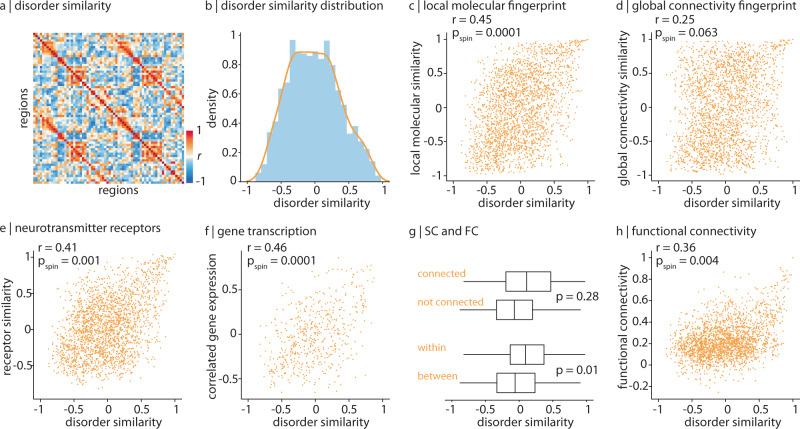
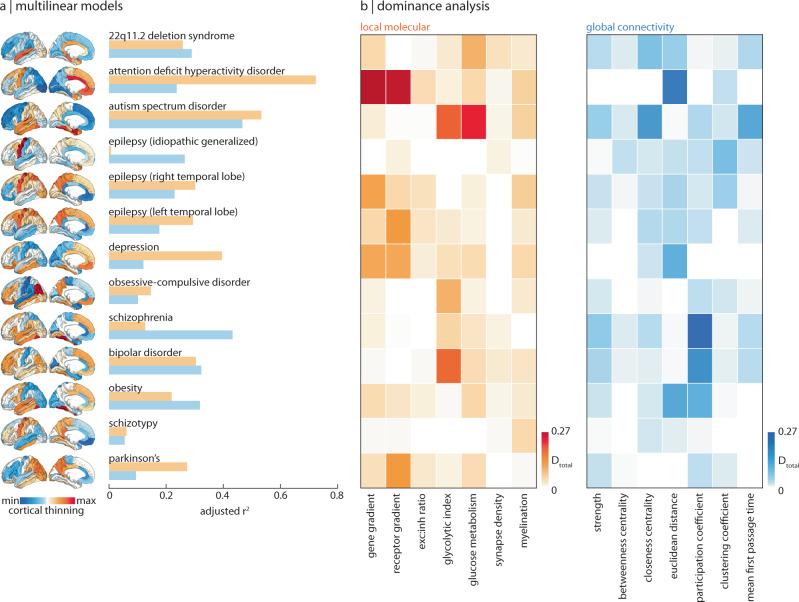
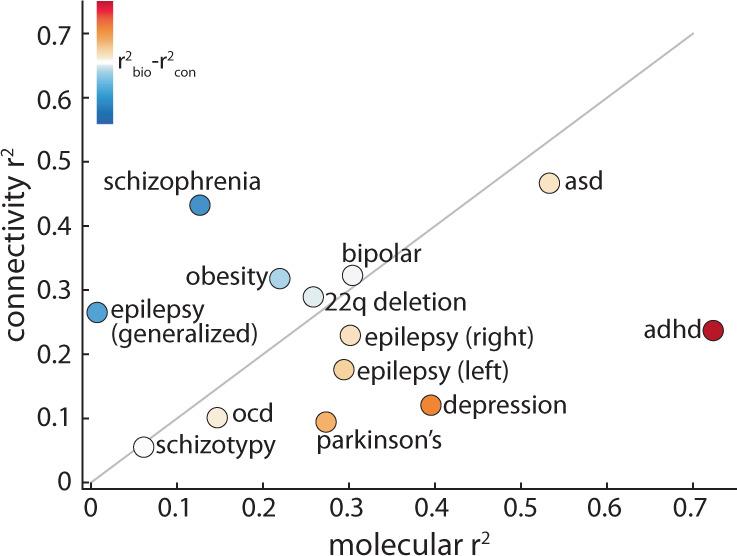
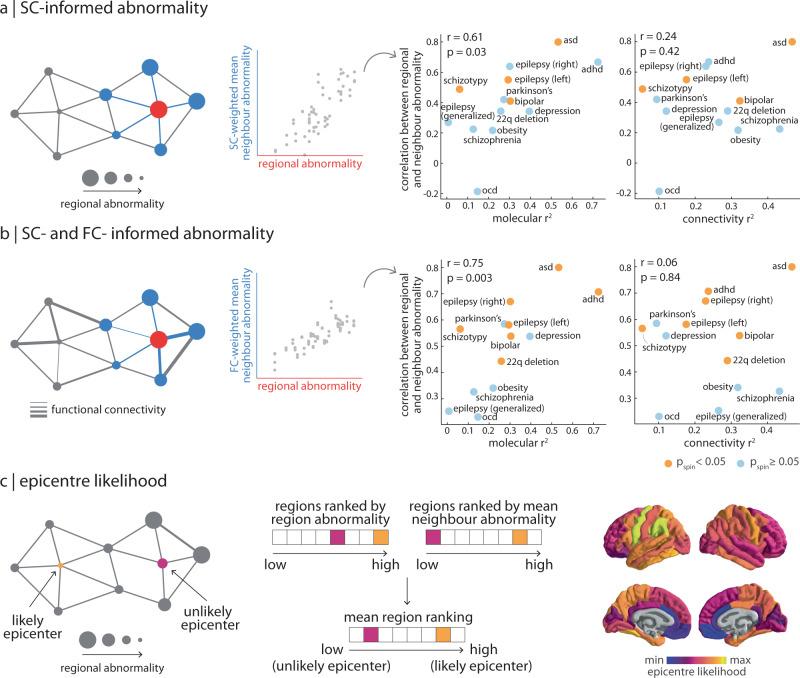
Numerous brain disorders demonstrate structural brain abnormalities, which are thought to arise from molecular perturbations or connectome miswiring. The unique and shared contributions of these molecular and connectomic vulnerabilities to brain disorders remain unknown, and has yet to be studied in a single multi-disorder framework. Using MRI morphometry from the ENIGMA consortium, we construct maps of cortical abnormalities for thirteen neurodevelopmental, neurological, and psychiatric disorders from N = 21,000 participants and N = 26,000 controls, collected using a harmonised processing protocol. We systematically compare cortical maps to multiple micro-architectural measures, including gene expression, neurotransmitter density, metabolism, and myelination (molecular vulnerability), as well as global connectomic measures including number of connections, centrality, and connection diversity (connectomic vulnerability). We find a relationship between molecular vulnerability and white-matter architecture that drives cortical disorder profiles. Local attributes, particularly neurotransmitter receptor profiles, constitute the best predictors of both disorder-specific cortical morphology and cross-disorder similarity. Finally, we find that cross-disorder abnormalities are consistently subtended by a small subset of network epicentres in bilateral sensory-motor, inferior temporal lobe, precuneus, and superior parietal cortex. Collectively, our results highlight how local molecular attributes and global connectivity jointly shape cross-disorder cortical abnormalities.
许多脑部疾病都表现出结构性脑异常,这些异常被认为是由分子扰动或连接组错误连接引起的。这些分子和连接组脆弱性对脑部疾病的独特和共同贡献仍然未知,尚未在单一的多疾病框架中进行研究。我们使用 ENIGMA 联盟的 MRI 形态测量学,从 N=21000 名参与者和 N=26000 名对照中构建了 13 种神经发育、神经和精神疾病的皮质异常图,这些数据是使用协调的处理协议收集的。我们系统地将皮质图谱与多种微观结构测量值进行比较,包括基因表达、神经递质密度、代谢和髓鞘形成(分子脆弱性),以及包括连接数量、中心度和连接多样性在内的全局连接组测量值(连接脆弱性)。我们发现分子脆弱性与白质结构之间存在关系,这种关系驱动了皮质疾病图谱。局部属性,特别是神经递质受体图谱,是预测特定疾病皮质形态和跨疾病相似性的最佳指标。最后,我们发现跨疾病异常始终由双侧感觉运动、下颞叶、楔前叶和顶叶上回的一小部分网络中心(subtended)。总的来说,我们的研究结果强调了局部分子属性和全局连通性如何共同塑造跨疾病的皮质异常。

 Zotero 插件