
协作式新冠疫情期间传染性医疗废物管理逆向物流网络
Collaborative Reverse Logistics Network for Infectious Medical Waste Management during the COVID-19 Outbreak.
机构信息
School of Management Science and Real Estate, Chongqing University, Chongqing 400044, China.
出版信息
Int J Environ Res Public Health. 2022 Aug 8;19(15):9735. doi: 10.3390/ijerph19159735.
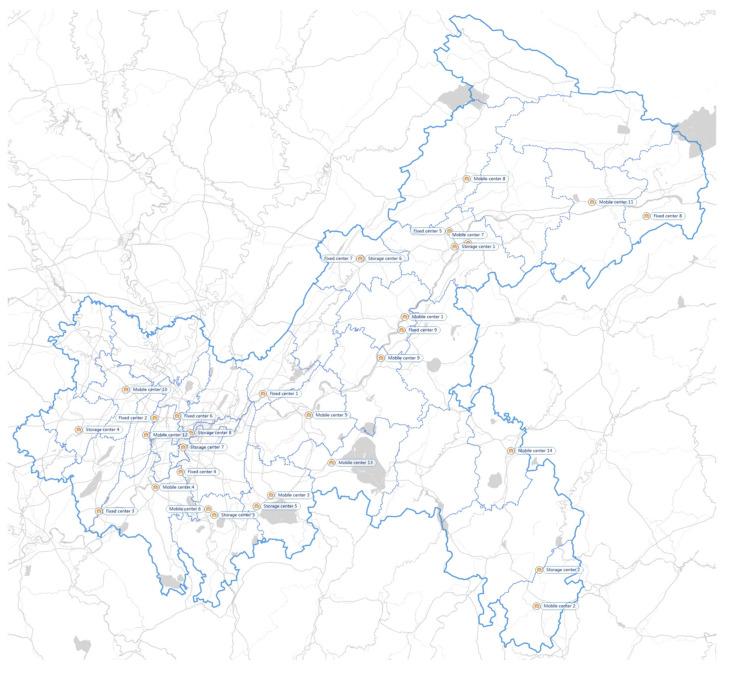
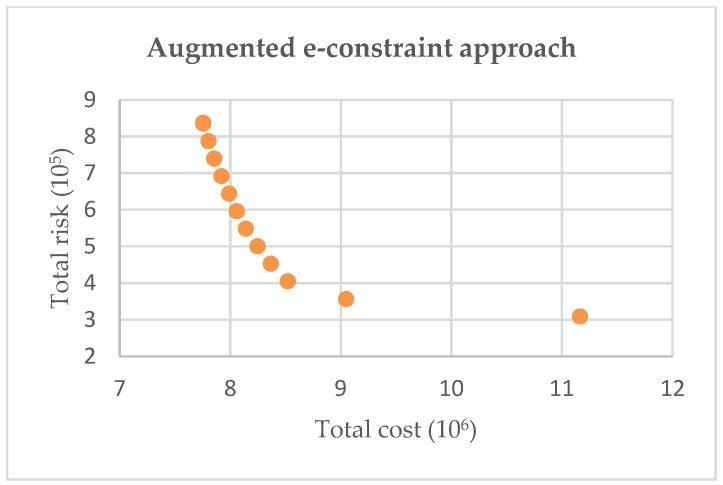
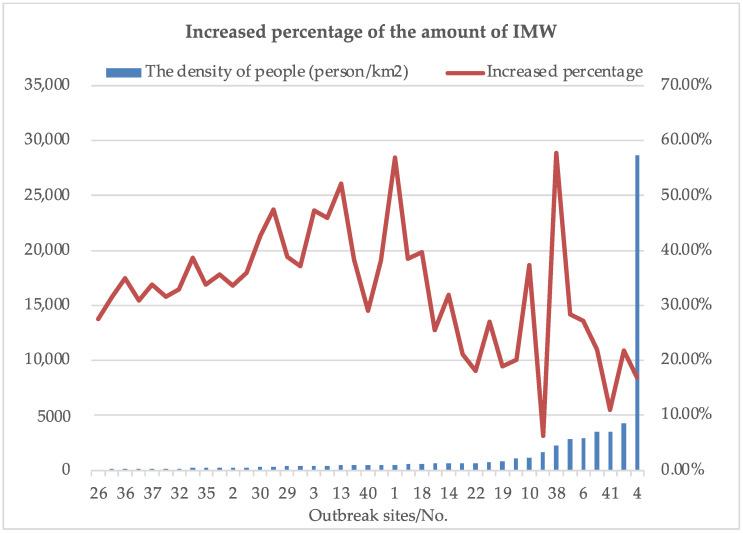
The development of COVID-19 in China has gradually become normalized; thus, the prevention and control of the pandemic has encountered new problems: the amount of infectious medical waste (IMW) has increased sharply; the location of outbreaks are highly unpredictable; and the pandemic occurs everywhere. Thus, it is vital to design an effective IMW reverse logistics network to cope with these problems. This paper firstly introduces mobile processing centers (MPCs) into an IMW reverse logistics network for resource-saving, quick response, and the sufficient capacity of processing centers. Then, a multi-participant-based (public central hospitals, disposal institutions, the logistics providers, and the government) collaborative location and a routing optimization model for IMW reverse logistics are built from an economic, environmental perspective. An augmented ε-constraint method is developed to solve this proposed model. Through a case study in Chongqing, it is found that for uncertain outbreak situations, fixed processing centers (FPCs) and MPCs can form better disposal strategies. MPC can expand the processing capacity flexibly in response to the sudden increase in IMW. The results demonstrate good performance in reduction in cost and infection risk, which could greatly support the decision making of IMW management for the government in the pandemic prevention and control.
在中国,COVID-19 的发展逐渐趋于常态化;因此,疫情防控遇到了新问题:感染性医疗废物(IMW)的数量急剧增加;疫情爆发的地点极难预测;疫情无处不在。因此,设计一个有效的 IMW 逆向物流网络来应对这些问题至关重要。本文首先将移动处理中心(MPC)引入 IMW 逆向物流网络,以实现资源节约、快速响应和处理中心的充足容量。然后,从经济和环境角度出发,建立了一个基于多方参与者(公立中心医院、处理机构、物流供应商和政府)的协作选址和 IMW 逆向物流路径优化模型。开发了一种增强的 ε-约束方法来解决这个提出的模型。通过对重庆的案例研究发现,对于不确定的疫情情况,固定处理中心(FPC)和 MPC 可以形成更好的处理策略。MPC 可以灵活扩展处理能力,以应对 IMW 的突然增加。结果表明,在降低成本和感染风险方面表现良好,这将极大地支持政府在疫情防控中的 IMW 管理决策。





 Zotero 插件