
多种疾病与跌倒及其介导因素之间的前瞻性关联:爱尔兰老龄化纵向研究的结果
Prospective Association between Multimorbidity and Falls and Its Mediators: Findings from the Irish Longitudinal Study on Ageing.
作者信息
Jacob Louis, Shin Jae Il, Kostev Karel, Haro Josep Maria, López-Sánchez Guillermo F, Smith Lee, Koyanagi Ai
机构信息
Research and Development Unit, Parc Sanitari Sant Joan de Déu, Dr. Antoni Pujadas, 42, Sant Boi de Llobregat, 08830 Barcelona, Spain.
Centro de Investigación Biomédica en Red de Salud Mental (CIBERSAM), ISCIII, 28029 Madrid, Spain.
出版信息
J Clin Med. 2022 Jul 31;11(15):4470. doi: 10.3390/jcm11154470.
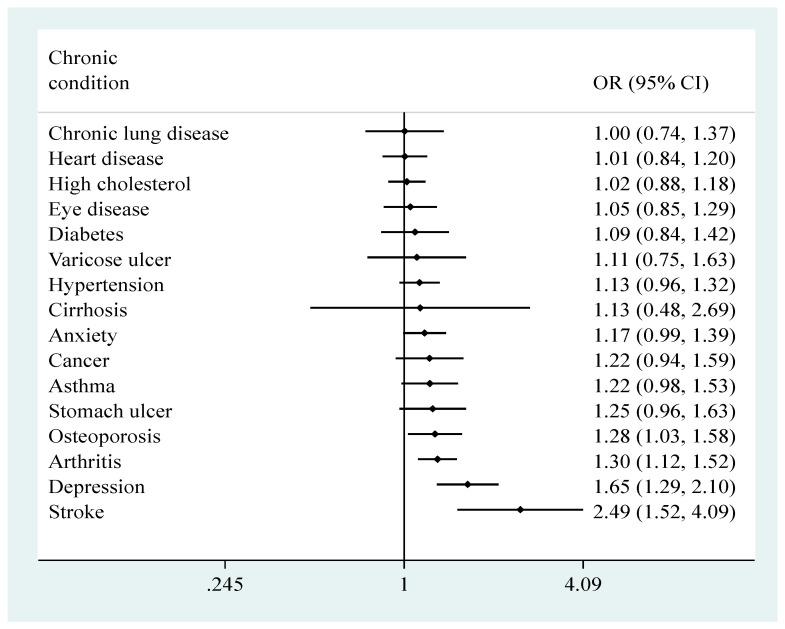
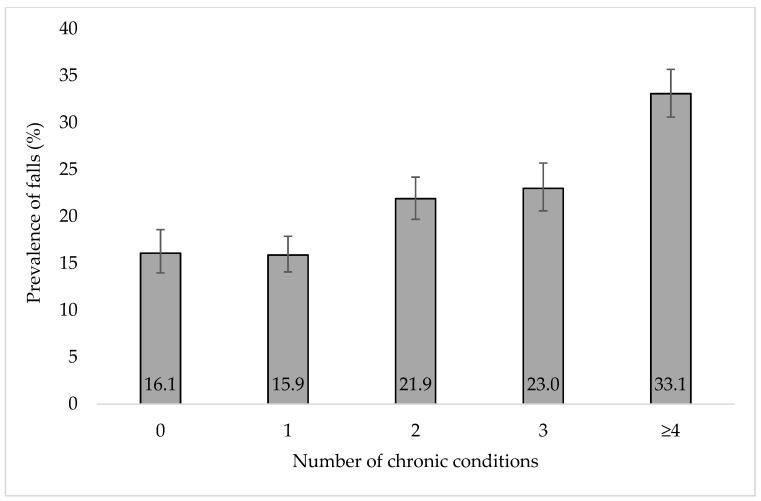
This study including older adults from Ireland aimed to analyze the prospective association between multimorbidity and falls and to identify the mediators in this relationship. The present study used data from two consecutive waves of the Irish Longitudinal Study on Ageing (TILDA) survey. Multimorbidity was assessed at Wave 1 (2009-2011) and was defined as the presence of at least two chronic conditions. Falls occurring at Wave 2 (2012-2013) were self-reported. Mediating variables considered were polypharmacy, cognitive impairment, sleep problems, pain, low handgrip strength, difficulty in activities of daily living (ADL), obesity, and underweight. Multivariable binary logistic regression and mediation analysis using the Karlson Holm Breen method were conducted. This study included 6900 adults aged ≥50 years (51.6% women; mean [SD] age 63.1 [8.9] years). Compared to no chronic conditions at baseline, there was a positive and significant association between multimorbidity and falls at follow-up, with ORs ranging from 1.32 (95% CI = 1.06-1.64) for 2 conditions to 1.92 (95% CI = 1.54-2.38) for ≥4 conditions. Pain (23.5%), polypharmacy (13.3%), and difficulty in ADL (10.7%) explained the largest proportion of the multimorbidity-fall relationship. Multimorbidity increased risk for incident falls in older adults from Ireland. Interventions should be implemented to reduce fall risk in people with multimorbidity, especially targeting the identified mediators.
这项针对爱尔兰老年人的研究旨在分析多重疾病与跌倒之间的前瞻性关联,并确定这种关系中的中介因素。本研究使用了爱尔兰老龄化纵向研究(TILDA)调查连续两轮的数据。在第一轮(2009 - 2011年)评估多重疾病情况,其定义为至少存在两种慢性病。第二轮(2012 - 2013年)发生的跌倒情况通过自我报告获取。所考虑的中介变量包括多重用药、认知障碍、睡眠问题、疼痛、握力低下、日常生活活动(ADL)困难、肥胖和体重过轻。采用卡尔森·霍尔姆·布林方法进行多变量二元逻辑回归和中介分析。本研究纳入了6900名年龄≥50岁的成年人(女性占51.6%;平均[标准差]年龄为63.1[8.9]岁)。与基线时无慢性病相比,随访时多重疾病与跌倒之间存在正向且显著的关联,2种疾病的比值比(OR)为1.32(95%置信区间 = 1.06 - 1.64),≥4种疾病的OR为1.92(95%置信区间 = 1.54 - 2.38)。疼痛(23.5%)、多重用药(13.3%)和ADL困难(10.7%)在多重疾病与跌倒的关系中占最大比例。多重疾病增加了爱尔兰老年人发生跌倒的风险。应实施干预措施以降低患有多重疾病者的跌倒风险,尤其针对已确定的中介因素。
 Zotero 插件