
生菜 GDB:生菜遗传学和组学的社区数据库。
LettuceGDB: The community database for lettuce genetics and omics.
机构信息
Beijing Academy of Agriculture and Forestry Sciences, Beijing 100097, P.R. China; State Key Laboratory of Protein and Plant Gene Research, Peking-Tsinghua Center for Life Sciences, School of Life Sciences and School of Advanced Agricultural Sciences, Peking University, Beijing 100871, P.R. China; Beijing Key Laboratory of Agricultural Genetic Resources and Biotechnology, Beijing Agro-biotechnology Research Center, Beijing 100097, P.R. China; College of Biology and the Environment, Nanjing Forestry University, Nanjing 510275, P.R. China.
Beijing Academy of Agriculture and Forestry Sciences, Beijing 100097, P.R. China; Beijing Key Laboratory of Agricultural Genetic Resources and Biotechnology, Beijing Agro-biotechnology Research Center, Beijing 100097, P.R. China.
出版信息
Plant Commun. 2023 Jan 9;4(1):100425. doi: 10.1016/j.xplc.2022.100425. Epub 2022 Aug 12.
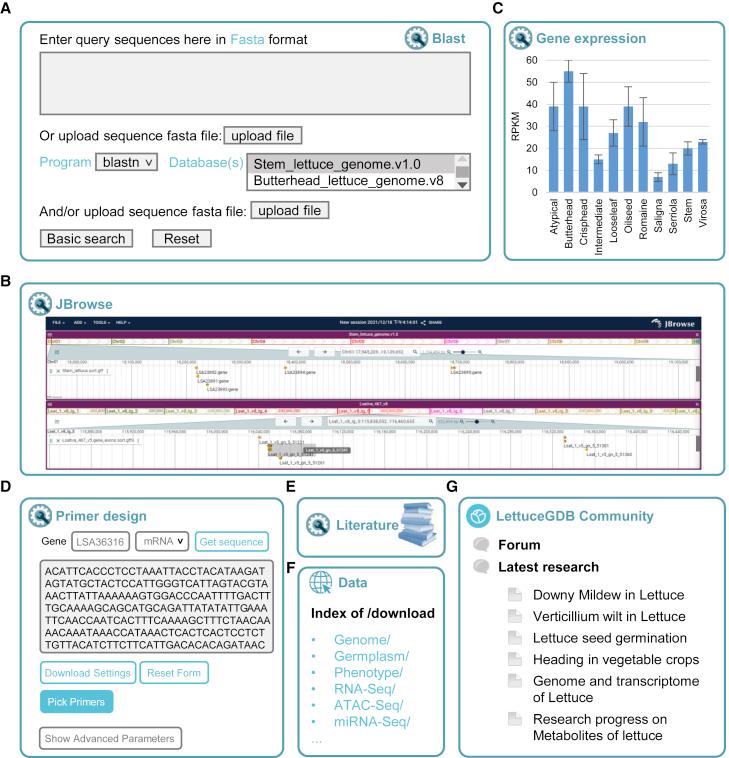
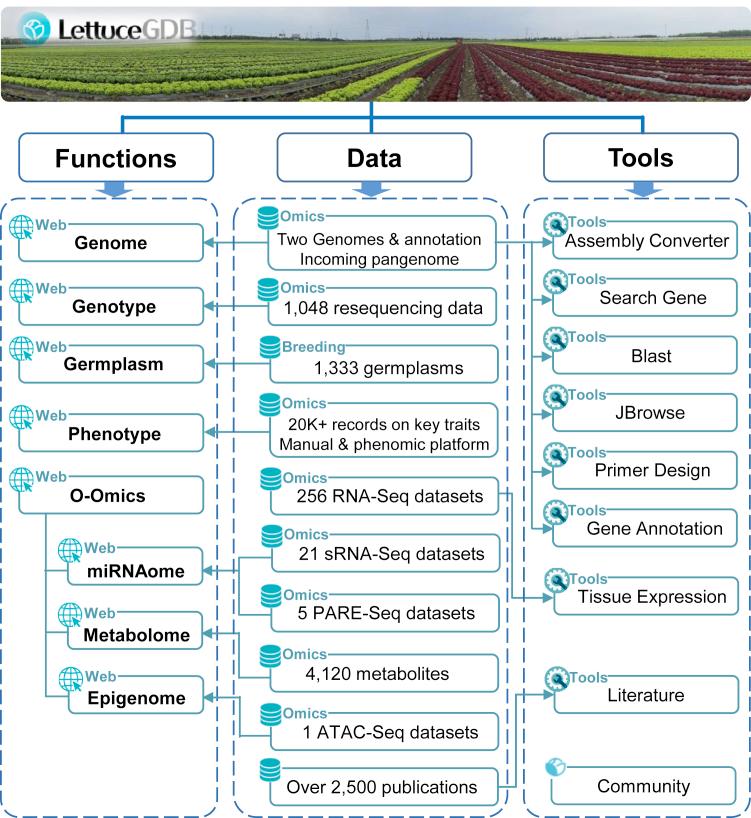
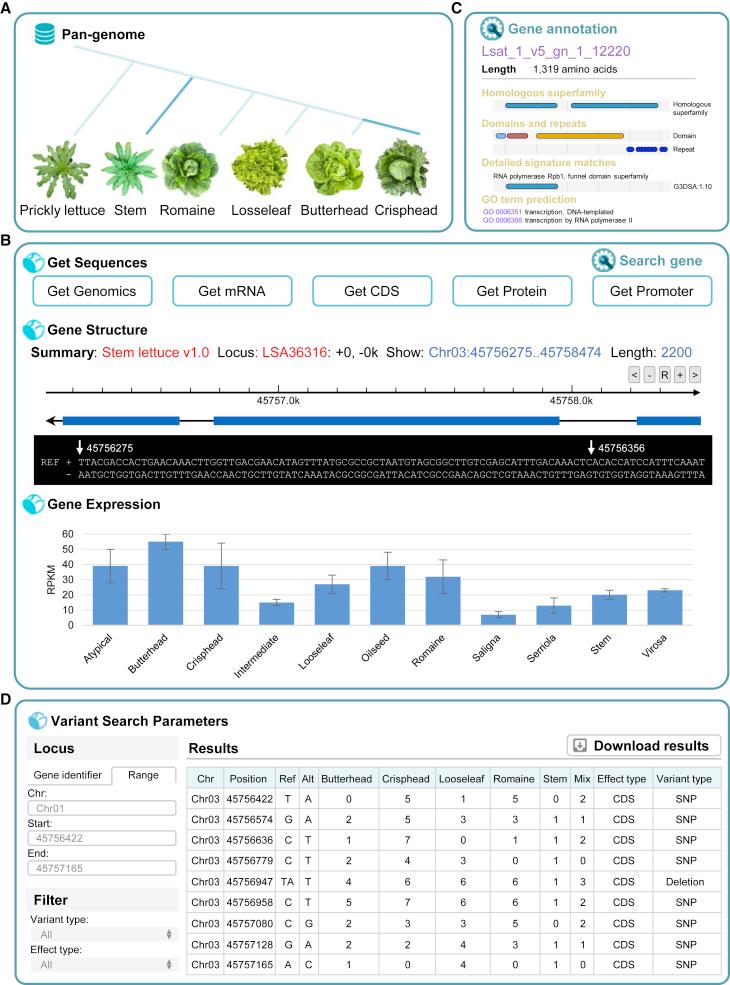
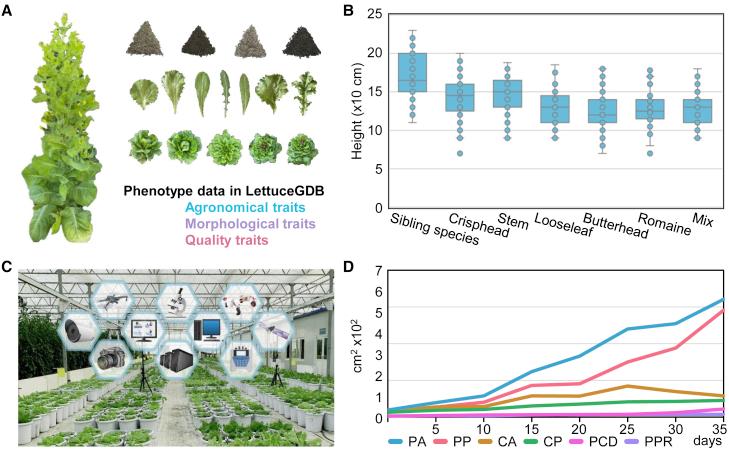
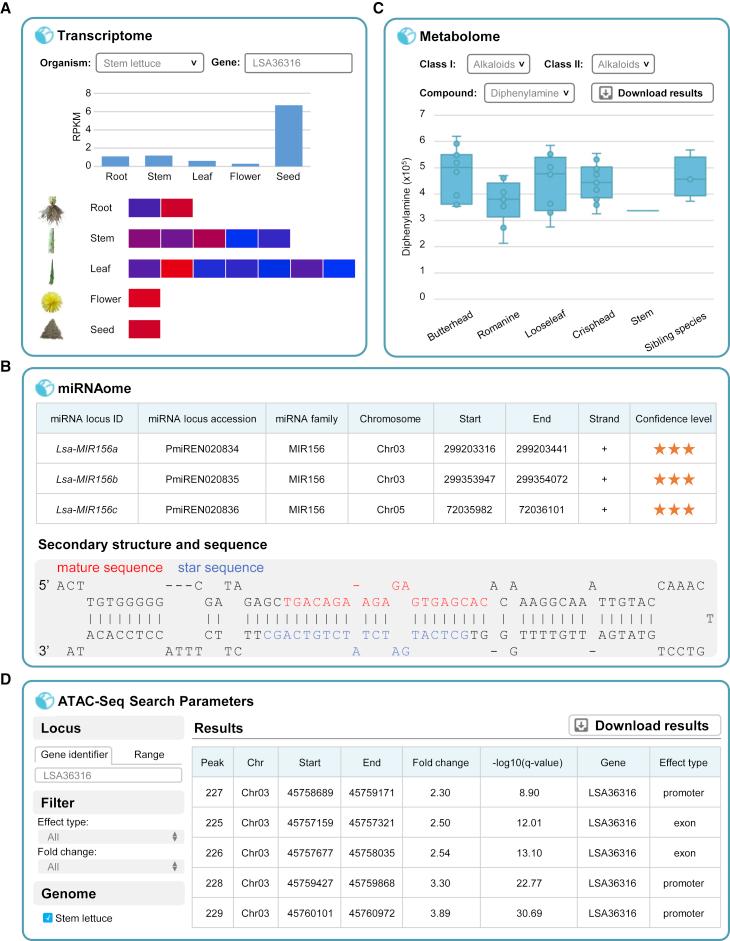
As a globally popular leafy vegetable and a representative plant of the Asteraceae family, lettuce has great economic and academic significance. In the last decade, high-throughput sequencing, phenotyping, and other multi-omics data in lettuce have accumulated on a large scale, thus increasing the demand for an integrative lettuce database. Here, we report the establishment of a comprehensive lettuce database, LettuceGDB (https://www.lettucegdb.com/). As an omics data hub, the current LettuceGDB includes two reference genomes with detailed annotations; re-sequencing data from over 1000 lettuce varieties; a collection of more than 1300 worldwide germplasms and millions of accompanying phenotypic records obtained with manual and cutting-edge phenomics technologies; re-analyses of 256 RNA sequencing datasets; a complete miRNAome; extensive metabolite information for representative varieties and wild relatives; epigenetic data on the genome-wide chromatin accessibility landscape; and various lettuce research papers published in the last decade. Five hierarchically accessible functions (Genome, Genotype, Germplasm, Phenotype, and O-Omics) have been developed with a user-friendly interface to enable convenient data access. Eight built-in tools (Assembly Converter, Search Gene, BLAST, JBrowse, Primer Design, Gene Annotation, Tissue Expression, Literature, and Data) are available for data downloading and browsing, functional gene exploration, and experimental practice. A community forum is also available for information sharing, and a summary of current research progress on different aspects of lettuce is included. We believe that LettuceGDB can be a comprehensive functional database amenable to data mining and database-driven exploration, useful for both scientific research and lettuce breeding.
作为一种全球流行的叶菜类蔬菜和菊科植物的代表,生菜具有重要的经济和学术意义。在过去十年中,生菜的高通量测序、表型分析和其他多组学数据已经大规模积累,从而增加了对综合生菜数据库的需求。在这里,我们报告了一个综合生菜数据库 LettuceGDB(https://www.lettucegdb.com/)的建立。作为一个组学数据中心,目前的 LettuceGDB 包括两个带有详细注释的参考基因组;来自 1000 多种生菜品种的重测序数据;超过 1300 种全球种质资源的集合,以及使用手动和尖端表型技术获得的数百万个伴随的表型记录;对 256 个 RNA 测序数据集的重新分析;完整的 miRNA 组;代表性品种和野生近缘种的广泛代谢物信息;全基因组染色质可及性景观的表观遗传数据;以及过去十年发表的各种生菜研究论文。五个层次化的可访问功能(基因组、基因型、种质资源、表型和 O-Omics)已经开发出来,具有用户友好的界面,方便数据访问。八个内置工具(Assembly Converter、Search Gene、BLAST、JBrowse、Primer Design、Gene Annotation、Tissue Expression、Literature 和 Data)可用于数据下载和浏览、功能基因探索和实验实践。还提供了一个社区论坛,用于信息共享,并包括生菜不同方面当前研究进展的摘要。我们相信 LettuceGDB 可以成为一个综合的功能数据库,适用于数据挖掘和数据库驱动的探索,对科学研究和生菜育种都很有用。

 Zotero 插件