
先天性免疫和微生物失调与化脓性汗腺炎-慢性炎症的恶性循环。
Innate immunity and microbial dysbiosis in hidradenitis suppurativa - vicious cycle of chronic inflammation.
机构信息
Wound Healing and Regenerative Medicine Research Program, Dr. Phillip Frost Department of Dermatology and Cutaneous Surgery, University of Miami Miller School of Medicine, Miami, FL, United States.
College of Medicine, University of Toledo College of Medicine and Life Sciences, Toledo, OH, United States.
出版信息
Front Immunol. 2022 Jul 28;13:960488. doi: 10.3389/fimmu.2022.960488. eCollection 2022.
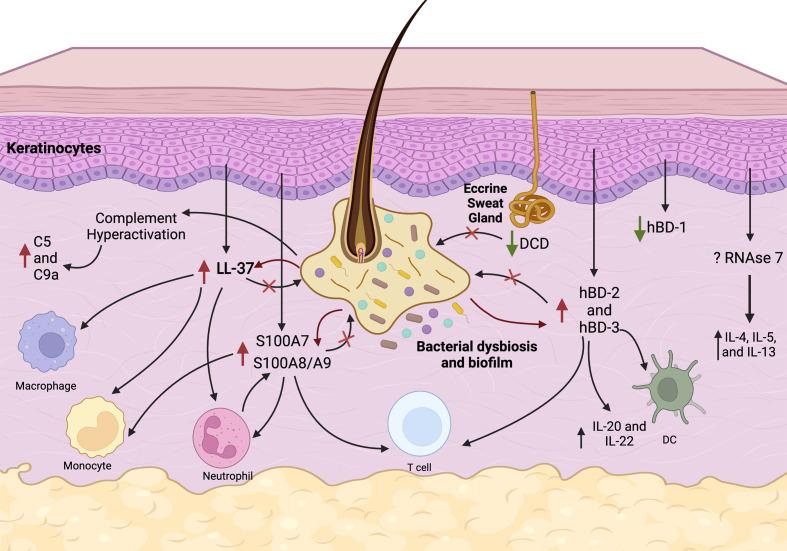
Hidradenitis Suppurativa (HS) is a chronic multifactorial inflammatory skin disease with incompletely understood mechanisms of disease pathology. HS is characterized by aberrant activation of the innate immune system, resulting in activation of pathways that aim to protect against pathogenic microorganisms, and also contribute to failure to resolve inflammation. Imbalance in innate immunity is evident in deregulation of host antimicrobial peptides (AMPs) and the complement system associated with the microbiome dysbiosis. The pathology is further complicated by ability of pathogens associated with HS to overcome host immune response. Potential roles of major AMPs, cathelicidin, defensins, dermcidin, S100 proteins, RNAse 7 and complement proteins are discussed. Dysregulated expression pattern of innate immunity components in conjunction with bacterial component of the disease warrants consideration of novel treatment approaches targeting both host immunity and pathogenic microbiome in HS.
化脓性汗腺炎(HS)是一种慢性多因素炎症性皮肤病,其发病机制尚不完全清楚。HS 的特征是先天免疫系统异常激活,导致旨在抵御致病微生物的途径被激活,也导致炎症无法得到解决。先天免疫失衡表现在与微生物失调相关的宿主抗菌肽(AMP)和补体系统的失调。病原体逃避宿主免疫反应的能力使病理更加复杂。主要 AMP 、抗菌肽、防御素、皮纹蛋白、S100 蛋白、RNAse7 和补体蛋白的潜在作用将被讨论。先天免疫成分的失调表达模式与疾病的细菌成分一起,需要考虑针对 HS 中宿主免疫和致病微生物组的新型治疗方法。
 Zotero 插件