
俄勒冈州医疗补助计划中患有阿片类药物使用障碍患者的治疗环境与结局之间的关联:一项回顾性队列研究。
Association between treatment setting and outcomes among oregon medicaid patients with opioid use disorder: a retrospective cohort study.
机构信息
Oregon State University College of Pharmacy, Portland, OR, USA.
College of Pharmacy, Oregon State University @ Oregon Health & Science University, Robertson Collaborative Life Sciences Building (RLSB), 2730 S Moody Ave., CL5CP, Portland, OR, 97201-5042, USA.
出版信息
Addict Sci Clin Pract. 2022 Aug 19;17(1):45. doi: 10.1186/s13722-022-00318-1.
BACKGROUND
Residential treatment is a common approach for treating opioid use disorder (OUD), however, few studies have directly compared it to outpatient treatment. The objective of this study was to compare OUD outcomes among individuals receiving residential and outpatient treatment.
METHODS
A retrospective cohort study used linked data from a state Medicaid program, vital statistics, and the Substance Abuse and Mental Health Services Administration (SAMHSA) Treatment Episodes Dataset (TEDS) to compare OUD-related health outcomes among individuals treated in a residential or outpatient setting between 2014 and 2017. Multivariable Cox proportional hazards and logistic regression models examined the association between treatment setting and outcomes (i.e., opioid overdose, non-overdose opioid-related and all-cause emergency department (ED) visits, hospital admissions, and treatment retention) controlling for patient characteristics, co-morbidities, and use of medications for opioid use disorders (MOUD). Interaction models evaluated how MOUD use modified associations between treatment setting and outcomes.
RESULTS
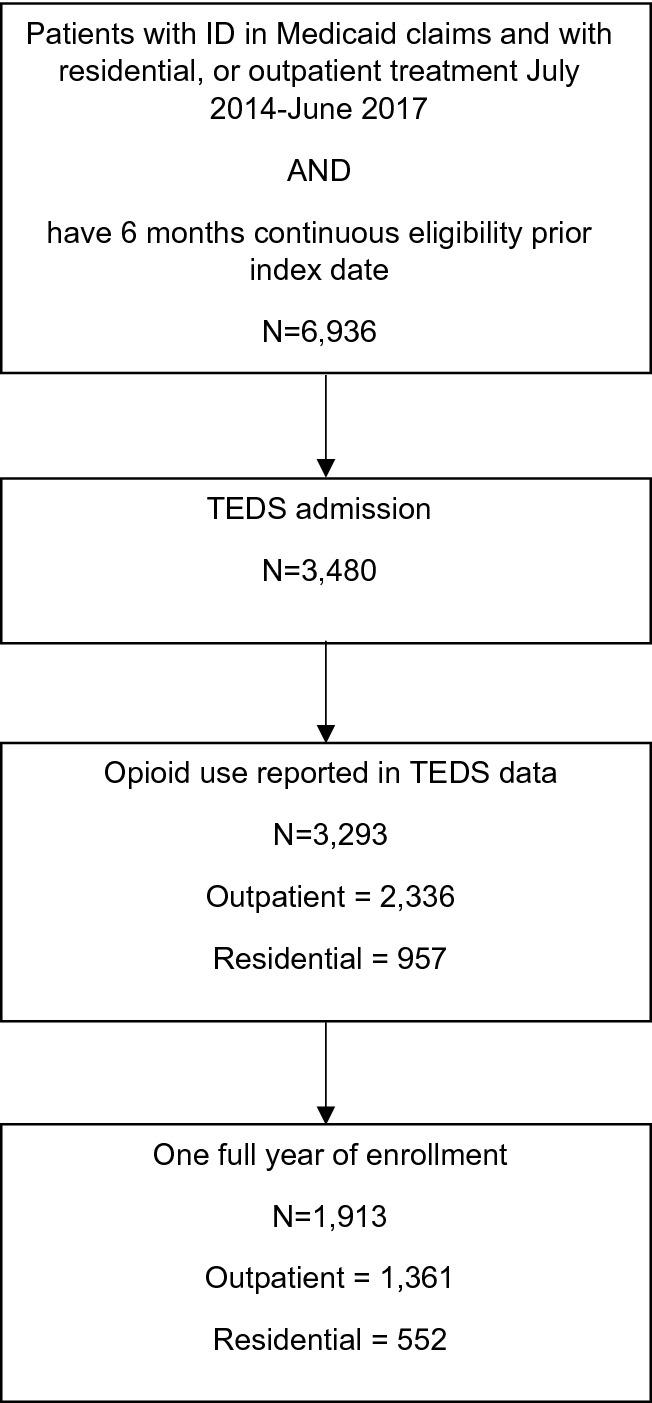
Of 3293 individuals treated for OUD, 957 (29%) received treatment in a residential facility. MOUD use was higher among those treated as an outpatient (43%) compared to residential (19%). The risk of opioid overdose (aHR 1.39; 95% CI 0.73-2.64) or an opioid-related emergency department encounter or admission (aHR 1.02; 95% CI 0.80-1.29) did not differ between treatment settings. Independent of setting, MOUD use was associated with a significant reduction in overdose risk (aHR 0.45; 95% CI 0.23-0.89). Residential care was associated with greater odds of retention at 6-months (aOR 1.71; 95% CI 1.32-2.21) but not 1-year. Residential treatment was only associated with improved retention for individuals not receiving MOUD (6-month aOR 2.05; 95% CI 1.56-2.71) with no benefit observed in those who received MOUD (aOR 0.75; 95% CI 0.46-1.29; interaction p = 0.001).
CONCLUSIONS
Relative to outpatient treatment, residential treatment was not associated with reductions in opioid overdose or opioid-related ED encounters/hospitalizations. Regardless of setting, MOUD use was associated with a significant reduction in opioid overdose risk.
背景
住院治疗是治疗阿片类药物使用障碍(OUD)的常用方法,然而,很少有研究直接将其与门诊治疗进行比较。本研究的目的是比较接受住院和门诊治疗的个体的 OUD 结局。
方法
使用来自州医疗补助计划、生命统计数据和物质滥用和心理健康服务管理局(SAMHSA)治疗发作数据集(TEDS)的链接数据进行回顾性队列研究,以比较 2014 年至 2017 年间在住院或门诊环境中接受治疗的个体的 OUD 相关健康结局。多变量 Cox 比例风险和逻辑回归模型控制患者特征、合并症和阿片类药物使用障碍(MOUD)药物的使用,研究了治疗环境与结局(即阿片类药物过量、非阿片类药物过量相关和所有原因急诊部(ED)就诊、住院和治疗保留)之间的关联。交互模型评估了 MOUD 使用如何改变治疗环境与结局之间的关联。
结果
在 3293 名接受 OUD 治疗的个体中,有 957 名(29%)在住院设施中接受治疗。门诊治疗者(43%)比住院治疗者(19%)更常使用 MOUD。阿片类药物过量(aHR 1.39;95%CI 0.73-2.64)或阿片类药物相关 ED 就诊或入院(aHR 1.02;95%CI 0.80-1.29)的风险在治疗环境之间无差异。独立于环境,MOUD 使用与过量风险显著降低相关(aHR 0.45;95%CI 0.23-0.89)。住院治疗与 6 个月时保留的可能性更大相关(aOR 1.71;95%CI 1.32-2.21),但 1 年时无差异。对于未接受 MOUD 治疗的个体,住院治疗仅与保留率提高相关(6 个月 aOR 2.05;95%CI 1.56-2.71),而对于接受 MOUD 治疗的个体则无获益(aOR 0.75;95%CI 0.46-1.29;交互 p = 0.001)。
结论
与门诊治疗相比,住院治疗与阿片类药物过量或阿片类药物相关 ED 就诊/住院无关。无论治疗环境如何,MOUD 使用均与阿片类药物过量风险显著降低相关。
 Zotero 插件