
超分子 DNA 纳米结构的纳米孔指纹图谱。
Nanopore fingerprinting of supramolecular DNA nanostructures.
机构信息
School of Electronic and Electrical Engineering and Pollard Institute, University of Leeds, Leeds, United Kingdom; Bragg Centre for Materials Research, Leeds, United Kingdom.
School of Chemistry, University of Leeds, Leeds, United Kingdom.
出版信息
Biophys J. 2022 Dec 20;121(24):4882-4891. doi: 10.1016/j.bpj.2022.08.020. Epub 2022 Aug 18.
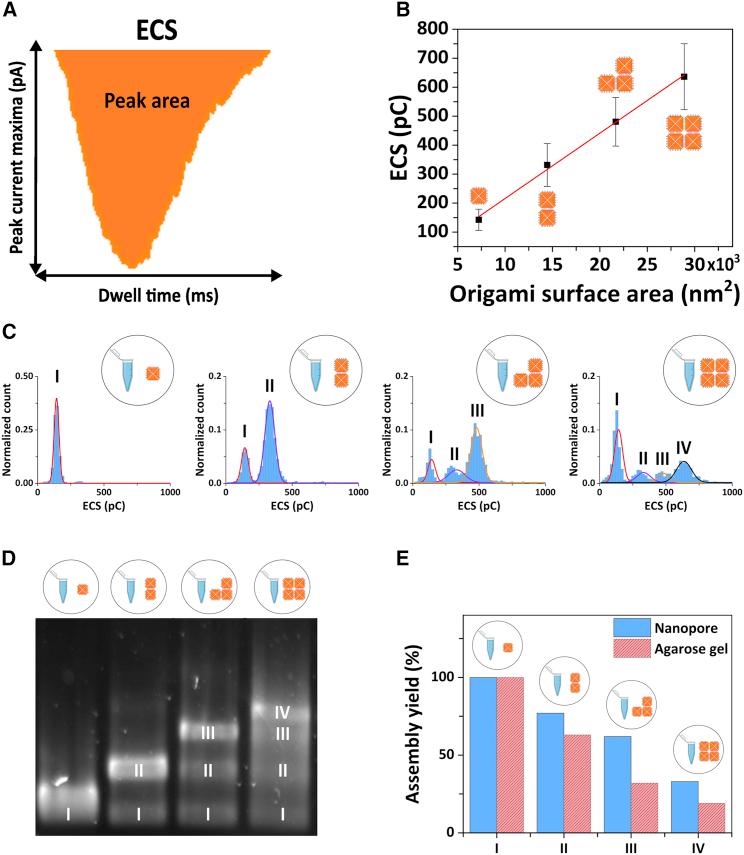
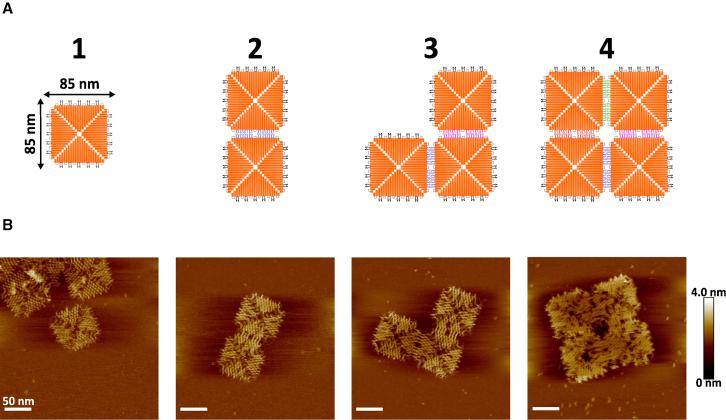
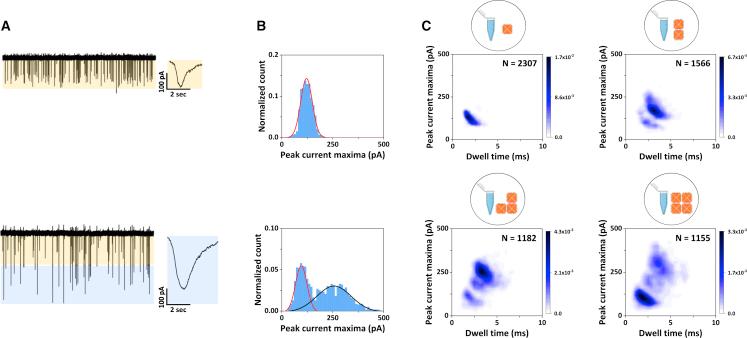
DNA nanotechnology has paved the way for new generations of programmable nanomaterials. Utilizing the DNA origami technique, various DNA constructs can be designed, ranging from single tiles to the self-assembly of large-scale, complex, multi-tile arrays. This technique relies on the binding of hundreds of short DNA staple strands to a long single-stranded DNA scaffold that drives the folding of well-defined nanostructures. Such DNA nanostructures have enabled new applications in biosensing, drug delivery, and other multifunctional materials. In this study, we take advantage of the enhanced sensitivity of a solid-state nanopore that employs a poly-ethylene glycol enriched electrolyte to deliver real-time, non-destructive, and label-free fingerprinting of higher-order assemblies of DNA origami nanostructures with single-entity resolution. This approach enables the quantification of the assembly yields for complex DNA origami nanostructures using the nanostructure-induced equivalent charge surplus as a discriminant. We compare the assembly yield of four supramolecular DNA nanostructures obtained with the nanopore with agarose gel electrophoresis and atomic force microscopy imaging. We demonstrate that the nanopore system can provide analytical quantification of the complex supramolecular nanostructures within minutes, without any need for labeling and with single-molecule resolution. We envision that the nanopore detection platform can be applied to a range of nanomaterial designs and enable the analysis and manipulation of large DNA assemblies in real time.
DNA 纳米技术为新一代可编程纳米材料铺平了道路。利用 DNA 折纸技术,可以设计各种 DNA 结构,从单个瓦片到大规模、复杂、多瓦片阵列的自组装。该技术依赖于数百个短 DNA 订书钉与长单链 DNA 支架的结合,从而驱动定义良好的纳米结构的折叠。这种 DNA 纳米结构在生物传感、药物输送和其他多功能材料等领域有了新的应用。在这项研究中,我们利用了聚乙二醇丰富电解质的固态纳米孔的增强灵敏度,实时、无损和无标记地对 DNA 折纸纳米结构的更高阶组装进行指纹识别,具有单粒子分辨率。这种方法可以利用纳米结构诱导的等效电荷过剩作为判别标准,对复杂 DNA 折纸纳米结构的组装产率进行定量。我们将用纳米孔获得的四种超分子 DNA 纳米结构的组装产率与琼脂糖凝胶电泳和原子力显微镜成像进行了比较。我们证明,纳米孔系统可以在几分钟内提供复杂的超分子纳米结构的分析定量,而无需标记,并且具有单分子分辨率。我们设想纳米孔检测平台可以应用于一系列纳米材料设计,并能够实时分析和操作大型 DNA 组装。


 Zotero 插件