
转化生长因子-β和基质金属蛋白酶-2在遗传性牙龈纤维瘤病上皮细胞中的表达。上皮对其发病机制的可能作用。
Expression of TGF-β and MMP-2 in hereditary gingival fibromatosis epithelial cells. A possible contribution of the epithelium to its pathogenesis.
作者信息
Kamal Naglaa M, Hamouda Mai A, Abdelgawad Nora
机构信息
Department of Oral Pathology, Faculty of Oral and Dental Medicine, Ahram Canadian University, 6th of October, Egypt.
Department of Oral Medicine, Periodontology, Diagnosis and Radiology, Faculty of Dental Medicine for Girls, Al Azhar University, Cairo, Egypt.
出版信息
J Oral Biol Craniofac Res. 2022 Sep-Oct;12(5):617-622. doi: 10.1016/j.jobcr.2022.08.015. Epub 2022 Aug 14.
BACKGROUND
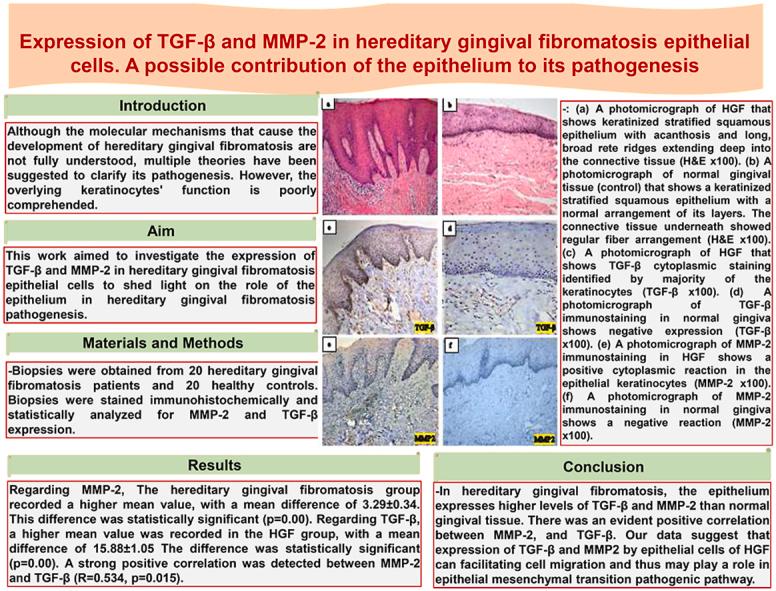
Although the molecular mechanisms that cause the development of hereditary gingival fibromatosis are not fully understood, multiple theories have been suggested to clarify its pathogenesis. However, the overlying keratinocytes' function is poorly comprehended. This work aimed to investigate the expression of TGF-β and MMP-2 in hereditary gingival fibromatosis epithelial cells compared to the normal gingival epithelium to give an insight into the mechanism of the development of this condition.
METHODS
Biopsies were obtained from 20 hereditary gingival fibromatosis patients and 20 healthy controls. Biopsies were stained immunohistochemically and statistically analyzed for MMP-2 and TGF-β expression.
RESULTS
Regarding MMP-2, The hereditary gingival fibromatosis group recorded a higher mean value compared to the normal gingiva, with a mean difference of 3.29 ± 0.34. This difference was statistically significant (p = 0.00). Regarding TGF-β, a higher mean value was recorded in the HGF group compared to the normal gingiva, with a mean difference of 15.88 ± 1.05 The difference was statistically significant (p = 0.00). A strong positive correlation was detected between MMP-2 and TGF-β (R = 0.534, p = 0.015).
CONCLUSIONS
In hereditary gingival fibromatosis, the epithelium expresses higher levels of TGF-β and MMP-2 than normal gingival tissue. There was an evident positive correlation between MMP-2 and TGF-β. Our data suggest that the expression of TGF-β and MMP2 by epithelial cells of HGF may play a role in the epithelial-mesenchymal transition pathogenic pathway.
背景
尽管导致遗传性牙龈纤维瘤病发生发展的分子机制尚未完全明确,但已提出多种理论来阐明其发病机制。然而,对于覆盖其上的角质形成细胞的功能了解甚少。本研究旨在调查遗传性牙龈纤维瘤病上皮细胞中转化生长因子-β(TGF-β)和基质金属蛋白酶-2(MMP-2)的表达情况,并与正常牙龈上皮进行比较,以深入了解该病的发病机制。
方法
从20例遗传性牙龈纤维瘤病患者和20例健康对照者中获取活检组织。对活检组织进行免疫组织化学染色,并对MMP-2和TGF-β的表达进行统计学分析。
结果
关于MMP-2,遗传性牙龈纤维瘤病组的平均值高于正常牙龈,平均差值为3.29±0.34。这一差异具有统计学意义(p = 0.00)。关于TGF-β,遗传性牙龈纤维瘤病组的平均值高于正常牙龈,平均差值为15.88±1.05。这一差异具有统计学意义(p = 0.00)。MMP-2与TGF-β之间存在强正相关(R = 0.534, p = 0.015)。
结论
在遗传性牙龈纤维瘤病中,上皮细胞表达的TGF-β和MMP-2水平高于正常牙龈组织。MMP-2与TGF-β之间存在明显的正相关。我们的数据表明,遗传性牙龈纤维瘤病上皮细胞中TGF-β和MMP2的表达可能在上皮-间充质转化致病途径中发挥作用。
 Zotero 插件