
耐盐促生根际细菌提高沙漠盐生植物的盐度和沙尘胁迫耐受性。
Improved salinity and dust stress tolerance in the desert halophyte by halotolerant plant growth-promoting rhizobacteria.
作者信息
Najafi Zilaie Mahmood, Mosleh Arani Asghar, Etesami Hassan, Dinarvand Mehri
机构信息
Department of Environmental Sciences, Faculty of Natural Resources, Yazd University, Yazd, Iran.
Department of Soil Science, University of Tehran, Karaj, Iran.
出版信息
Front Plant Sci. 2022 Aug 3;13:948260. doi: 10.3389/fpls.2022.948260. eCollection 2022.
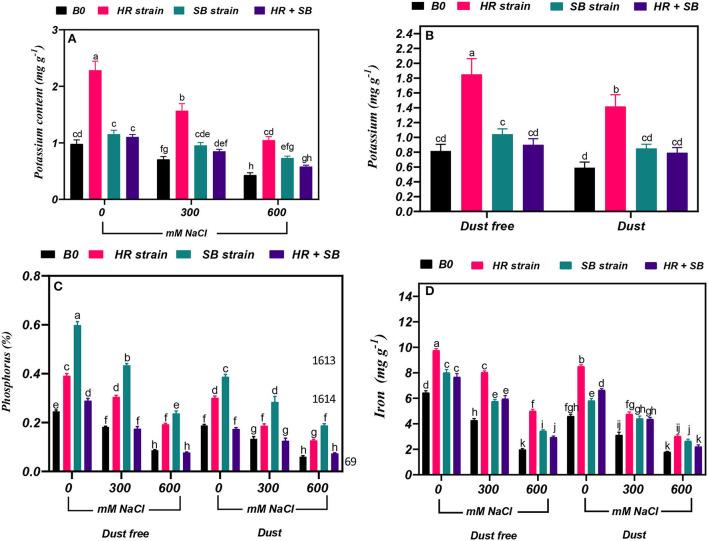
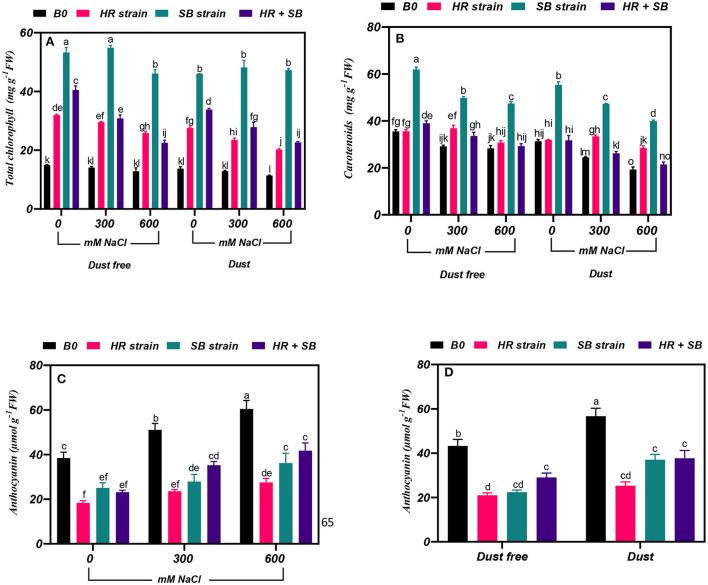
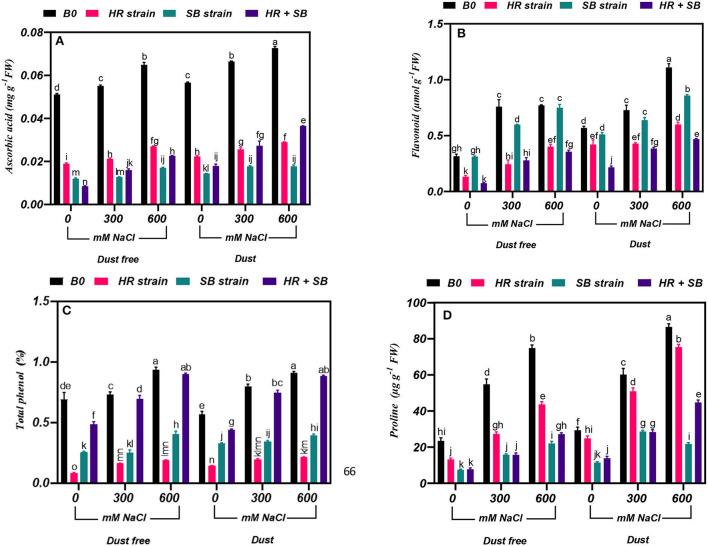
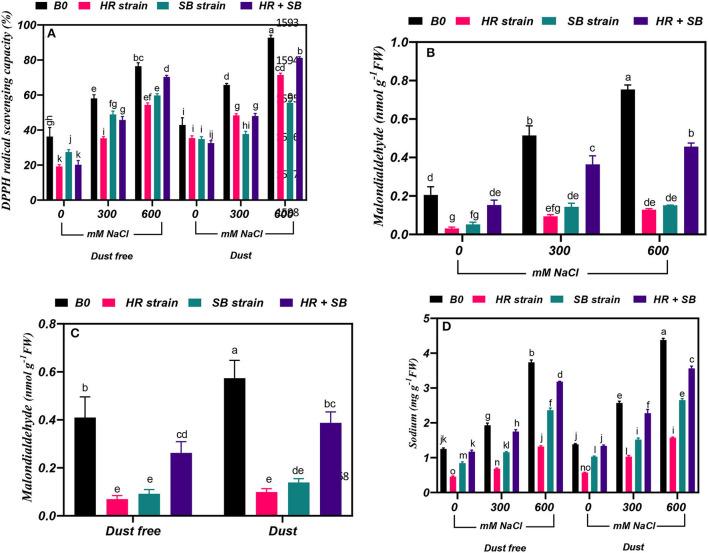
Because of global warming, desertification is increasing. One of the best strategies for combating desertification is reforestation of forests and biological operations of vegetation. However, events like soil salinity and dust storms, as the most important manifestations of desertification, prevent vegetation from settling in these areas. In this study, the effects of two halotolerant plant growth-promoting rhizobacterial strains, HR and SB, on physiological and nutritional status of the desert halophyte under the stress of salinity (0, 300, and 600 mM NaCl) and dust (0 and 1.5 g m month) were examined. Under dust application, the SB strain compared to the HR strain and the combination of these two bacterial strains improved the content of total chlorophyll (247 and 316%), carotenoid (94 and 107%), phosphorus (113 and 209%), magnesium (196 and 212%), and total dry biomass (13 and 28%) in at salinity levels of 300 and 600 mM NaCl, respectively. Under conditions of combined application of dust and salinity, HR compared to SB and the combination of two strains at salinity levels of 300 and 600 mM NaCl, respectively, had better performance in increasing the content of iron (53 and 69%), calcium (38 and 161%), and seedling quality index (95 and 56%) in . The results also showed that both bacterial strains and their combination were able to reduce the content of ascorbic acid, flavonoid, total phenol, proline, and malondialdehyde, and catalase activity, and ultimately improve the antioxidant capacity of . This showed that the use of halotolerant rhizobacteria can stop the production of free radicals and thus prevent cell membrane damage and the formation of malondialdehyde under salinity and dust stress. The results of this study for the first time showed that halotolerant rhizobacteria can increase the seedling quality index of under combined conditions of salinity and dust. The use of these bacteria can be useful in the optimal afforestation of species in arid and semi-arid ecosystems.
由于全球变暖,沙漠化正在加剧。对抗沙漠化的最佳策略之一是森林重新造林和植被的生物操作。然而,诸如土壤盐碱化和沙尘暴等事件,作为沙漠化的最重要表现形式,阻碍了植被在这些地区定居。在本研究中,研究了两种耐盐促生根际细菌菌株HR和SB,在盐度(0、300和600 mM NaCl)和沙尘(0和1.5 g m月)胁迫下,对沙漠盐生植物生理和营养状况的影响。在施加沙尘的情况下,与HR菌株以及这两种细菌菌株的组合相比,SB菌株在300和600 mM NaCl盐度水平下,分别提高了总叶绿素含量(247%和316%)、类胡萝卜素含量(94%和107%)、磷含量(113%和209%)、镁含量(196%和212%)以及总干生物量(13%和28%)。在沙尘和盐度联合施加的条件下,与SB菌株以及两种菌株的组合相比,HR菌株在300和600 mM NaCl盐度水平下,分别在提高铁含量(53%和69%)、钙含量(38%和161%)以及幼苗质量指数(95%和56%)方面表现更好。结果还表明,两种细菌菌株及其组合都能够降低抗坏血酸、类黄酮、总酚、脯氨酸和丙二醛的含量以及过氧化氢酶活性,并最终提高抗氧化能力。这表明使用耐盐根际细菌可以阻止自由基的产生,从而在盐度和沙尘胁迫下防止细胞膜损伤和丙二醛的形成。本研究结果首次表明,耐盐根际细菌在盐度和沙尘联合条件下可以提高幼苗质量指数。使用这些细菌对于干旱和半干旱生态系统中物种的最佳造林可能是有用的。
 Zotero 插件