
坦桑尼亚钩端螺旋体病疫情:形势令人担忧。
Leptospirosis outbreak in Tanzania: An alarming situation.
作者信息
Masunga Daniel Stephen, Rai Anushree, Abbass Mortada, Uwishema Olivier, Wellington Jack, Uweis Lama, El Saleh Rayyan, Arab Sara, Onyeaka Chinyere Vivian Patrick, Onyeaka Helen
机构信息
Oli Health Magazine Organization, Research and Education, Kigali, Rwanda.
Kilimanjaro Christian Medical University College (KCMUCo), Kilimanjaro, Tanzania.
出版信息
Ann Med Surg (Lond). 2022 Aug 6;80:104347. doi: 10.1016/j.amsu.2022.104347. eCollection 2022 Aug.
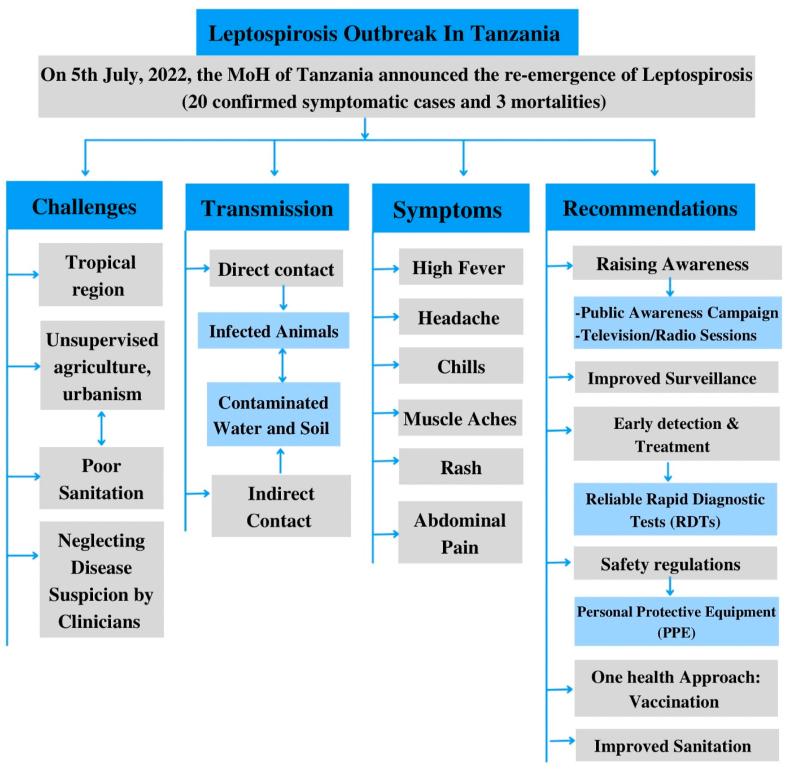
On July 5, 2022, the Tanzanian Ministry of Health (MoH) announced the re-emergence of leptospirosis after reporting 20 confirmed symptomatic cases and 3 mortalities. Leptospirosis is caused by a spirochete bacterium that lives in an animal's renal tubule and spreads to individuals through contact with contaminated animal urine. Unsupervised agricultural practices, urban development, wildlife infiltration, and a lack of sanitation have all been proposed as potential environmental causes of the present outbreak. The MoH is taking the necessary steps to halt the spread of said outbreak with assistance from the World Health Organization (WHO). This article examines the risk factors, etiology, number of confirmed cases, and subsequent case index to analyse the epidemiology of the current leptospirosis outbreak in Tanzania's southern Linda region. In light of these findings, this research further details recent recommendations made by the WHO, Centers for Disease Control and Prevention, and MoH to mitigate such an alarming situation. These recommendations include early detection and isolation, contact tracing, and chemoprophylaxis using doxycycline. The article concludes by outlining suggestions for individuals and governments, including the launch of public awareness campaigns, immunisation, increased surveillance, rapid detection testing, and the installation of suitable purification systems, to help contain future leptospirosis outbreaks.
2022年7月5日,坦桑尼亚卫生部宣布钩端螺旋体病再次出现,此前报告了20例确诊的有症状病例和3例死亡病例。钩端螺旋体病由一种螺旋体细菌引起,这种细菌生活在动物的肾小管中,并通过接触受污染的动物尿液传播给个体。无监管的农业 practices、城市发展、野生动物入侵和缺乏卫生设施都被认为是此次疫情爆发的潜在环境原因。卫生部正在世界卫生组织(WHO)的协助下采取必要措施阻止上述疫情的传播。本文研究了风险因素、病因、确诊病例数和后续病例指数,以分析坦桑尼亚南部林达地区当前钩端螺旋体病疫情的流行病学情况。根据这些发现,本研究进一步详细介绍了世界卫生组织、疾病控制和预防中心以及卫生部最近提出的缓解这种令人担忧情况的建议。这些建议包括早期检测和隔离、接触者追踪以及使用多西环素进行化学预防。文章最后概述了对个人和政府的建议,包括开展公众意识运动、免疫接种、加强监测、快速检测测试以及安装合适的净化系统,以帮助控制未来的钩端螺旋体病疫情。
 Zotero 插件