
妊娠期间处方类阿片类镇痛药的特点与新生儿阿片类戒断综合征的风险。
Characteristics of Prescription Opioid Analgesics in Pregnancy and Risk of Neonatal Opioid Withdrawal Syndrome in Newborns.
机构信息
Department of Epidemiology, Boston University School of Public Health, Boston, Massachusetts.
Division of Pharmacoepidemiology and Pharmacoeconomics, Brigham and Women's Hospital, Boston, Massachusetts.
出版信息
JAMA Netw Open. 2022 Aug 1;5(8):e2228588. doi: 10.1001/jamanetworkopen.2022.28588.
IMPORTANCE
Prescription opioids are often used during pregnancy even though they are associated with neonatal opioid withdrawal syndrome (NOWS). Most studies of adverse outcomes of opioid use for pain have assessed only the class-wide outcome despite the pharmacodynamic and pharmacokinetic heterogeneity across opioid medications.
OBJECTIVE
To compare the risk of NOWS across common types of opioids when prescribed as monotherapy during the last 3 months of pregnancy.
DESIGN, SETTING, AND PARTICIPANTS: This cohort study analyzed administrative claims data of Medicaid-insured mothers and newborns in 46 states and Washington DC from January 1, 2000, through December 31, 2014. Participants were mothers with 2 or more dispensed opioid prescriptions within 90 days before delivery and their eligible live-born neonates. Data were analyzed from February 2020 to March 2021.
EXPOSURE
Different types of opioid medications were compared by agonist strength (strong vs weak) and half-life (medium vs short and long vs short) of the opioid active ingredient.
MAIN OUTCOMES AND MEASURES
The primary outcome was NOWS, which was identified using an International Classification of Diseases, Ninth Revision, Clinical Modification diagnostic code in the 30 days after delivery. Relative risks (RRs) were adjusted for an exposure propensity score, including demographic characteristics, comorbidities, other medication use, and opioid treatment characteristics (including morphine milligram equivalents), using fine stratification.
RESULTS
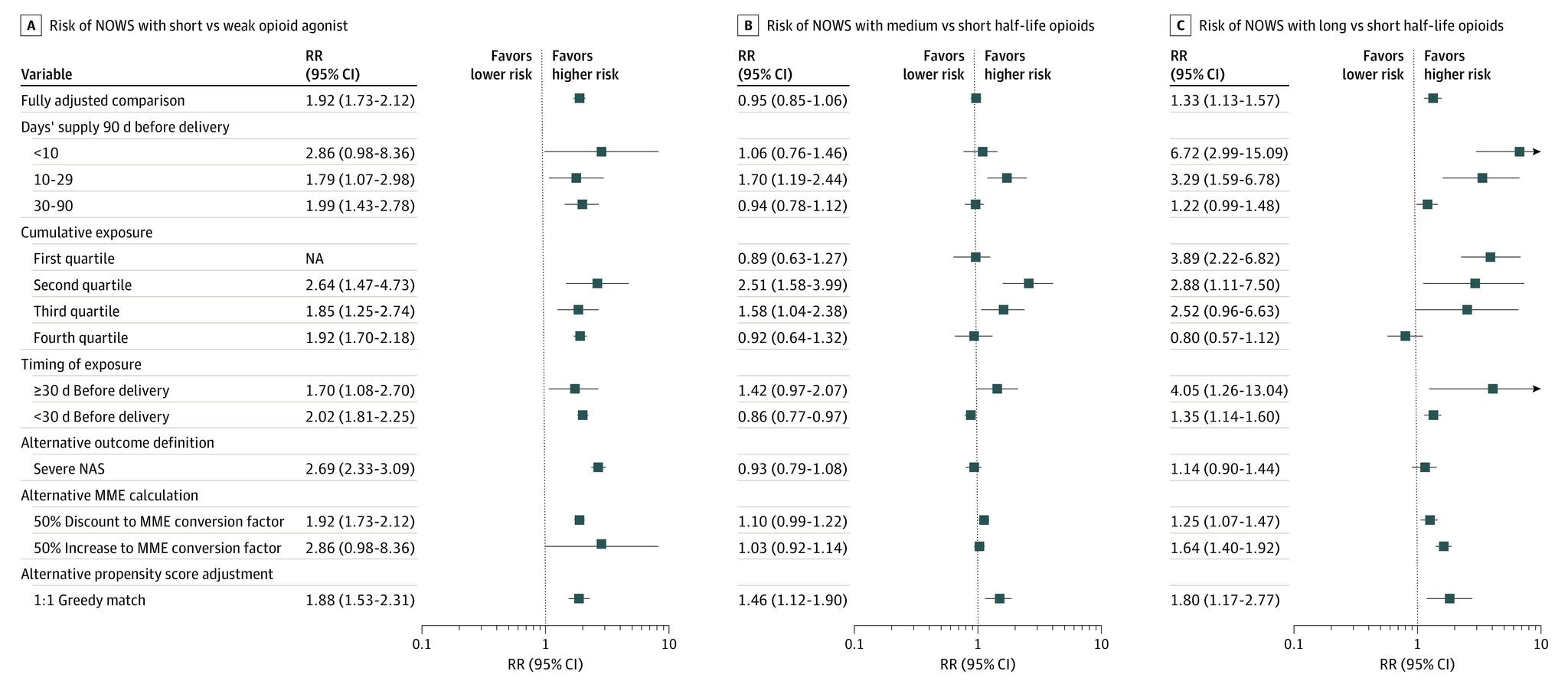
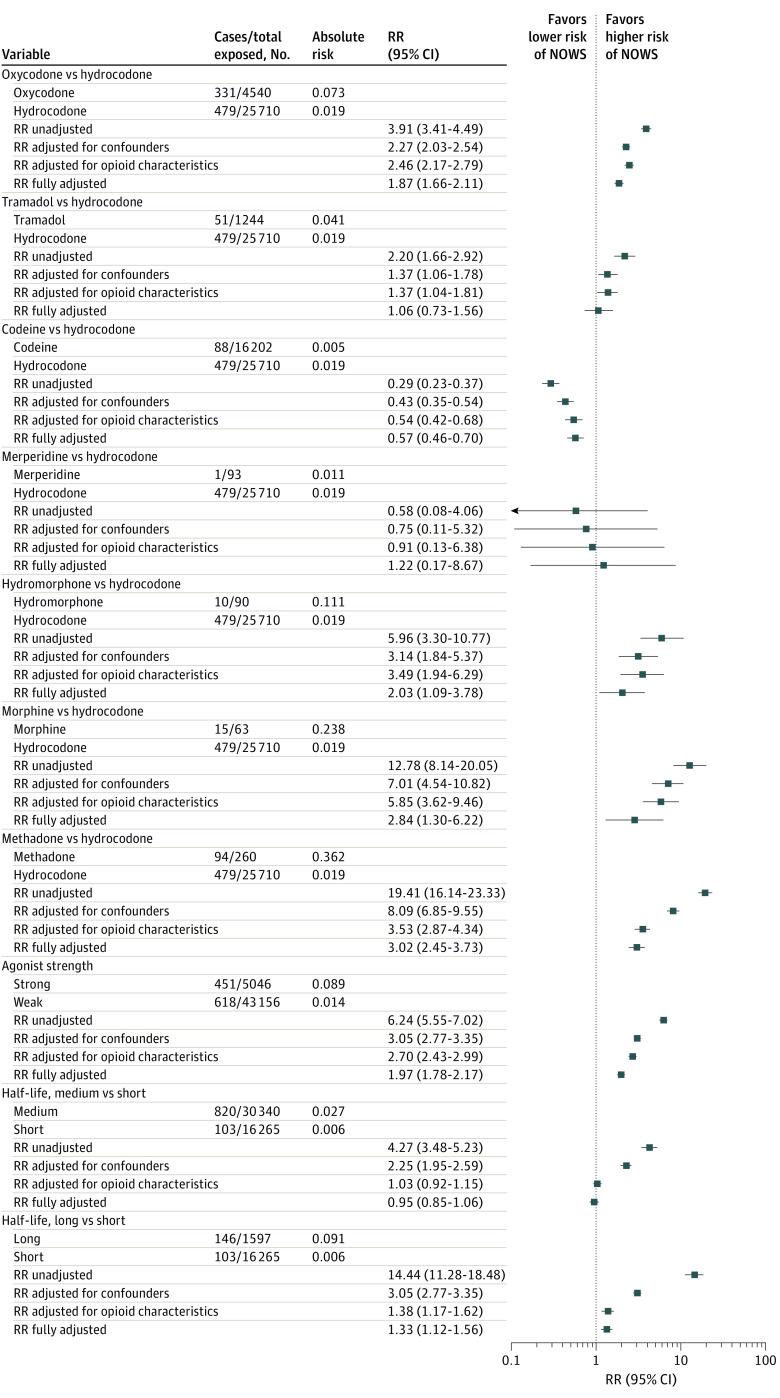
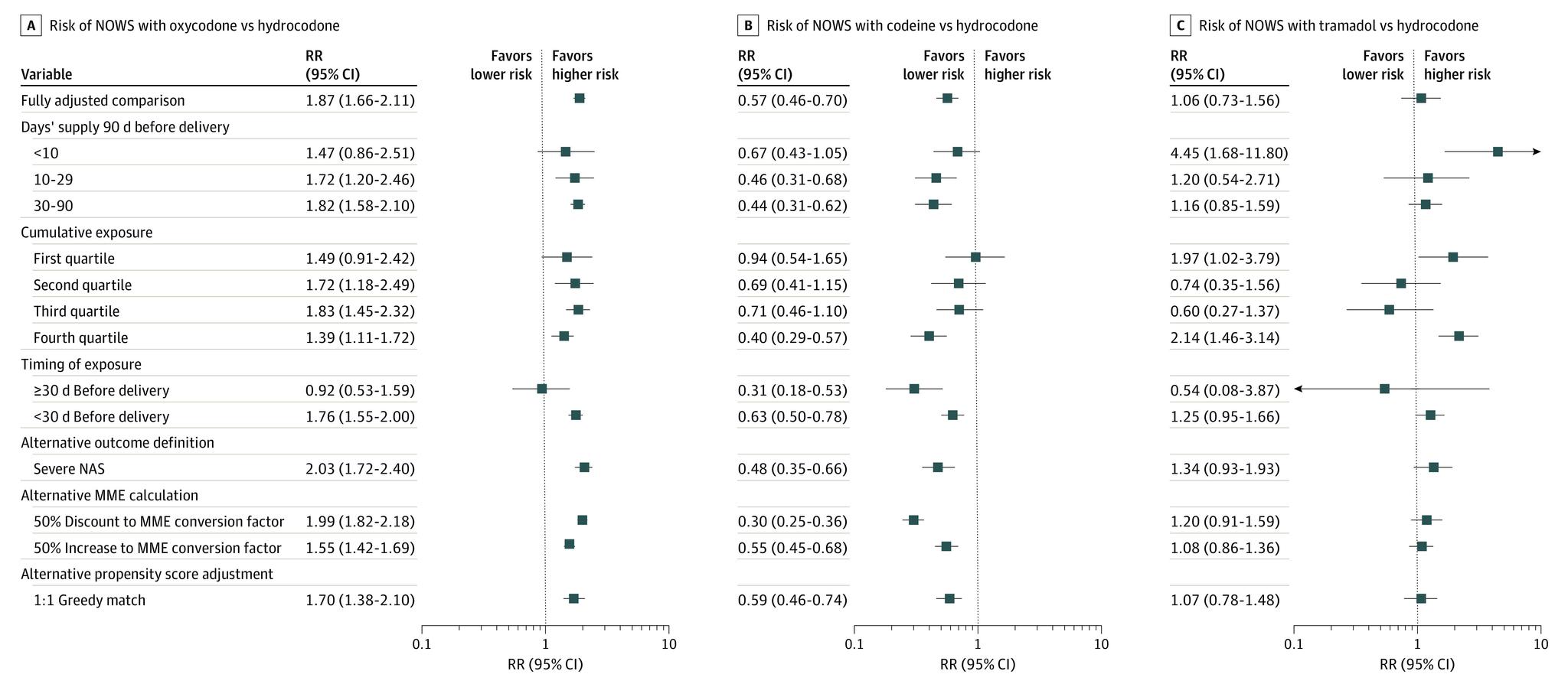
The cohort comprised 48 202 opioid-exposed pregnancies with live newborns. A total of 1069 neonates (2.2%) had NOWS and 559 (1.2%) had severe NOWS. Opioid exposure during pregnancy included 16 202 pregnancies exposed to codeine, 4540 to oxycodone, 1244 to tramadol, 260 to methadone (dispensed for pain), 90 to hydromorphone, and 63 to morphine compared with 25 710 exposed to hydrocodone. Demographic characteristics varied across opioids, with tramadol, oxycodone, methadone, hydromorphone, and morphine being more commonly dispensed at older maternal age (≥35 years). Compared with hydrocodone, codeine had a lower adjusted RR of NOWS (0.57; 95% CI, 0.46-0.70), with a similar adjusted RR for tramadol (RR, 1.06; 95% CI, 0.73-1.56), and 2- to 3-fold higher adjusted RRs for oxycodone (1.87; 95% CI, 1.66-2.11), morphine (2.84; 95% CI, 1.30-6.22), methadone (3.02; 95% CI, 2.45-3.73), and hydromorphone (2.03; 95% CI, 1.09-3.78). Strong agonists were associated with a higher risk of NOWS than weak agonists (RR, 1.97; 95% CI, 1.78-2.17), and long half-life opioids were associated with an increased risk compared with short half-life products (RR, 1.33; 95% CI, 1.12-1.56). Findings were consistent across sensitivity and subgroup analyses.
CONCLUSIONS AND RELEVANCE
Results of this study show higher risk of NOWS and severe NOWS among neonates with in utero exposure to strong agonists and long half-life prescription opioids. Information on the opioid-specific risk of NOWS may help prescribers select opioids for pain management in late stages of pregnancy.
重要性
尽管处方类阿片与新生儿阿片戒断综合征(NOWS)有关,但在怀孕期间,它们仍经常被使用。尽管不同的阿片类药物在药效动力学和药代动力学方面存在差异,但大多数关于疼痛治疗中阿片类药物不良结局的研究仅评估了整个类别的结果。
目的
比较在妊娠最后 3 个月单药治疗时,常见类型的阿片类药物发生 NOWS 的风险。
设计、设置和参与者:这项队列研究分析了来自 46 个州和华盛顿特区的 2000 年 1 月 1 日至 2014 年 12 月 31 日期间接受医疗补助的母亲及其合格的活产新生儿的行政索赔数据。参与者为在分娩前 90 天内有 2 次或以上阿片类药物处方的母亲及其活产新生儿。数据分析于 2020 年 2 月至 2021 年 3 月进行。
暴露
通过阿片类药物活性成分的激动剂强度(强 vs 弱)和半衰期(中 vs 短和长 vs 短)比较不同类型的阿片类药物。
主要结局和测量指标
主要结局为产后 30 天内发生的 NOWS,通过使用国际疾病分类第 9 版临床修正诊断代码进行识别。使用精细分层,通过暴露倾向评分(包括人口统计学特征、合并症、其他药物使用和阿片类药物治疗特征[包括吗啡毫克当量])调整相对风险(RR)。
结果
该队列包括 48202 例接受阿片类药物暴露的妊娠分娩活产儿。共有 1069 例新生儿(2.2%)患有 NOWS,559 例(1.2%)患有严重 NOWS。怀孕期间的阿片类药物暴露包括 16202 例接受可待因暴露的妊娠、4540 例接受羟考酮暴露、1244 例接受曲马多暴露、260 例接受美沙酮(用于疼痛治疗)暴露、90 例接受氢吗啡酮暴露和 63 例接受吗啡暴露,而接受氢可酮暴露的有 25710 例。阿片类药物的人口统计学特征存在差异,曲马多、羟考酮、美沙酮、氢吗啡酮和吗啡更常被用于年龄较大的产妇(≥35 岁)。与氢可酮相比,可待因的 NOWS 调整 RR 较低(0.57;95%CI,0.46-0.70),曲马多的调整 RR 相似(RR,1.06;95%CI,0.73-1.56),羟考酮(1.87;95%CI,1.66-2.11)、吗啡(2.84;95%CI,1.30-6.22)、美沙酮(3.02;95%CI,2.45-3.73)和氢吗啡酮(2.03;95%CI,1.09-3.78)的调整 RR 高 2 至 3 倍。强激动剂与 NOWS 风险增加相关,弱激动剂的 RR 为 1.97(95%CI,1.78-2.17),长半衰期阿片类药物与短半衰期产品相比,RR 增加(RR,1.33;95%CI,1.12-1.56)。敏感性和亚组分析的结果一致。
结论和相关性
这项研究的结果表明,在子宫内接触强激动剂和长半衰期处方阿片类药物的新生儿中,NOWS 和严重 NOWS 的风险更高。关于 NOWS 的阿片类药物特异性风险的信息可能有助于医生在妊娠晚期选择用于疼痛管理的阿片类药物。

 Zotero 插件