
利用葡萄糖增强的水溶性荧光生物探针检测水中的 S。
Detection of S in Water by a Glucose Enhanced Water-Soluble Fluorescent Bioprobe.
机构信息
Shaanxi Key Laboratory of Natural Products and Chemical Biology, College of Chemistry & Pharmacy, Northwest A&F University, Yangling, Shaanxi 712100, China.
出版信息
Biosensors (Basel). 2022 Aug 4;12(8):600. doi: 10.3390/bios12080600.
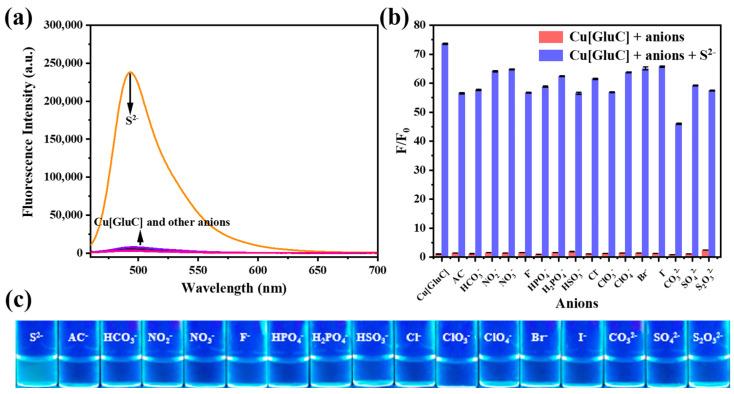
That sulfide anions (S) in aquatic environments are produced by microorganisms through degrading sulfur-containing proteins and other organics are harmful to human health. Thus, it is of significance to develop a convenient method for the detection of S in water. Small molecular fluorescent probes are very popular for their advantages of visualization, real-time, high sensitivity, and convenience. However, low solubility in water limits the application of existing S probes. In this work, we found that our previously developed water-soluble glycosylated fluorescent bioprobe Cu[GluC] can achieve detection of S in water. Cu[GluC] can restore fluorescence within 20 s when it encounters S and shows good sensitivity towards S with a detection limit of 49.6 nM. Besides, Cu[GluC] derived fluorescent test strips were obtained by immersion and realized conveniently visual S detection in water by coupling with a UV lamp and a smartphone app. This work provides a fluorescent bioprobe with good water solubility as well as its derived fluorescent test strip for sensitive and simple detection of S in water, which shows good prospects in on-site water quality monitoring.
在水生环境中,硫离子(S)是由微生物通过降解含硫蛋白质和其他有机物产生的,对人体健康有害。因此,开发一种方便的水中 S 检测方法具有重要意义。小分子荧光探针因其可视化、实时、高灵敏度和方便等优点而非常受欢迎。然而,现有的 S 探针在水中的溶解度低限制了其应用。在这项工作中,我们发现之前开发的水溶性糖基化荧光生物探针 Cu[GluC]可以实现在水中检测 S。当遇到 S 时,Cu[GluC]在 20 秒内恢复荧光,并对 S 表现出良好的灵敏度,检测限为 49.6 nM。此外,通过浸渍获得了 Cu[GluC]衍生的荧光测试条,并通过与紫外灯和智能手机应用程序耦合,方便地实现了水中 S 的可视化检测。这项工作为水中 S 的灵敏、简单检测提供了一种具有良好水溶性的荧光生物探针及其衍生的荧光测试条,在现场水质监测方面具有广阔的应用前景。


 Zotero 插件