
调节伴侣蛋白介导的自噬及其在癌症中的临床应用。
Modulating Chaperone-Mediated Autophagy and Its Clinical Applications in Cancer.
机构信息
Department of Pathology, Medical University of Vienna, 1090 Vienna, Austria.
Comprehensive Cancer Center, Medical University of Vienna, 1090 Vienna, Austria.
出版信息
Cells. 2022 Aug 17;11(16):2562. doi: 10.3390/cells11162562.
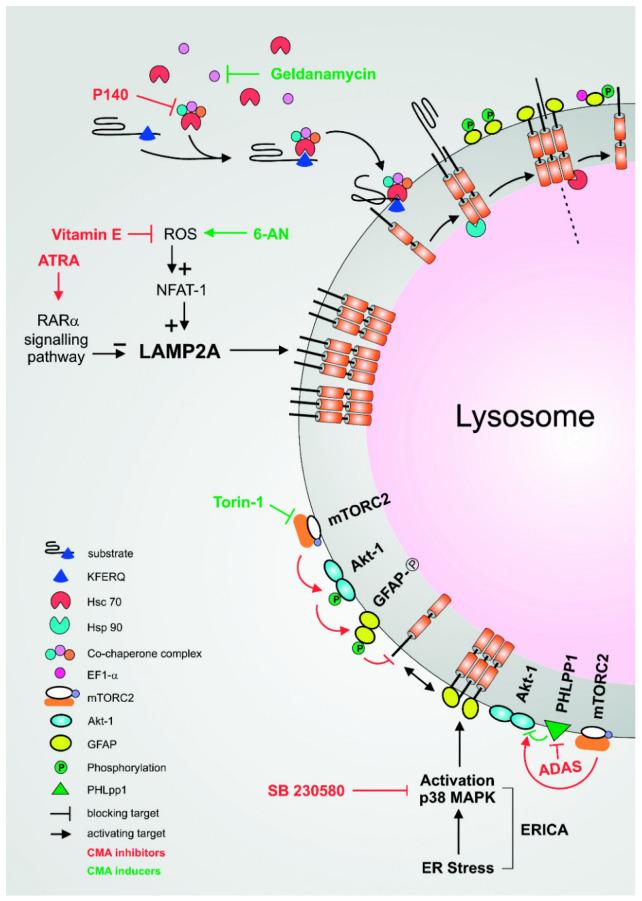
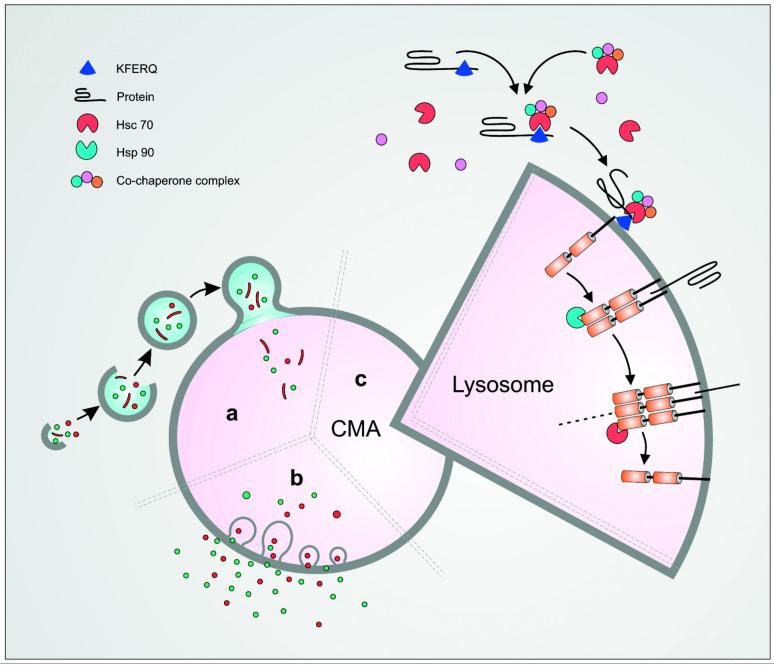
Autophagy is a central mechanism for maintaining cellular homeostasis in health and disease as it provides the critical energy through the breakdown and recycling of cellular components and molecules within lysosomes. One of the three types of autophagy is chaperone-mediated autophagy (CMA), a degradation pathway selective for soluble cytosolic proteins that contain a targeting motif related to KFERQ in their amino acid sequence. This motif marks them as CMA substrate and is, in the initial step of CMA, recognised by the heat shock protein 70 (Hsc70). The protein complex is then targeted to the lysosomal membrane where the interaction with the splice variant A of the lysosomal-associated membrane protein-2 (LAMP-2A) results in its unfolding and translocation into the lysosome for degradation. Altered levels of CMA have been reported in a wide range of pathologies including many cancer types that upregulate CMA as part of the pro-tumorigenic phenotype, while in aging a decline is observed and associated with a decrease of LAMP-2 expression. The potential of altering CMA to modify a physiological or pathological process has been firmly established through genetic manipulation in animals and chemical interference with this pathway. However, its use for therapeutic purposes has remained limited. Compounds used to target and modify CMA have been applied successfully to gain a better understanding of its cellular mechanisms, but they are mostly not specific, also influence other autophagic pathways and are associated with high levels of toxicity. Here, we will focus on the molecular mechanisms involved in CMA regulation as well as on potential ways to intersect them, describe modulators successfully used, their mechanism of action and therapeutic potential. Furthermore, we will discuss the potential benefits and drawbacks of CMA modulation in diseases such as cancer.
自噬是维持细胞内环境稳定的核心机制,它通过溶酶体分解和循环利用细胞成分和分子提供关键能量。自噬的三种类型之一是伴侣介导的自噬(CMA),这是一种选择性降解可溶性细胞质蛋白的途径,这些蛋白质在其氨基酸序列中含有与 KFERQ 相关的靶向基序。该基序将它们标记为 CMA 底物,并且在 CMA 的初始步骤中,被热休克蛋白 70(Hsc70)识别。然后,该蛋白复合物被靶向到溶酶体膜,在那里与溶酶体相关膜蛋白 2(LAMP-2A)的剪接变体 A 相互作用导致其展开并转运到溶酶体中进行降解。已报道 CMA 的水平在广泛的病理学中发生改变,包括许多上调 CMA 的癌症类型,这是肿瘤发生表型的一部分,而在衰老中观察到 CMA 水平下降,并与 LAMP-2 表达减少相关。通过在动物中的遗传操作和对该途径的化学干扰,已经明确证实了改变 CMA 以修饰生理或病理过程的潜力。然而,其用于治疗目的的应用仍然有限。用于靶向和修饰 CMA 的化合物已成功应用于更好地了解其细胞机制,但它们大多不具有特异性,也会影响其他自噬途径,并与高水平的毒性相关。在这里,我们将重点介绍 CMA 调节所涉及的分子机制以及潜在的交叉途径,描述成功使用的调节剂、它们的作用机制和治疗潜力。此外,我们将讨论在癌症等疾病中调节 CMA 的潜在益处和缺点。
 Zotero 插件