
从政策到实践:儿童肥胖预防的全国性评估——全美幼儿照护机构国家实施策略
Moving from Policy to Practice for Early Childhood Obesity Prevention: A Nationwide Evaluation of State Implementation Strategies in Childcare.
机构信息
Department of Nutrition, Harvard T.H. Chan School of Public Health, Boston, MA 02115, USA.
Department of Social and Behavioral Sciences, Harvard T.H. Chan School of Public Health, Boston, MA 02115, USA.
出版信息
Int J Environ Res Public Health. 2022 Aug 18;19(16):10304. doi: 10.3390/ijerph191610304.
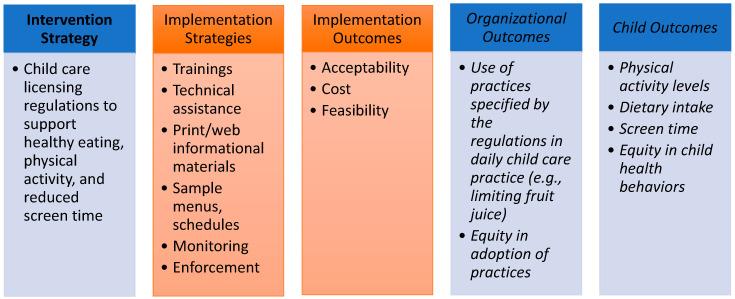
Policies requiring childcare settings to promote healthy eating, physical activity, and limited screentime have the potential to improve young children's health. However, policies may have limited impact without effective implementation strategies to promote policy adoption. In this mixed-methods study, we evaluated the type, quality, and dose of implementation strategies for state-level childcare licensing regulations focused on healthy eating, physical activity, or screentime using: (1) a survey of state licensing staff and technical assistance providers (n = 89) in 32 states; (2) a structured review of each state's childcare licensing and training websites for childcare providers; and (3) in-depth, semi-structured interviews with 31 childcare licensing administrators and technical assistance providers across 17 states. Implementation strategies for supporting childcare providers in adopting healthy eating, physical activity, and screentime regulations vary substantially by state, in quantity and structure. Childcare programs' financial challenges, staff turnover, and lack of adequate facilities were identified as key barriers to adoption. Access to federal food programs was seen as critical to implementing nutrition regulations. Implementation resources such as training and informational materials were rarely available in multiple languages or targeted to providers serving low-income or racially/ethnically diverse families. There is a substantial need for implementation supports for ensuring policies are successfully and equitably implemented in childcare.
要求儿童保育机构推广健康饮食、身体活动和限制屏幕时间的政策有可能改善幼儿的健康。然而,如果没有有效的实施策略来促进政策采纳,政策可能影响有限。在这项混合方法研究中,我们使用以下方法评估了针对健康饮食、身体活动或屏幕时间的州级儿童保育许可法规的实施策略的类型、质量和剂量:(1)对 32 个州的 89 名州许可工作人员和技术援助提供者进行了调查;(2)对每个州的儿童保育许可和培训网站进行了结构化审查,以了解儿童保育提供者;(3)在 17 个州对 31 名儿童保育许可管理人员和技术援助提供者进行了深入的半结构化访谈。支持儿童保育提供者采用健康饮食、身体活动和屏幕时间法规的实施策略因州而异,在数量和结构上存在差异。儿童保育计划的财务挑战、员工流失以及缺乏足够的设施被确定为采用的关键障碍。获得联邦食品计划被视为实施营养法规的关键。培训和信息材料等实施资源很少以多种语言提供,也很少针对服务低收入或种族/族裔多样化家庭的提供者。需要大量的实施支持,以确保政策在儿童保育中得到成功和公平的实施。
 Zotero 插件