
多氟化合物的生物降解策略。
Strategies for the Biodegradation of Polyfluorinated Compounds.
作者信息
Wackett Lawrence P
机构信息
Department of Biochemistry, Molecular Biology and Biophysics and BioTechnology Institute, University of Minnesota, Minneapolis, MN 55455, USA.
出版信息
Microorganisms. 2022 Aug 17;10(8):1664. doi: 10.3390/microorganisms10081664.
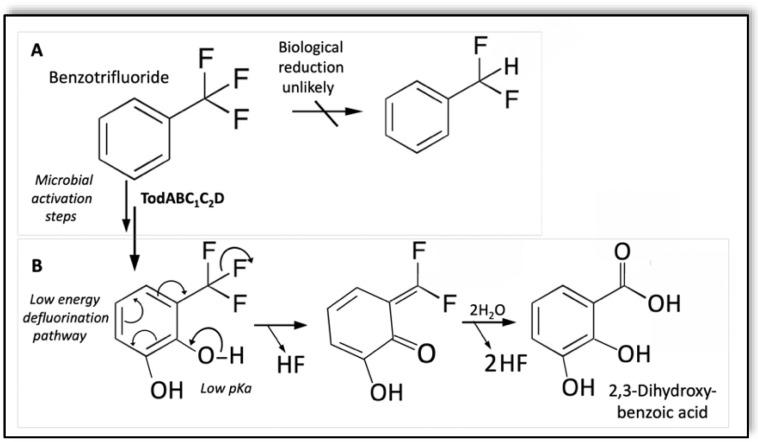
Many cite the strength of C-F bonds for the poor microbial biodegradability of polyfluorinated organic compounds (PFCs). However, commercial PFCs almost invariably contain more functionality than fluorine. The additional functionality provides a weak entry point for reactions that activate C-F bonds and lead to their eventual cleavage. This metabolic activation strategy is common in microbial biodegradation pathways and is observed with aromatic hydrocarbons, chlorinated compounds, phosphonates and many other compounds. Initial metabolic activation precedes critical bond breakage and assimilation of nutrients. A similar strategy with commercial PFCs proceeds via initial attack at the non-fluorinated functionalities: sulfonates, carboxylates, chlorines, phenyl rings, or phosphonates. Metabolic transformation of these non-fluorinated groups can activate the C-F bonds, allowing more facile cleavage than a direct attack on the C-F bonds. Given that virtually all compounds denoted as "PFAS" are not perfluorinated and are not alkanes, it is posited here that considering their individual chemical classes is more useful for both chemical and microbiological considerations of their fate.
许多人认为,碳氟键的强度导致了多氟有机化合物(PFCs)的微生物生物降解性较差。然而,商业用PFCs几乎总是含有比氟更多的官能团。这些额外的官能团为激活碳氟键并最终导致其断裂的反应提供了一个薄弱的切入点。这种代谢激活策略在微生物生物降解途径中很常见,在芳烃、氯化化合物、膦酸盐和许多其他化合物中也有观察到。初始代谢激活先于关键键的断裂和营养物质的同化。商业用PFCs的类似策略是通过首先攻击非氟化官能团进行的:磺酸盐、羧酸盐、氯、苯环或膦酸盐。这些非氟化基团的代谢转化可以激活碳氟键,使其比直接攻击碳氟键更容易断裂。鉴于几乎所有被称为“PFAS”的化合物都不是全氟化的,也不是烷烃,本文认为,考虑它们各自的化学类别对于从化学和微生物学角度考虑它们的归宿更有用。


 Zotero 插件