
氧化银纳米颗粒作为新一代抗菌化合物的候选物。
AgO Nanoparticles as a Candidate for Antimicrobial Compounds of the New Generation.
作者信息
Gudkov Sergey V, Serov Dmitriy A, Astashev Maxim E, Semenova Anastasia A, Lisitsyn Andrey B
机构信息
Prokhorov General Physics Institute of the Russian Academy of Sciences, 119991 Moscow, Russia.
V. M. Gorbatov Federal Research Center for Food Systems of Russian Academy of Sciences, 109316 Moscow, Russia.
出版信息
Pharmaceuticals (Basel). 2022 Aug 5;15(8):968. doi: 10.3390/ph15080968.
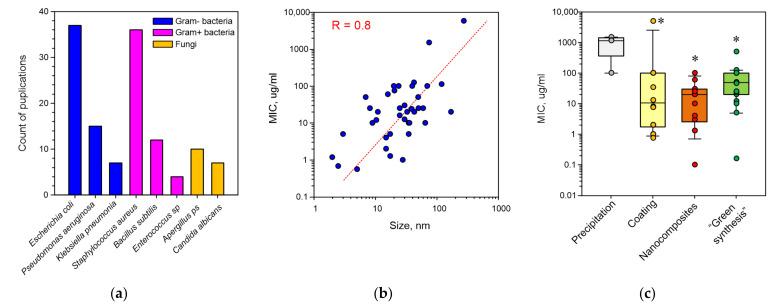
Antibiotic resistance in microorganisms is an important problem of modern medicine which can be solved by searching for antimicrobial preparations of the new generation. Nanoparticles (NPs) of metals and their oxides are the most promising candidates for the role of such preparations. In the last few years, the number of studies devoted to the antimicrobial properties of silver oxide NPs have been actively growing. Although the total number of such studies is still not very high, it is quickly increasing. Advantages of silver oxide NPs are the relative easiness of production, low cost, high antibacterial and antifungal activities and low cytotoxicity to eukaryotic cells. This review intends to provide readers with the latest information about the antimicrobial properties of silver oxide NPs: sensitive organisms, mechanisms of action on microorganisms and further prospects for improving the antimicrobial properties.
微生物中的抗生素耐药性是现代医学的一个重要问题,可通过寻找新一代抗菌制剂来解决。金属及其氧化物的纳米颗粒(NPs)是这类制剂最有前景的候选者。在过去几年中,致力于氧化银纳米颗粒抗菌特性的研究数量一直在积极增长。尽管这类研究的总数仍然不是很高,但正在迅速增加。氧化银纳米颗粒的优点包括生产相对容易、成本低、具有高抗菌和抗真菌活性以及对真核细胞的细胞毒性低。本综述旨在为读者提供有关氧化银纳米颗粒抗菌特性的最新信息:敏感生物、对微生物的作用机制以及改善抗菌特性的进一步前景。

 Zotero 插件