
水热合成法制备聚酰亚胺/TiO@MoS纳米纤维及其光催化性能
Design and Preparation of Polyimide/TiO@MoS Nanofibers by Hydrothermal Synthesis and Their Photocatalytic Performance.
作者信息
Chang Zhenjun, Sun Xiaoling, Liao Zhengzheng, Liu Qiang, Han Jie
机构信息
College of Materials Science and Engineering, Jiangsu University of Science and Technology, Zhenjiang 212003, China.
Polytex Engineering Group, Yangzhou 225000, China.
出版信息
Polymers (Basel). 2022 Aug 9;14(16):3230. doi: 10.3390/polym14163230.
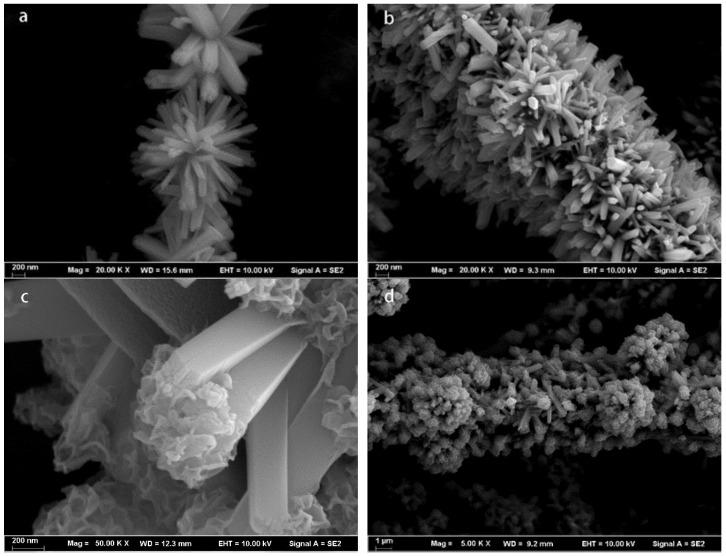
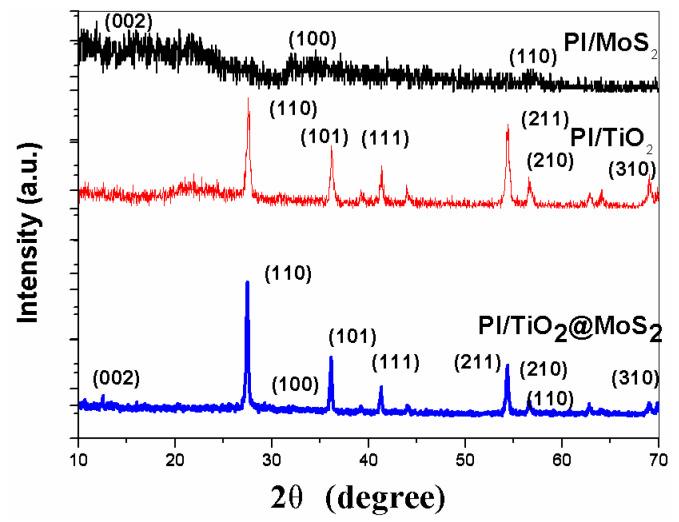
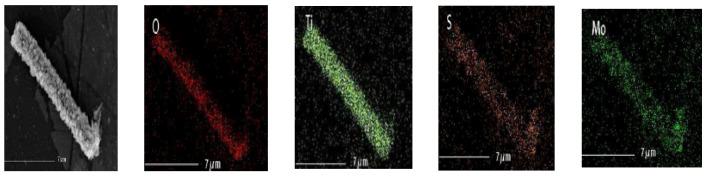
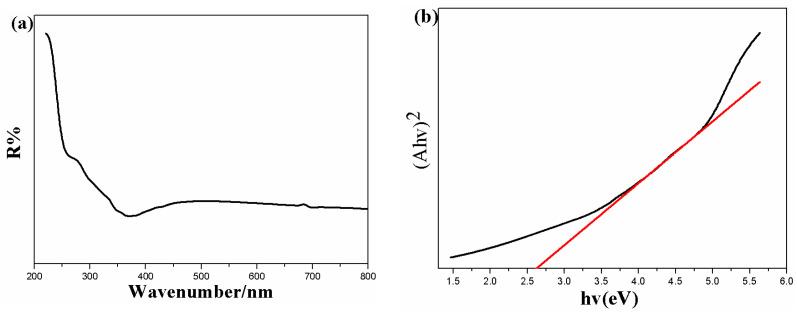
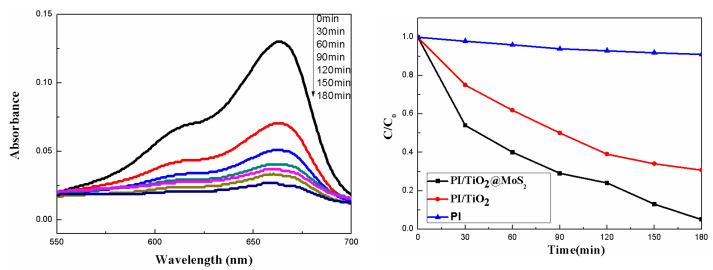
Organic-inorganic nanocomposite fibers can avoid the agglomeration of single nanoparticles and reduce the cost (nanoparticles assembled on the surface of nanofibers), but also can produce new chemical, electrical, optical, and other properties, with a composite synergistic effect. Aromatic polyimide (PI) is a high-performance polymer with a rigid heterocyclic imide ring and an aromatic benzene ring in its macromolecular framework. Due to its excellent mechanical properties, thermal stability, and easy-to-adjust molecular structure, PI has been widely used in electronics, aerospace, automotive, and other industries related to many applications. Here, we report that TiO nanorods were grown on polyimide nanofibers by hydrothermal reaction, and MoS nanosheets were grown on TiO nanorods the same way. Based on theoretical analysis and experimental findings, the possible growth mechanism was determined in detail. Further experiments showed that MoS nanosheets were uniformly coated on the surface of TiO nanorods. The TiO nanorods have photocatalytic activity in the ultraviolet region, but the bandgap of organic/inorganic layered nanocomposites can redshift to visible light and improve their photocatalytic performance.
有机-无机纳米复合纤维不仅可以避免单个纳米颗粒的团聚并降低成本(纳米颗粒组装在纳米纤维表面),还能产生新的化学、电学、光学等性能,具有复合协同效应。芳香族聚酰亚胺(PI)是一种高性能聚合物,其大分子骨架中含有刚性杂环酰亚胺环和芳香苯环。由于其优异的机械性能、热稳定性以及易于调节的分子结构,PI已广泛应用于电子、航空航天、汽车等众多相关行业。在此,我们报道通过水热反应在聚酰亚胺纳米纤维上生长TiO纳米棒,并以相同方式在TiO纳米棒上生长MoS纳米片。基于理论分析和实验结果,详细确定了可能的生长机制。进一步的实验表明,MoS纳米片均匀地包覆在TiO纳米棒表面。TiO纳米棒在紫外区域具有光催化活性,但有机/无机层状纳米复合材料的带隙可以红移至可见光区域并提高其光催化性能。




 Zotero 插件