
大学生对校园内接种新冠病毒疫苗、脑膜炎球菌结合疫苗和麻疹腮腺炎风疹疫苗的态度及疫苗接种推广策略前瞻性研究
Cross-Sectional Study of University Students' Attitudes to 'On Campus' Delivery of COVID-19, MenACWY and MMR Vaccines and Future-Proofing Vaccine Roll-Out Strategies.
作者信息
Webb Adam, Gogoi Mayuri, Weidman Sarah, Woolf Katherine, Zavala Maria, Ladhani Shamez N, Pareek Manish, Gies Lieve, Bayliss Christopher D
机构信息
Department of Genetics and Genome Biology, University of Leicester, Leicester LE1 7RH, UK.
Department of Respiratory Sciences, University of Leicester, Leicester LE1 9HN, UK.
出版信息
Vaccines (Basel). 2022 Aug 10;10(8):1287. doi: 10.3390/vaccines10081287.
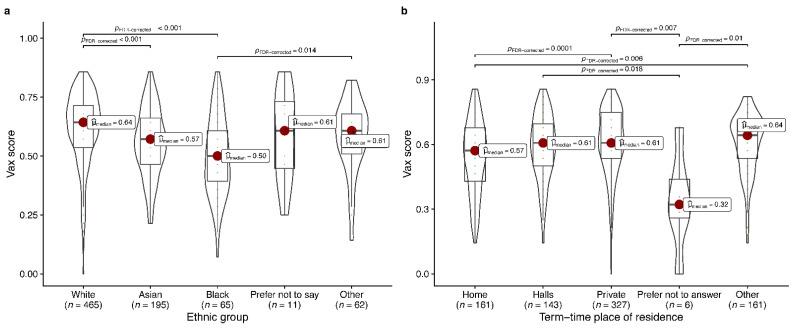
University students are a critical group for vaccination programmes against COVID-19, meningococcal disease (MenACWY) and measles, mumps and rubella (MMR). We aimed to evaluate risk factors for vaccine hesitancy and views about on-campus vaccine delivery among university students. Data were obtained through a cross-sectional anonymous online questionnaire study of undergraduate students in June 2021 and analysed by univariate and multivariate tests to detect associations. Complete data were obtained from 827 participants (7.6% response-rate). Self-reporting of COVID-19 vaccine status indicated uptake by two-thirds (64%; 527/827), willing for 23% (194/827), refusal by 5% (40/827) and uncertain results for 8% (66/827). Hesitancy for COVID-19 vaccines was 5% (40/761). COVID-19 vaccine hesitancy was associated with Black ethnicity (aOR, 7.01, 95% CI, 1.8-27.3) and concerns about vaccine side-effects (aOR, 1.72; 95% CI, 1.23-2.39). Uncertainty about vaccine status was frequently observed for MMR (11%) and MenACWY (26%) vaccines. Campus-associated COVID-19 vaccine campaigns were favoured by UK-based students (definitely, 45%; somewhat, 16%) and UK-based international students (definitely, 62%; somewhat, 12%). Limitations of this study were use of use of a cross-sectional approach, self-selection of the response cohort, slight biases in the demographics and a strict definition of vaccine hesitancy. Vaccine hesitancy and uncertainty about vaccine status are concerns for effective vaccine programmes. Extending capabilities of digital platforms for accessing vaccine information and sector-wide implementation of on-campus vaccine delivery are strategies for improving vaccine uptake among students. Future studies of vaccine hesitancy among students should aim to extend our observations to student populations in a wider range of university settings and with broader definitions of vaccine hesitancy.
大学生是新冠病毒疾病、脑膜炎球菌病(MenACWY)以及麻疹、腮腺炎和风疹(MMR)疫苗接种计划的关键群体。我们旨在评估大学生疫苗犹豫的风险因素以及他们对校园疫苗接种的看法。数据通过2021年6月对本科生进行的横断面匿名在线问卷调查获得,并通过单变量和多变量测试进行分析以检测关联。从827名参与者(回复率7.6%)获得了完整数据。自我报告的新冠病毒疫苗接种状况显示,三分之二(64%;527/827)的人接种了疫苗,23%(194/827)愿意接种,5%(40/827)拒绝接种,8%(66/827)结果不确定。对新冠病毒疫苗的犹豫率为5%(40/761)。新冠病毒疫苗犹豫与黑人种族(调整后比值比,7.01,95%置信区间,1.8 - 27.3)以及对疫苗副作用的担忧(调整后比值比,1.72;95%置信区间,1.23 - 2.39)相关。对于MMR疫苗(11%)和MenACWY疫苗(26%),疫苗接种状况的不确定性经常被观察到。英国本土学生(肯定会,45%;有点会,16%)和英国国际学生(肯定会,62%;有点会,12%)支持与校园相关的新冠病毒疫苗接种活动。本研究的局限性在于采用横断面方法、回复队列的自我选择、人口统计学上的轻微偏差以及对疫苗犹豫的严格定义。疫苗犹豫和疫苗接种状况的不确定性是有效疫苗计划的关注点。扩展数字平台获取疫苗信息的能力以及在全部门实施校园疫苗接种是提高学生疫苗接种率的策略。未来关于学生疫苗犹豫的研究应旨在将我们的观察结果扩展到更广泛大学环境中的学生群体,并采用更宽泛的疫苗犹豫定义。
 Zotero 插件