
ABBV-383 是一种 B 细胞成熟抗原 × CD3 双特异性 T 细胞重定向抗体,在复发/难治性多发性骨髓瘤患者中开展的 I 期首次人体研究。
A Phase I First-in-Human Study of ABBV-383, a B-Cell Maturation Antigen × CD3 Bispecific T-Cell Redirecting Antibody, in Patients With Relapsed/Refractory Multiple Myeloma.
机构信息
Division of Hematology/Oncology, Department of Medicine, Medical College of Wisconsin, Milwaukee, WI.
Division of Hematology and Oncology, University of California, San Francisco, San Francisco, CA.
出版信息
J Clin Oncol. 2022 Nov 1;40(31):3576-3586. doi: 10.1200/JCO.22.01504. Epub 2022 Aug 27.
PURPOSE
ABBV-383, a B-cell maturation antigen × CD3 T-cell engaging bispecific antibody, has demonstrated promising results in an ongoing first-in-human phase I study (ClinicalTrials.gov identifier: NCT03933735) in patients with relapsed/refractory multiple myeloma (RRMM). Herein, we report safety and efficacy outcomes of this phase I dose escalation/expansion study.
METHODS
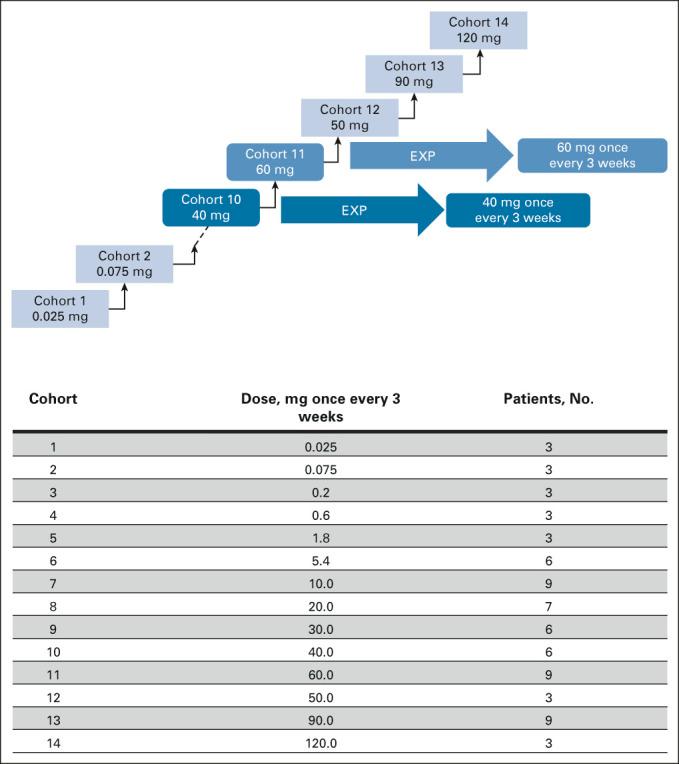
Patients with RRMM (≥ three prior lines including a proteasome inhibitor, an immunomodulatory drug, and an anti-CD38 monoclonal antibody) were eligible. ABBV-383 was administered intravenously over 1-2 hours once every 3 weeks, without any step dosing. A 3 + 3 design with backfilling for dose escalation was used (intrapatient escalation to highest safe dose permitted) followed by initiation of dose expansion.
RESULTS
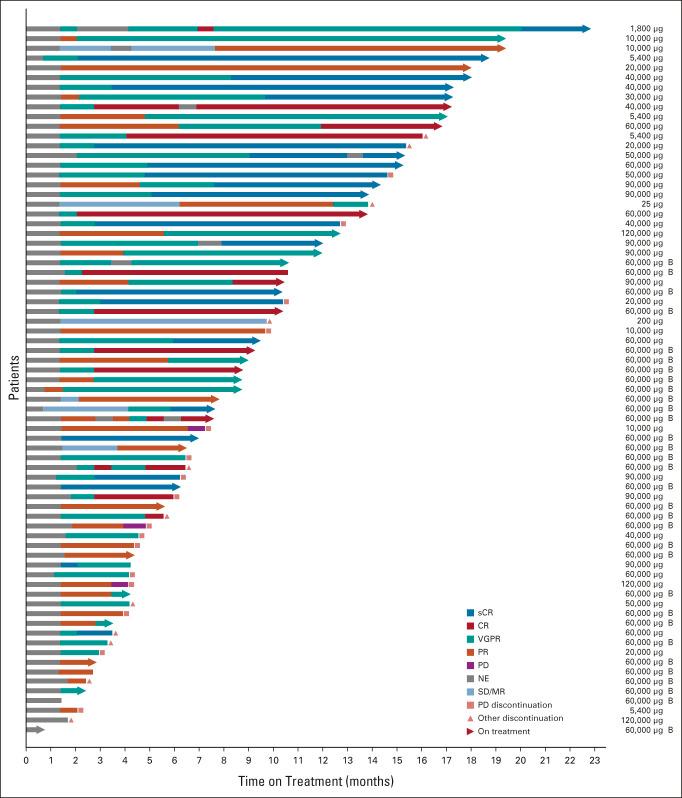
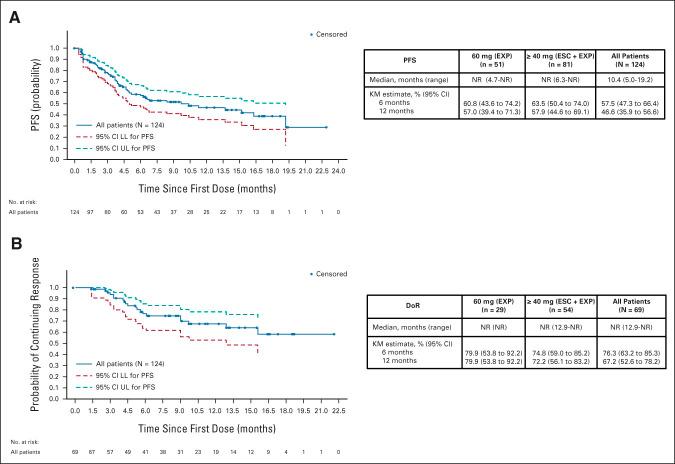
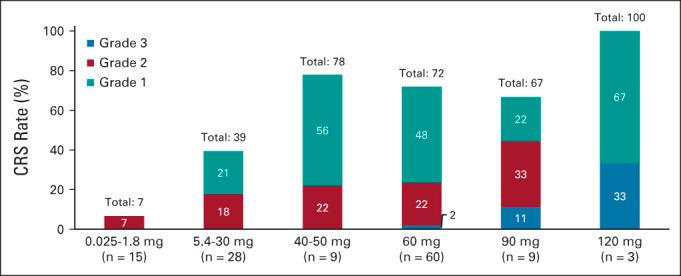
As of January 8, 2022, 124 patients (dose escalation [0.025-120 mg], n = 73; dose expansion [60 mg], n = 51) have received ABBV-383; median age was 68 years (range, 35-92 years). The most common hematologic treatment-emergent adverse events (TEAEs) were neutropenia (all grades: 37%) and anemia (29%). The most common nonhematologic TEAEs were cytokine release syndrome (57%) and fatigue (30%). Seven deaths from TEAEs were reported with all considered unrelated to study drug by the investigator. For all efficacy-evaluable patients (n = 122; all doses), the objective response rate (ORR) was 57% and very good partial response (VGPR) or better (≥ VGPR) rate was 43%. In the 60 mg dose expansion cohort (n = 49), the ORR and ≥ VGPR rates were 59% and 39%, respectively; and in the ≥ 40 mg dose escalation plus dose expansion cohorts (n = 79) were 68% and 54%, respectively.
CONCLUSION
ABBV-383 in patients with RRMM was well tolerated with an ORR of 68% at doses ≥ 40 mg. This novel therapy's promising preliminary antitumor activity in heavily pretreated patients warrants further clinical evaluation.
目的
BBV-383 是一种 B 细胞成熟抗原 × CD3 T 细胞双特异性抗体,在复发/难治性多发性骨髓瘤(RRMM)患者中进行的一项正在进行的首次人体 I 期研究(ClinicalTrials.gov 标识符:NCT03933735)中显示出良好的结果。在此,我们报告这项 I 期剂量递增/扩展研究的安全性和疗效结果。
方法
RRMM 患者(既往接受过≥3 线治疗,包括蛋白酶体抑制剂、免疫调节剂和抗 CD38 单克隆抗体)符合条件。ABBV-383 每 3 周静脉输注一次,每次 1-2 小时,无需分步给药。采用 3+3 设计,带有回补的剂量递增(允许每个患者递增至最高安全剂量),然后开始剂量扩展。
结果
截至 2022 年 1 月 8 日,124 名患者(剂量递增[0.025-120mg],n=73;剂量扩展[60mg],n=51)接受了 ABBV-383 治疗;中位年龄为 68 岁(范围,35-92 岁)。最常见的血液学治疗相关不良事件(TEAEs)为中性粒细胞减少症(所有级别:37%)和贫血症(29%)。最常见的非血液学 TEAEs 为细胞因子释放综合征(57%)和疲劳(30%)。7 例因 TEAEs 导致的死亡,研究者均认为与研究药物无关。所有可评估疗效的患者(n=122;所有剂量)的客观缓解率(ORR)为 57%,非常好的部分缓解(VGPR)或更好(≥VGPR)率为 43%。在 60mg 剂量扩展队列(n=49)中,ORR 和≥VGPR 率分别为 59%和 39%;在≥40mg 剂量递增加剂量扩展队列(n=79)中,ORR 和≥VGPR 率分别为 68%和 54%。
结论
ABBV-383 在 RRMM 患者中耐受性良好,≥40mg 剂量的 ORR 为 68%。这种新型治疗药物在既往接受过大量治疗的患者中具有有前景的初步抗肿瘤活性,值得进一步临床评估。
 Zotero 插件