
类器官作为研究胃肠道线虫发育和宿主相互作用的工具。
Organoids as tools to investigate gastrointestinal nematode development and host interactions.
机构信息
Institute of Immunology & Infection Research, School of Biological Sciences, University of Edinburgh, Edinburgh, United Kingdom.
Cambridge Institute of Therapeutic Immunology and Infectious Disease, University of Cambridge, Cambridge, United Kingdom.
出版信息
Front Cell Infect Microbiol. 2022 Aug 12;12:976017. doi: 10.3389/fcimb.2022.976017. eCollection 2022.
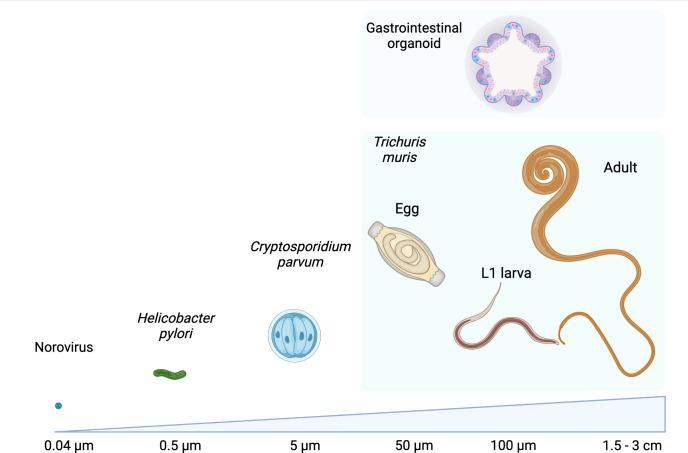
Gastrointestinal nematodes are a diverse class of pathogens that colonise a quarter of the world's human population and nearly all grazing livestock. These macroparasites establish, and some migrate, within host gastrointestinal niches during their life cycles and release molecules that condition the host mucosa to enable chronic infections. Understanding how helminths do this, and defining the molecules and mechanisms involved in host modulation, holds promise for novel strategies of anthelmintics and vaccines, as well as new knowledge of immune regulation and tissue repair. Yet the size and complexity of these multicellular parasites, coupled with the reliance on hosts to maintain their life cycles, present obstacles to interrogate how they interact with the gastric and intestinal epithelium, stroma and immune cells during infection, and also to develop protocols to genetically modify these parasites. Gastrointestinal organoids have transformed research on gastric and gut physiology during homeostasis and disease, including investigations on host-pathogen interactions with viruses, bacteria, protozoa and more recently, parasitic nematodes. Here we outline applications and important considerations for the best use of organoids to study gastrointestinal nematode development and interactions with their hosts. The careful use of different organoid culture configurations in order to achieve a closer replication of the infection context will lead not only to new knowledge on gastrointestinal nematode infection biology, but also towards the replication of their life cycles , and the development of valuable experimental tools such as genetically modified parasites.
胃肠道线虫是一类多样化的病原体,它们寄生在世界四分之一的人口和几乎所有放牧家畜中。这些大型寄生虫在生命周期中在宿主胃肠道小生境中定居,有些则迁移,并释放出调节宿主黏膜的分子,从而使慢性感染得以维持。了解寄生虫如何做到这一点,以及确定宿主调节中涉及的分子和机制,有望为驱虫药和疫苗提供新的策略,以及对免疫调节和组织修复的新认识。然而,这些多细胞寄生虫的大小和复杂性,加上对宿主维持其生命周期的依赖,给研究它们在感染过程中与胃和肠道上皮、基质和免疫细胞的相互作用带来了障碍,也阻碍了开发用于遗传修饰这些寄生虫的方案。胃肠道类器官改变了对胃和肠道生理学在稳态和疾病中的研究,包括对宿主-病原体与病毒、细菌、原生动物以及最近的寄生线虫相互作用的研究。在这里,我们概述了类器官在研究胃肠道线虫发育和与宿主相互作用方面的应用和最佳使用的重要考虑因素。为了更接近地复制感染环境,仔细使用不同的类器官培养配置不仅将导致对胃肠道线虫感染生物学的新知识,而且还将导致对其生命周期的复制,并开发出有价值的实验工具,如遗传修饰寄生虫。
 Zotero 插件