
衰老的新标志:2022 年哥本哈根衰老会议总结。
New hallmarks of ageing: a 2022 Copenhagen ageing meeting summary.
机构信息
Department of Clinical Molecular Biology, University of Oslo and Akershus University Hospital, Lørenskog 1478, Norway.
Jagiellonian Centre for Experimental Therapeutics (JCET), Jagiellonian University, Krakow 30-348, Poland.
出版信息
Aging (Albany NY). 2022 Aug 29;14(16):6829-6839. doi: 10.18632/aging.204248.
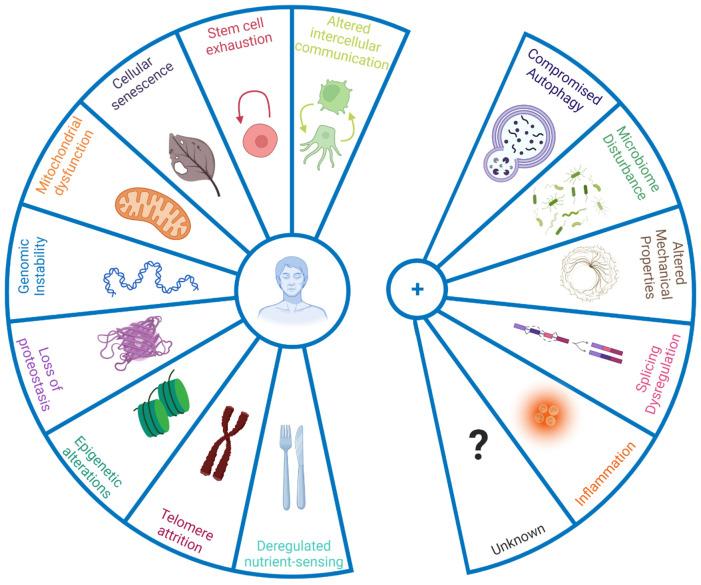
Genomic instability, telomere attrition, epigenetic alterations, mitochondrial dysfunction, loss of proteostasis, deregulated nutrient-sensing, cellular senescence, stem cell exhaustion, and altered intercellular communication were the original nine hallmarks of ageing proposed by López-Otín and colleagues in 2013. The proposal of these hallmarks of ageing has been instrumental in guiding and pushing forward research on the biology of ageing. In the nearly past 10 years, our in-depth exploration on ageing research has enabled us to formulate new hallmarks of ageing which are compromised autophagy, microbiome disturbance, altered mechanical properties, splicing dysregulation, and inflammation, among other emerging ones. Amalgamation of the 'old' and 'new' hallmarks of ageing may provide a more comprehensive explanation of ageing and age-related diseases, shedding light on interventional and therapeutic studies to achieve healthy, happy, and productive lives in the elderly.
基因组不稳定性、端粒磨损、表观遗传改变、线粒体功能障碍、蛋白质稳态丧失、营养感应失调、细胞衰老、干细胞衰竭和细胞间通讯失调是 López-Otín 和同事在 2013 年提出的最初的九大衰老标志。这些衰老标志的提出对于指导和推动衰老生物学的研究起到了重要作用。在过去的近 10 年中,我们对衰老研究的深入探索使我们能够制定新的衰老标志,包括自噬受损、微生物组紊乱、机械性能改变、剪接失调和炎症等新兴标志。将“旧”和“新”的衰老标志结合起来,可能会对衰老和与年龄相关的疾病提供更全面的解释,为干预和治疗研究提供线索,以实现老年人健康、快乐和富有成效的生活。

 Zotero 插件