
病例报告:一名携带杂合致病性基因变异c.898C>T和22q11.2远端微缺失的中国女性患者。
Case Report: Chinese female patients with a heterozygous pathogenic gene variant c.898C>T and distal 22q11.2 microdeletion.
作者信息
Cong Yan, Jin Hongxing, Wu Ke, Wang Hao, Wang Dong
机构信息
Rehabilitation Department, Yiwu Maternity and Child Health Care Hospital, Yiwu, China.
Pediatric Department, Yiwu Maternity and Child Health Care Hospital, Yiwu, China.
出版信息
Front Genet. 2022 Aug 15;13:900226. doi: 10.3389/fgene.2022.900226. eCollection 2022.
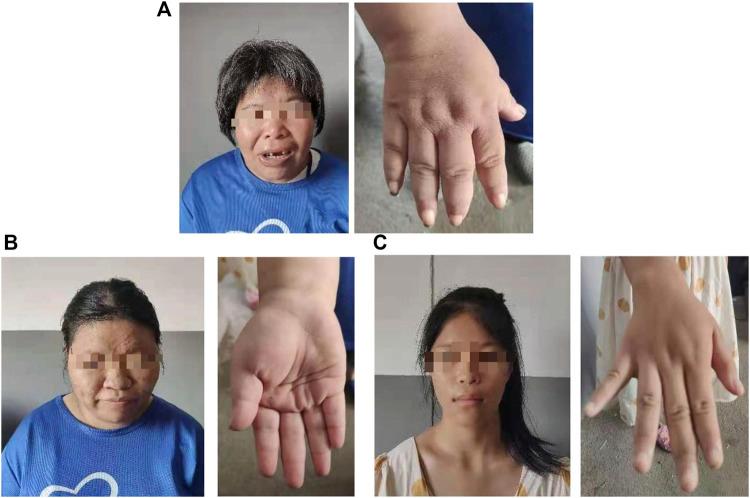
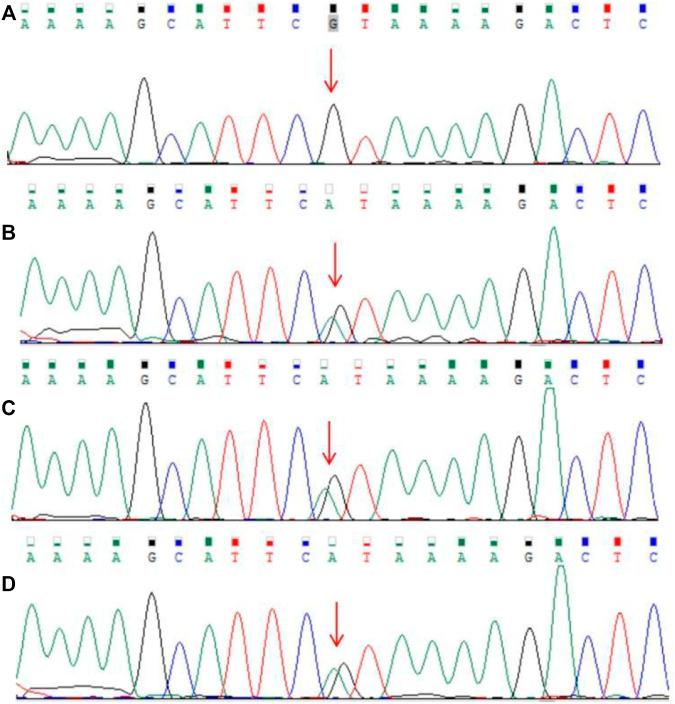
Coffin-Lowry syndrome (CLS) [OMIM#303600] is a rare X-linked dominant syndrome. CLS is caused by highly heterogeneous loss-of-function mutations in the gene (OMIM*300,075). CLS is characterized by intellectual disability (ID), short stature, tapered fingers, characteristic facial features, and progressive skeletal changes. Distal 22q11.2 microdeletion syndrome (OMIM#611867) is an autosomal dominant and recurrent genomic disorder. It mainly includes three types [distal type I (D-E/F), type II (E-F), and type III (F-G)] and exhibits variable clinical phenotypes (mild, moderate, or even normal): preterm birth, pre- and/or postnatal growth restriction, development delay, ID, behavioral problems, cardiovascular defects, skeletal anomalies, and dysmorphic facial features. We investigated the genetic etiology of a Chinese pedigree with ID, short stature, digit abnormalities, facial dysmorphism, and menstrual disorder. A heterozygous gene variant c.898C>T (p.R300X) was identified in this familial case. Two female CLS patients with distal 22q11.2 microdeletion presented with more severe clinical phenotypes. We provided clinical characteristics of these Chinese female CLS patients. We described a Chinese family with three affected females (the mother, the elder sister, and the proband). The mother and the elder sister had more severe clinical phenotypes (moderate facial dysmorphism, more severe cognitive impairment, and shorter stature). The common characteristic phenotypes are ID, short stature, facial dysmorphism, irregular menstruation, and cardiovascular disorders. Peripheral blood samples were collected from the pedigree. Whole-exome sequencing (WES) identified a heterozygous nonsense gene variant c.898C>T (p.R300X). It was verified by Sanger sequencing. Copy number variation sequencing (CNV-seq) showed that both the mother and the elder sister carried a CNVseq [hg19] del (22) (q11.22-q11.23) (22997582-23637176)×0.5. RNA from peripheral blood samples was used for measuring the relative quantification of mRNA (expressed by exon 14 of ). The levels of mRNA relative expressions were significantly lower in the mother's and the elder sister's blood samples. The levels of mRNA relative expressions were significantly higher in the proband's blood sample. X-chromosome inactivation (XCI) studies demonstrated that the proband showed extremely skewed XCI, and the XCI pattern of the elder sister was random. Herein, we reported three Chinese female patients with a heterozygous nonsense gene variant c.898C>T. Further genetic studies were performed. To our knowledge, Chinese patients with this variant have not been previously reported in the literature. The three female patients presented with variable degrees of severity. The clinical characteristics of these Chinese female CLS patients could expand the phenotypic spectrum of CLS. We helped physicians to understand the genotype-phenotype correlation further.
科芬-洛里综合征(CLS)[OMIM#303600]是一种罕见的X连锁显性综合征。CLS由基因(OMIM*300,075)中高度异质性的功能丧失突变引起。CLS的特征为智力残疾(ID)、身材矮小、手指变细、特征性面部特征和进行性骨骼改变。22q11.2远端微缺失综合征(OMIM#611867)是一种常染色体显性且复发性基因组疾病。它主要包括三种类型[I型远端(D-E/F)、II型(E-F)和III型(F-G)],并表现出可变的临床表型(轻度、中度甚至正常):早产、产前和/或产后生长受限、发育迟缓、ID、行为问题、心血管缺陷、骨骼异常和面部畸形特征。我们调查了一个具有ID、身材矮小、手指异常、面部畸形和月经紊乱的中国家系的遗传病因。在这个家族病例中鉴定出一个杂合基因变异c.898C>T(p.R300X)。两名患有22q11.2远端微缺失的女性CLS患者表现出更严重的临床表型。我们提供了这些中国女性CLS患者的临床特征。我们描述了一个有三名患病女性(母亲、姐姐和先证者)的中国家系。母亲和姐姐有更严重的临床表型(中度面部畸形、更严重的认知障碍和更矮的身材)。常见的特征性表型为ID、身材矮小、面部畸形、月经不调和心血管疾病。从该家系采集了外周血样本。全外显子测序(WES)鉴定出一个杂合无义基因变异c.898C>T(p.R300X)。通过桑格测序进行了验证。拷贝数变异测序(CNV-seq)显示母亲和姐姐均携带一个CNVseq [hg19] del(22)(q11.22-q11.23)(22997582-23637176)×0.5。来自外周血样本的RNA用于测量mRNA的相对定量(由的外显子14表示)。母亲和姐姐的血样本中mRNA相对表达水平显著更低。先证者的血样本中mRNA相对表达水平显著更高。X染色体失活(XCI)研究表明先证者表现出极度偏态的XCI,而姐姐的XCI模式是随机的。在此,我们报告了三名携带杂合无义基因变异c.898C>T的中国女性患者。进行了进一步的遗传学研究。据我们所知,此前文献中尚未报道过携带此变异的中国患者。这三名女性患者表现出不同程度的严重程度。这些中国女性CLS患者的临床特征可扩展CLS的表型谱。我们帮助医生进一步了解基因型-表型相关性。





 Zotero 插件