
黎巴嫩人群对心血管疾病的知识、态度和实践。
Knowledge, Attitude, and Practice Toward Cardiovascular Diseases in the Lebanese Population.
机构信息
Faculty of Medical Sciences, Lebanese University, Hadath, Lebanon.
Beirut Cardiac Institute, Al-Rassoul Al-Aazam Hospital, Beirut, Lebanon.
出版信息
Glob Heart. 2022 Jul 29;17(1):47. doi: 10.5334/gh.1138. eCollection 2022.
BACKGROUND & OBJECTIVE: Cardiovascular diseases (CVD) are the leading cause of death globally. Assessing CVD knowledge, attitude, and practice (KAP) is necessary to spread awareness about CVD in Lebanon, their corresponding risk factors, and behaviors in which individuals can avoid or minimize the possibility of developing a CVD.
SUBJECTS & METHODS: This was a case-control analytical study that targeted 921 CVD and non-CVD subjects. A questionnaire form was used to collect data related to patients' demographics, socioeconomic status, habits, medical and family history, KAP towards CVD, and source of information. Data was analyzed using SPSS v.25.
RESULTS
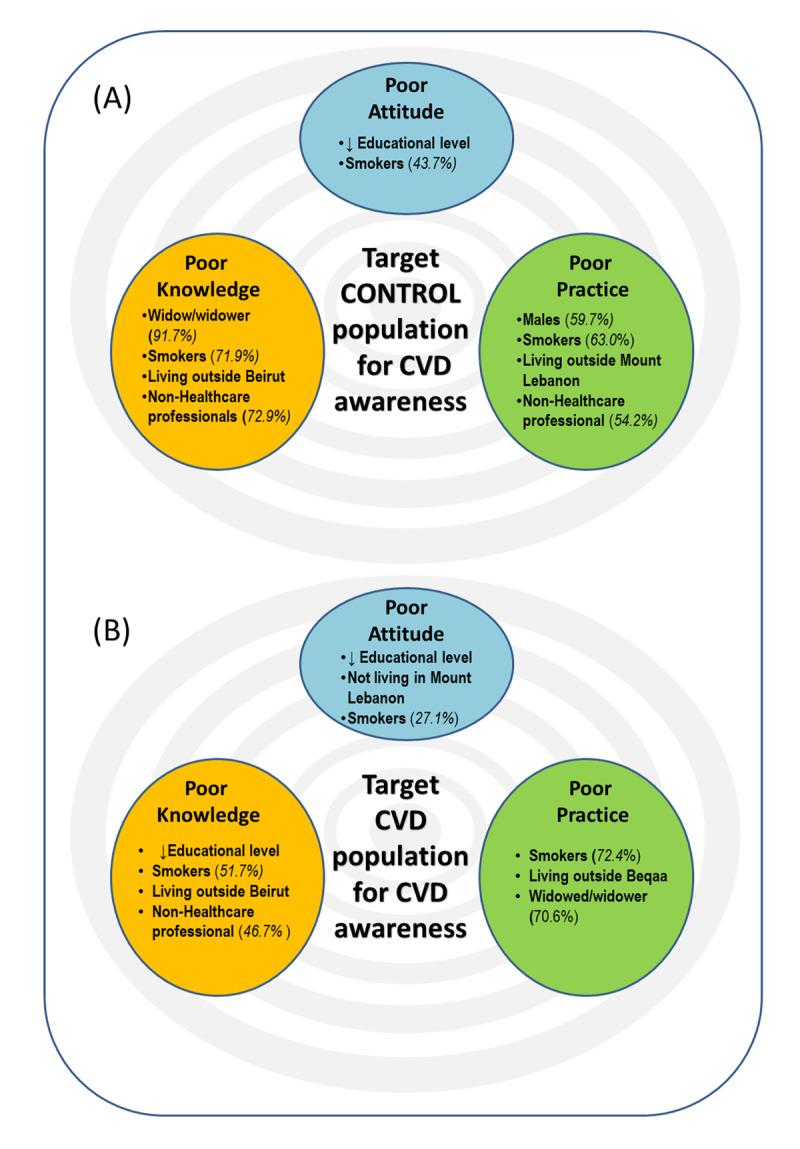
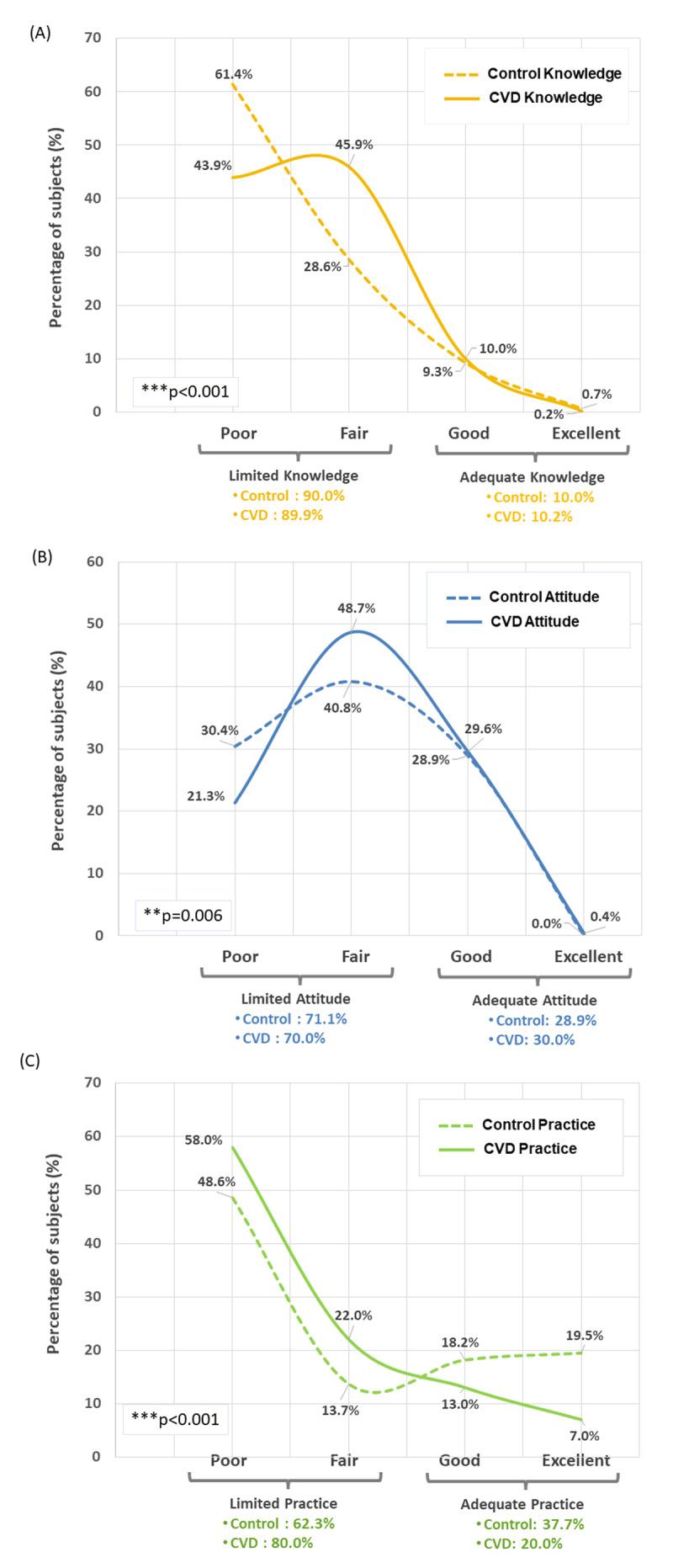
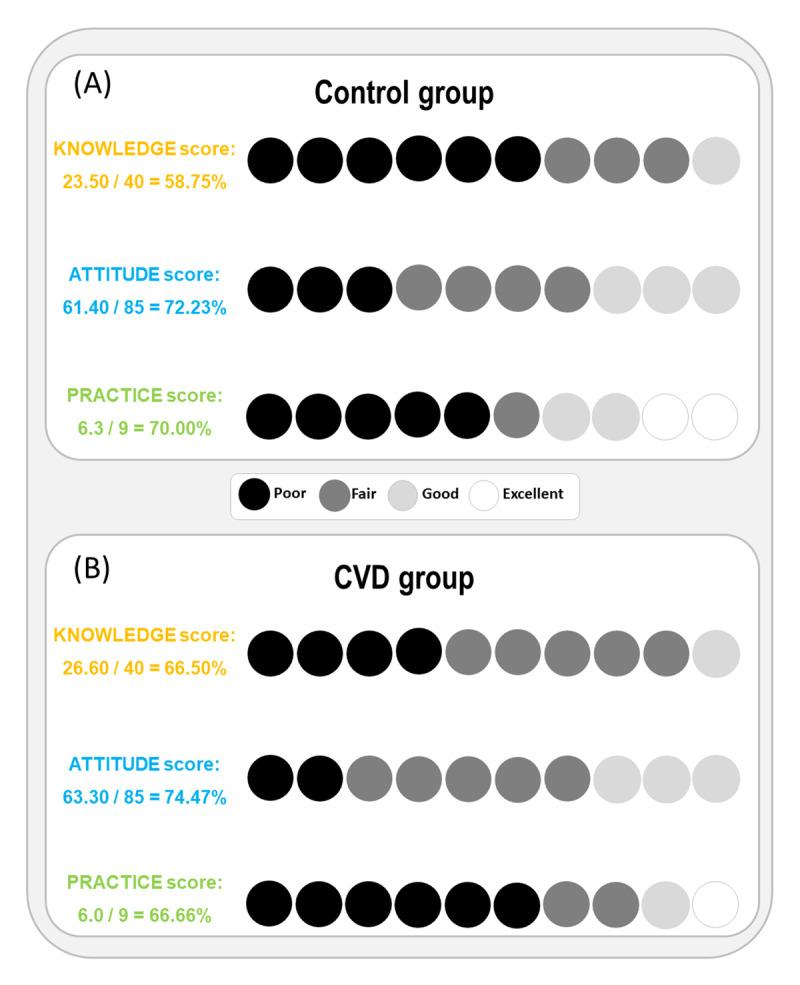
Data from 921 participants were distributed over the CVD group (52.6% males aged 58.3 ± 13.7 years [n = 460]) and the non-CVD group (47.7% males aged 36.3 ± 15.4 years [n = 461]). CVD patients were significantly older than non-CVD subjects (p < 0.001). All three KAP scores of both groups were of poor to fair levels. Both CVD knowledge and attitude mean scores in CVD patients (26.6 ± 5.2 over 40 [66.50%] and 63.3 ± 10.2 over 85 [74.47%], respectively) were significantly higher than the ones of non-CVD subjects (23.5 ± 7.9 over 40 [58.75%] and 61.4 ± 12.4 over 85 [72.74%], respectively, p < 0.001). However, the CVD mean practice score was significantly lower in CVD patients (6.0 ± 1.7 over 9 [66.67%]) than the one of non-CVD subjects (6.3 ± 2.2 over 9 [70.00%] p < 0.001). Mostly, educational level (p < 0.001), governorate (p < 0.01), and smoking (p < 0.001) were predictors of KAP CVD in both groups.
CONCLUSION
With an overall limited knowledge, attitude, and practice toward CVDs, the Lebanese population (with CVD or non-CVD) needs targeted national campaigns about CVD according to the identified predictors of CVD KAP to prevent and to alleviate the complications due to CVDs.
背景与目的
心血管疾病(CVD)是全球范围内的主要死亡原因。评估心血管疾病知识、态度和实践(KAP)对于在黎巴嫩传播心血管疾病及其相关风险因素的认识、以及个人可以避免或最小化患心血管疾病的可能性的行为至关重要。
对象与方法
这是一项病例对照分析研究,共纳入了 921 例心血管疾病患者和非心血管疾病患者。采用问卷形式收集了与患者人口统计学、社会经济状况、习惯、医疗和家族史、心血管疾病 KAP 以及信息来源相关的数据。数据使用 SPSS v.25 进行分析。
结果
921 名参与者的数据分布在心血管疾病组(52.6%的男性,年龄 58.3 ± 13.7 岁[n=460])和非心血管疾病组(47.7%的男性,年龄 36.3 ± 15.4 岁[n=461])。心血管疾病患者明显比非心血管疾病患者年龄更大(p<0.001)。两组的三个 KAP 评分均处于较差至一般水平。心血管疾病患者的心血管疾病知识和态度平均得分(40 分中得分为 26.6 ± 5.2[66.50%]和 85 分中得分为 63.3 ± 10.2[74.47%])明显高于非心血管疾病患者(40 分中得分为 23.5 ± 7.9[58.75%]和 85 分中得分为 61.4 ± 12.4[72.74%],p<0.001)。然而,心血管疾病患者的心血管疾病实践平均得分(9 分中得分为 6.0 ± 1.7[66.67%])明显低于非心血管疾病患者(9 分中得分为 6.3 ± 2.2[70.00%],p<0.001)。受教育程度(p<0.001)、省(p<0.01)和吸烟(p<0.001)是两组患者心血管疾病 KAP 的预测因素。
结论
黎巴嫩人群(有或无心血管疾病)对心血管疾病的总体知识、态度和实践有限,需要根据心血管疾病 KAP 的确定预测因素,开展有针对性的全国性运动,以预防和缓解心血管疾病的并发症。
 Zotero 插件