
不同心理干预措施对新冠疫情期间老年人自我报告的痛苦、抑郁和孤独感变化的影响。
Effect of distinct psychological interventions on changes in self-reported distress, depression and loneliness among older adults during COVID-19.
作者信息
Shapira Stav, Yeshua-Katz Daphna, Sarid Orly
机构信息
School of Public Health, Ben-Gurion University of the Negev, Beer Sheva 8410501, Israel.
The Spitzer Department of Social Work, Ben-Gurion University of the Negev, Beer Sheva 8410501, Israel.
出版信息
World J Psychiatry. 2022 Jul 19;12(7):970-981. doi: 10.5498/wjp.v12.i7.970.
BACKGROUND
Older adults have been considered a primary at-risk population during the coronavirus disease 2019 (COVID-19) pandemic, and many efforts have been and still are directed toward supporting them and enhancing their capacity to cope with the pandemic. Evidence shows that by enhancing proactive coping abilities through psychological interventions, in which cognitive-behavioral and mindfulness techniques are taught and practiced effectively, these interventions have supported older adults throughout the pandemic. However, the underlying mechanisms by which specific intervention components affect various mental states such as distress, depression and loneliness among older adults remain unclear and warrant investigation.
AIM
To determine the effect of an intervention using cognitive-behavioral and mindfulness techniques on changes in distress, depression and loneliness.
METHODS
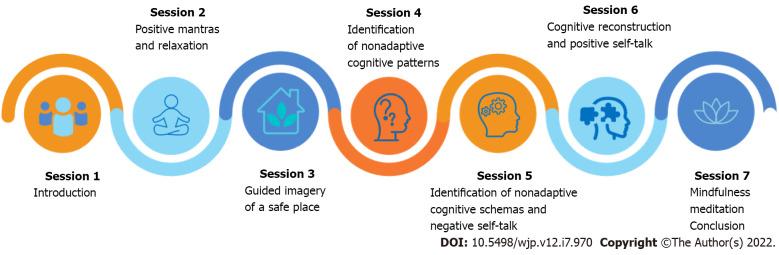
We performed a secondary analysis on data from a previous study in which community-dwelling older adults attended a short-term, internet-based intervention during the first COVID-19 wave in Israel. The intervention included seven sessions during which various cognitive-behavioral and mindfulness techniques were learned and practiced. In-session changes in psychological distress were measured using the Subjective Units of Distress Scale (SUDS), which participants rated at the beginning and end of each session. Participants also filled out questionnaires that evaluated levels of depression [Patient Health Ques-tionnaire (PHQ-9)] and loneliness (UCLA loneliness Scale) prior to and after the entire intervention process. The effect of in-session changes in the SUDS on changes in post-intervention depression and loneliness levels were assessed, as a proxy for distinct technique effectiveness.
RESULTS
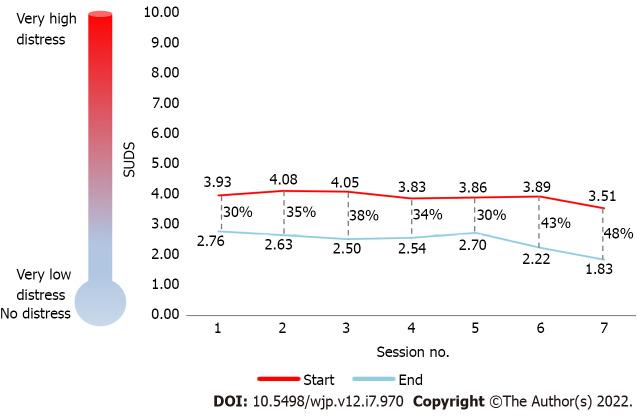
The findings indicated in-session differences in terms of a decrease in psychological distress (SUDS). Sessions that included relaxation exercises and guided imagery, as well as sessions that included cognitive restructuring and mindfulness meditation, demonstrated the largest decreases in in-session psychological distress (≥ 35%). Two multivariate regression models, one for levels of post-intervention depression (PHQ-9 score) and the other for levels of post-intervention loneliness (UCLA loneliness score), were fitted. The results revealed two statistically significant explanatory variables for depression: The SUDS difference for sessions in which cognitive restructuring and mindfulness meditation were practiced, beta = -0.25, 95%CI: -1.23 to -0.1, and the pre-intervention level of depression, beta = 0.62, 95%CI: 0.37-0.75. The second model for loneliness revealed only one significant explanatory variable: The SUDS difference for sessions in which relaxation and guided imagery were practiced, beta = 0.41, 95%CI: 0.14-0.65.
CONCLUSION
Different psychological techniques seem to have different effects on distress, loneliness and depression. Understanding the pathways by which distinct techniques affect negative mental symptoms has implications for future intervention design.
背景
在2019冠状病毒病(COVID-19)大流行期间,老年人被视为主要的高危人群,并且已经并仍在做出许多努力来支持他们并增强他们应对大流行的能力。有证据表明,通过心理干预提高积极应对能力,其中有效教授和实践认知行为和正念技巧,这些干预在整个大流行期间都为老年人提供了支持。然而,特定干预成分影响老年人各种心理状态(如痛苦、抑郁和孤独)的潜在机制仍不清楚,值得研究。
目的
确定使用认知行为和正念技巧的干预对痛苦、抑郁和孤独变化的影响。
方法
我们对之前一项研究的数据进行了二次分析,在该研究中,以色列社区居住的老年人在COVID-19第一波疫情期间参加了一项基于互联网的短期干预。该干预包括七个环节,在此期间学习和实践了各种认知行为和正念技巧。使用痛苦主观单位量表(SUDS)测量各环节中心理痛苦的变化,参与者在每个环节开始和结束时进行评分。参与者还填写了问卷,评估整个干预过程前后的抑郁水平[患者健康问卷(PHQ-9)]和孤独水平(加州大学洛杉矶分校孤独量表)。评估各环节中SUDS的变化对干预后抑郁和孤独水平变化的影响,以此作为不同技巧有效性的代表。
结果
研究结果表明,各环节中心理痛苦(SUDS)有所下降。包括放松练习和引导式意象的环节,以及包括认知重构和正念冥想的环节,在各环节中心理痛苦下降幅度最大(≥35%)。建立了两个多元回归模型,一个用于干预后抑郁水平(PHQ-9评分),另一个用于干预后孤独水平(加州大学洛杉矶分校孤独评分)。结果显示抑郁有两个具有统计学意义的解释变量:进行认知重构和正念冥想的环节中SUDS的差异,β=-0.25,95%CI:-1.23至-0.1,以及干预前的抑郁水平,β=0.62,95%CI:0.37-0.7。第二个关于孤独的模型仅显示一个显著的解释变量:进行放松和引导式意象的环节中SUDS的差异,β=0.41,95%CI:0.14-0.65。
结论
不同的心理技巧似乎对痛苦、孤独和抑郁有不同的影响。了解不同技巧影响负面心理症状的途径对未来的干预设计具有重要意义。
 Zotero 插件