
黑人和白人女性代谢组学特征的差异与冠心病风险:四项美国队列女性的观察性研究。
Differences in Metabolomic Profiles Between Black and White Women and Risk of Coronary Heart Disease: an Observational Study of Women From Four US Cohorts.
机构信息
Division of Women's Health (J.H., M.C.J., K.M.R.), Harvard Medical School, Boston, MA.
Department of Epidemiology (J.H., M.C.J., J.L., Q.S., E.B.R., A.H.E.), Harvard T.H. Chan School of Public Health, Boston, MA.
出版信息
Circ Res. 2022 Sep 16;131(7):601-615. doi: 10.1161/CIRCRESAHA.121.320134. Epub 2022 Sep 2.
BACKGROUND
Racial differences in metabolomic profiles may reflect underlying differences in social determinants of health by self-reported race and may be related to racial disparities in coronary heart disease (CHD) among women in the United States. However, the magnitude of differences in metabolomic profiles between Black and White women in the United States has not been well-described. It also remains unknown whether such differences are related to differences in CHD risk.
METHODS
Plasma metabolomic profiles were analyzed using liquid chromatography-tandem mass spectrometry in the WHI-OS (Women's Health Initiative-Observational Study; 138 Black and 696 White women), WHI-HT trials (WHI-Hormone Therapy; 156 Black and 1138 White women), MESA (Multi-Ethnic Study of Atherosclerosis; 114 Black and 219 White women), JHS (Jackson Heart Study; 1465 Black women with 107 incident CHD cases), and NHS (Nurses' Health Study; 2506 White women with 136 incident CHD cases). First, linear regression models were used to estimate associations between self-reported race and 472 metabolites in WHI-OS (discovery); findings were replicated in WHI-HT and validated in MESA. Second, we used elastic net regression to construct a racial difference metabolomic pattern (RDMP) representing differences in the metabolomic patterns between Black and White women in the WHI-OS; the RDMP was validated in the WHI-HT and MESA. Third, using conditional logistic regressions in the WHI (717 CHD cases and 719 matched controls), we examined associations of metabolites with large differences in levels by race and the RDMP with risk of CHD, and the results were replicated in Black women from the JHS and White women from the NHS.
RESULTS
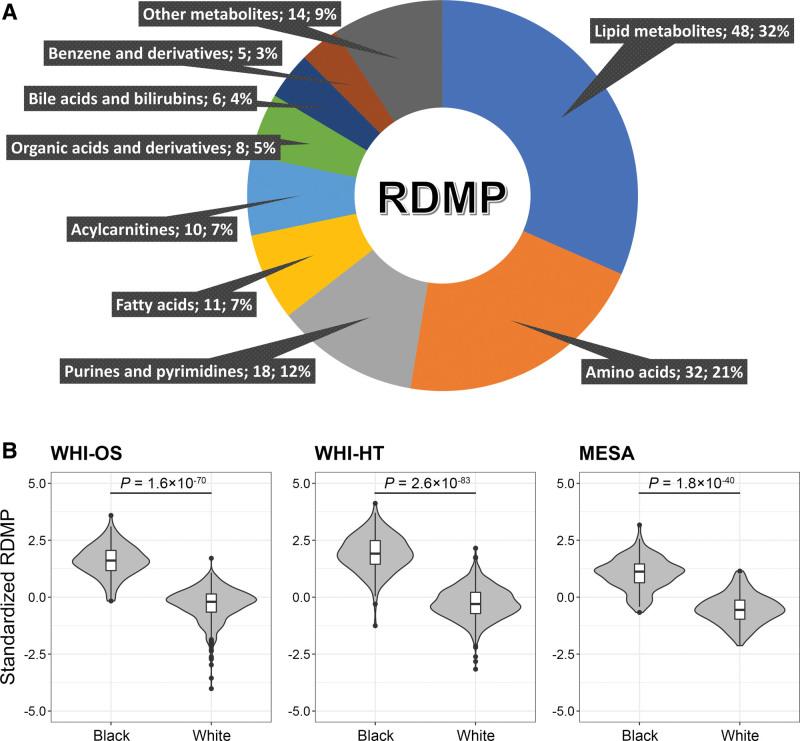
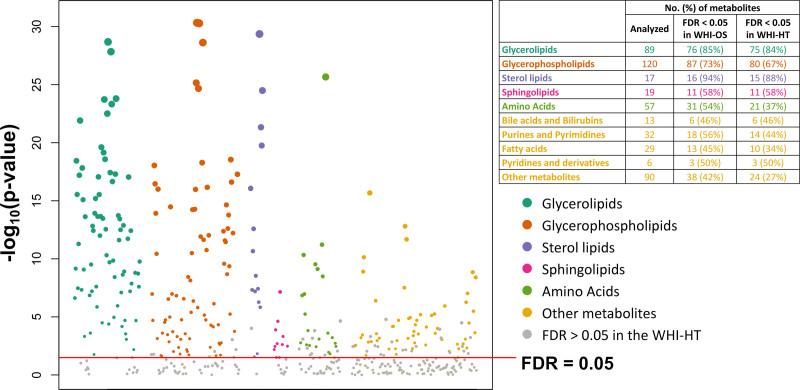
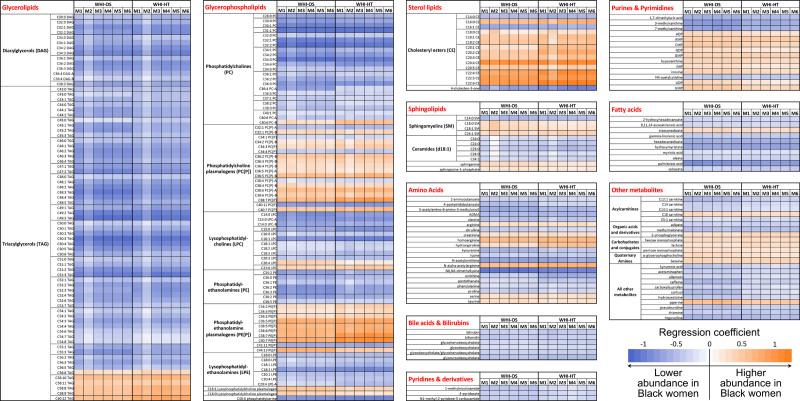
Of the 472 tested metabolites, levels of 259 (54.9%) metabolites, mostly lipid metabolites and amino acids, significantly differed between Black and White women in both WHI-OS and WHI-HT after adjusting for baseline characteristics, socioeconomic status, lifestyle factors, baseline health conditions, and medication use (false discovery rate <0.05); similar trends were observed in MESA. The RDMP, composed of 152 metabolites, was identified in the WHI-OS and showed significantly different distributions between Black and White women in the WHI-HT and MESA. Higher RDMP quartiles were associated with an increased risk of incident CHD (odds ratio=1.51 [0.97-2.37] for the highest quartile comparing to the lowest; =0.02), independent of self-reported race and known CHD risk factors. In race-stratified analyses, the RDMP-CHD associations were more pronounced in White women. Similar patterns were observed in Black women from the JHS and White women from the NHS.
CONCLUSIONS
Metabolomic profiles significantly and substantially differ between Black and White women and may be associated with CHD risk and racial disparities in US women.
背景
种族差异的代谢组特征可能反映了自我报告种族的健康社会决定因素的潜在差异,并且可能与美国女性中冠心病(CHD)的种族差异有关。然而,美国黑人和白人女性之间代谢组特征的差异程度尚未得到很好的描述。目前尚不清楚这些差异是否与 CHD 风险的差异有关。
方法
使用液相色谱-串联质谱法在 WHI-OS(妇女健康倡议观察性研究;138 名黑人女性和 696 名白人女性)、WHI-HT 试验(妇女健康倡议激素治疗;156 名黑人女性和 1138 名白人女性)、MESA(动脉粥样硬化多民族研究;114 名黑人女性和 219 名白人女性)、JHS(杰克逊心脏研究;1465 名黑人女性中有 107 例 CHD 病例)和 NHS(护士健康研究;2506 名白人女性中有 136 例 CHD 病例)中分析了血浆代谢组特征。首先,使用线性回归模型估计自我报告的种族与 WHI-OS 中的 472 种代谢物之间的关联(发现);在 WHI-HT 和 MESA 中复制了发现,并对其进行了验证。其次,我们使用弹性网络回归构建了代表 WHI-OS 中黑人和白人女性之间代谢组特征差异的种族差异代谢组模式(RDMP);在 WHI-HT 和 MESA 中验证了 RDMP。第三,使用 WHI 中的条件逻辑回归(717 例 CHD 病例和 719 例匹配对照),我们研究了与种族水平差异较大的代谢物以及 RDMP 与 CHD 风险之间的关联,结果在 JHS 的黑人女性和 NHS 的白人女性中得到了复制。
结果
在测试的 472 种代谢物中,在调整了基线特征、社会经济地位、生活方式因素、基线健康状况和药物使用后(错误发现率<0.05),259 种(54.9%)代谢物的水平在 WHI-OS 和 WHI-HT 中的黑人和白人女性之间存在显著差异,其中大多数为脂质代谢物和氨基酸;在 MESA 中也观察到了类似的趋势。RDMP 由 152 种代谢物组成,在 WHI-OS 中确定,并且在 WHI-HT 和 MESA 中显示出黑人和白人女性之间的分布存在显著差异。RDMP 四分位数越高,发生 CHD 的风险越高(与最低四分位数相比,最高四分位数的比值为 1.51[0.97-2.37];=0.02),独立于自我报告的种族和已知的 CHD 风险因素。在按种族分层的分析中,RDMP-CHD 关联在白人女性中更为明显。在 JHS 的黑人女性和 NHS 的白人女性中也观察到了类似的模式。
结论
黑人和白人女性之间的代谢组特征存在显著且显著的差异,并且可能与 CHD 风险和美国女性中的种族差异有关。

 Zotero 插件