
低剂量异丙嗪与地塞米松联合用药与昂丹司琼单药用于脊髓麻醉下子宫肌瘤切除术预防性止吐的比较:一项随机临床试验
Comparison of Low-Dose Promethazine and Dexamethasone against Ondansetron Monotherapy Given as Antiemetic Prophylaxis during Myomectomy Under Spinal Anesthesia: A Randomized Clinical Trial.
作者信息
Onokpite Emmanuel, Jasper Abiodun Oyinpreye, Edomwonyi Philomina Nosa
机构信息
Department of Anaesthesia, Delta State University Teaching Hospital, Oghara, Delta, Nigeria.
Department of Anesthesiology, University of Benin Teaching Hospital, Benin, Nigeria.
出版信息
Anesthesiol Res Pract. 2022 Aug 25;2022:2094662. doi: 10.1155/2022/2094662. eCollection 2022.
BACKGROUND
Postoperative nausea and vomiting (PONV) prophylaxis is still inadequate for a significant proportion of women undergoing myomectomy under spinal anesthesia; and it substantially decreases patient's quality of postoperative recovery. Current protocol and practice favor the use of combination therapy like promethazine/dexamethasone for PONV prophylaxis with minimal side effects and cost advantages in low-resource climes. . Seventy American Society of Anesthesiologist (ASA) class I or II women aged 21-65 years scheduled for myomectomy were recruited and randomized into group A (promethazine/dexamethasone group) and group B (ondansetron group). Myomectomy was performed on each patient using spinal anesthesia. After induction of spinal anesthesia, patients in group A received intravenous promethazine 12.5 mg and dexamethasone 8 mg while group B received intravenous ondansetron 8 mg. Early (0-3 h) and late (4-24 h) PONV was assessed using the numerical scoring scale.
RESULTS
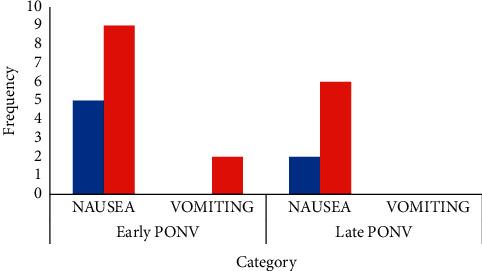
Data analysis was done using SPSS version 20. Postoperatively, there was no significant difference in the incidence of early ansd late PONV ( value >0.05) despite the higher incidents in the ondansetron group. The proportion of patients who required rescue antiemetics was more in the ondansetron group when compared with the promethazine/dexamethasone, with minimal and statistically insignificant side effects in both groups. There was significant patient satisfaction in both groups.
CONCLUSION
The study shows that the combination of low-dose promethazine and dexamethasone is comparable to ondansetron when used as prophylaxis for PONV with cost benefits in low-resource environments.
背景
对于很大一部分接受脊髓麻醉下子宫肌瘤切除术的女性,术后恶心呕吐(PONV)的预防措施仍然不足;这会大幅降低患者术后恢复的质量。当前的方案和实践倾向于使用异丙嗪/地塞米松等联合疗法来预防PONV,在资源匮乏地区具有最小的副作用和成本优势。招募了70名年龄在21 - 65岁、美国麻醉医师协会(ASA)分级为I或II级、计划进行子宫肌瘤切除术的女性,并将她们随机分为A组(异丙嗪/地塞米松组)和B组(昂丹司琼组)。每位患者均采用脊髓麻醉进行子宫肌瘤切除术。在脊髓麻醉诱导后,A组患者静脉注射12.5毫克异丙嗪和8毫克地塞米松,而B组患者静脉注射8毫克昂丹司琼。使用数字评分量表评估早期(0 - 3小时)和晚期(4 - 24小时)的PONV情况。
结果
使用SPSS 20版进行数据分析。术后,尽管昂丹司琼组的发生率较高,但早期和晚期PONV的发生率没有显著差异( 值>0.05)。与异丙嗪/地塞米松组相比,昂丹司琼组中需要使用急救止吐药的患者比例更高,两组的副作用均最小且无统计学意义。两组患者的满意度都很高。
结论
该研究表明,在资源匮乏的环境中,低剂量异丙嗪和地塞米松联合使用作为PONV的预防措施时,与昂丹司琼相当且具有成本效益。
 Zotero 插件