
新型冠状病毒肺炎中的高凝状态:从未知的开端到未来的治疗方法
Hypercoagulability in COVID-19: from an unknown beginning to future therapies.
作者信息
Duca Ştefania-Teodora, Costache Alexandru-Dan, Miftode Radu-Ştefan, Mitu Ovidiu, PetriŞ Antoniu-Octavian, Costache Irina-Iuliana
机构信息
Department of Medical Specialties I, Faculty of Medicine, "Grigore T. Popa" University of Medicine and Pharmacy Iasi, Romania.
"Sf. Spiridon" County Clinical Emergency Hospital, Iasi, Romania.
出版信息
Med Pharm Rep. 2022 Jul;95(3):236-242. doi: 10.15386/mpr-2195. Epub 2022 Jul 26.
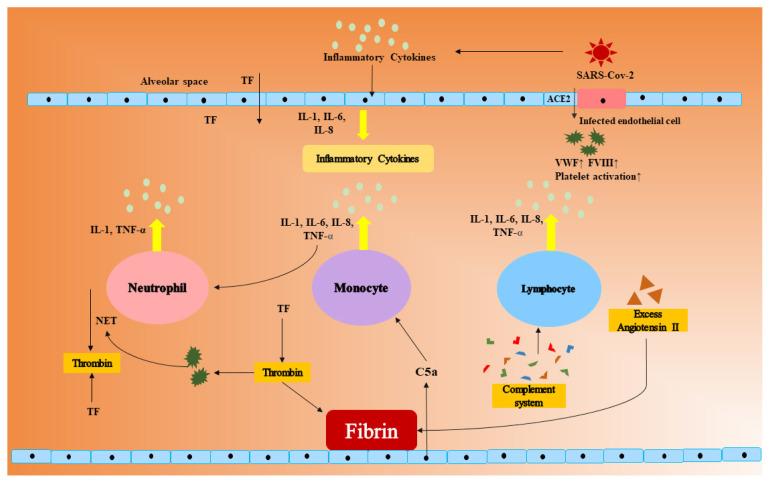
Coronavirus disease 2019 (COVID-19), caused by the severe acute respiratory syndrome coronavirus 2 (SARS-CoV-2), is a global public health concern and is characterized by an exaggerated inflammatory response that can lead to a large variety of clinical manifestations such as respiratory distress, sepsis, coagulopathy, and death. While it was initially considered primarily a respiratory illness, different data suggests that COVID-19 can lead to a pro-inflammatory milieu and a hypercoagulable state. Several mechanisms attempt to explain the pro-coagulant state seen in COVID-19 patients, including increased fibrinogen concentration, different receptor binding, exhausted fibrinolysis, cytokine storm, and endothelial dysfunction. Some hematological parameters, such as elevated D-dimers and other fibrinolytic products, indicate that the essence of coagulopathy is massive fibrin formation. Moreover, elevated D-dimer levels have emerged as an independent risk factor for a worse outcome, including death, indicating a potential risk for deep vein thrombosis and pulmonary thromboembolism. Prophylactic anticoagulation is recommended in all in-patients with COVID-19 to reduce the incidence of thrombosis. Those with elevated D-dimer values or with a higher risk of developing thromboembolic events should be treated with higher doses of anticoagulant. Anticoagulation may not be enough in some circumstances, highlighting the need for alternative therapies. An understanding of the complex cross-talk between inflammation and coagulopathy is necessary for developing direct appropriate interventional strategies.
2019冠状病毒病(COVID-19)由严重急性呼吸综合征冠状病毒2(SARS-CoV-2)引起,是一个全球公共卫生问题,其特征是炎症反应过度,可导致多种临床表现,如呼吸窘迫、脓毒症、凝血病和死亡。虽然它最初主要被认为是一种呼吸系统疾病,但不同数据表明,COVID-19可导致促炎环境和高凝状态。有几种机制试图解释COVID-19患者中出现的促凝状态,包括纤维蛋白原浓度增加、不同受体结合、纤溶功能耗竭、细胞因子风暴和内皮功能障碍。一些血液学参数,如D-二聚体和其他纤溶产物升高,表明凝血病的本质是大量纤维蛋白形成。此外,D-二聚体水平升高已成为包括死亡在内的不良结局的独立危险因素,表明存在深静脉血栓形成和肺血栓栓塞的潜在风险。建议对所有COVID-19住院患者进行预防性抗凝,以降低血栓形成的发生率。D-二聚体值升高或发生血栓栓塞事件风险较高的患者应使用更高剂量的抗凝剂治疗。在某些情况下,抗凝可能不够,这突出了需要替代疗法。了解炎症和凝血病之间复杂的相互作用对于制定直接适当的干预策略是必要的。
 Zotero 插件