
接受免疫检查点抑制剂治疗的癌症患者中的巨细胞病毒感染
Cytomegalovirus infection among patients with cancer receiving immune checkpoint inhibitors.
作者信息
Panneerselvam Kavea, Szafron David, Amin Rajan N, Wei Dongguang, Tan Dongfeng, Altan Mehmet, Okhuysen Pablo C, Shatila Malek, Raju Gottumukkala Subba, Thomas Anusha S, Wang Yinghong
机构信息
Department of Internal Medicine, Baylor College of Medicine, Houston, TX (Kavea Panneerselvam, David Szafron).
Department of Internal Medicine, The University of Texas Health Science Center at Houston, Houston, TX (Rajan N. Amin).
出版信息
Ann Gastroenterol. 2022 Sep-Oct;35(5):522-531. doi: 10.20524/aog.2022.0735. Epub 2022 Jul 15.
BACKGROUND
Immune checkpoint inhibitors (ICIs), used for the treatment of solid and hematologic malignancies, come with the risk of immune-related adverse events (irAEs). Opportunistic infections (e.g., cytomegalovirus [CMV]) mimic irAE symptoms and are understudied in this population. We aimed to describe the incidence, characteristics, treatment and outcomes of CMV infection in ICI-treated patients.
METHODS
We conducted a single-center retrospective review of all adult patients who were CMV-positive after ICI therapy between 06/2011 and 05/2020. A CMV-positive non-ICI cohort was matched to the ICI group based on age, sex and cancer type. Variables of interest were collected through electronic medical records.
RESULTS
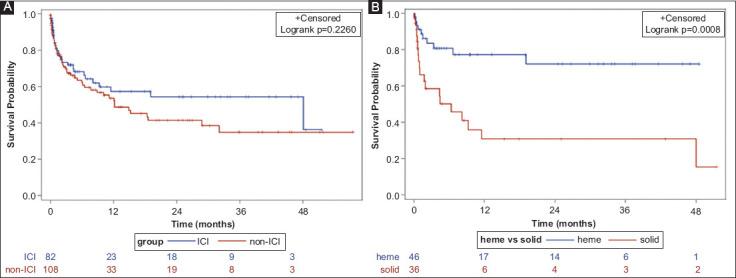
The study population comprised 192 patients overall. CMV infection incidence was 7.7% in ICI patients and 12.9% in non-ICI patients (P<0.001). Rates of infection clearance (83% vs. 50%, P=0.002) and recurrence (20% vs. 3%, P=0.037) were higher in ICI patients with hematologic vs. solid tumors, despite similar treatments. All-cause mortality was higher in solid rather than hematologic malignancies in ICI patients (83% vs. 54%, P=0.009); CMV-related mortality was low (3-4%) in both groups.
CONCLUSIONS
CMV infection occurred in about 7.7% of the ICI-treated cancer population. The infection can be disseminated in multiple organs and has a wide spectrum of clinical symptoms. ICI-treated patients with a hematologic malignancy had higher viral clearance and recurrence than those with solid tumors. In this study, CMV itself did not lead to high mortality in cancer patients. Further study is needed to investigate the role of CMV infection in patients' irAEs and cancer outcome.
背景
免疫检查点抑制剂(ICIs)用于治疗实体瘤和血液系统恶性肿瘤,存在免疫相关不良事件(irAEs)的风险。机会性感染(如巨细胞病毒[CMV])会模仿irAE症状,且在该人群中研究较少。我们旨在描述接受ICI治疗的患者中CMV感染的发生率、特征、治疗及结局。
方法
我们对2011年6月至2020年5月期间接受ICI治疗后CMV呈阳性的所有成年患者进行了单中心回顾性研究。根据年龄、性别和癌症类型,将CMV阳性的非ICI队列与ICI组进行匹配。通过电子病历收集感兴趣的变量。
结果
研究人群共包括192例患者。ICI患者中CMV感染发生率为7.7%,非ICI患者中为12.9%(P<0.001)。尽管治疗相似,但血液系统肿瘤的ICI患者与实体瘤患者相比,感染清除率(83%对50%,P=0.002)和复发率(20%对3%,P=0.037)更高。ICI患者中实体瘤患者的全因死亡率高于血液系统恶性肿瘤患者(83%对54%,P=0.009);两组中CMV相关死亡率均较低(3 - 4%)。
结论
约7.7%接受ICI治疗的癌症患者发生了CMV感染。该感染可在多个器官播散,具有广泛的临床症状。血液系统恶性肿瘤的ICI治疗患者比实体瘤患者具有更高的病毒清除率和复发率。在本研究中,CMV本身并未导致癌症患者的高死亡率。需要进一步研究以探讨CMV感染在患者irAE和癌症结局中的作用。

 Zotero 插件