
中国广州儿童和青少年的身体成分与青春期发育时间的关联。
Association of body composition with pubertal timing in children and adolescents from Guangzhou, China.
机构信息
Department of Epidemiology and Biostatistics, School of Public Health, Guangdong Pharmaceutical University, Guangzhou, China.
Guangzhou Health Care Promotion Center for Primary and Middle Schools, Guangzhou, China.
出版信息
Front Public Health. 2022 Aug 17;10:943886. doi: 10.3389/fpubh.2022.943886. eCollection 2022.
OBJECTIVE
An ongoing debate surrounds the relationship between body composition and pubertal timing, in particular for boys. This cross-sectional study aimed to investigate the association of body composition with pubertal timing among children and adolescents.
METHODS
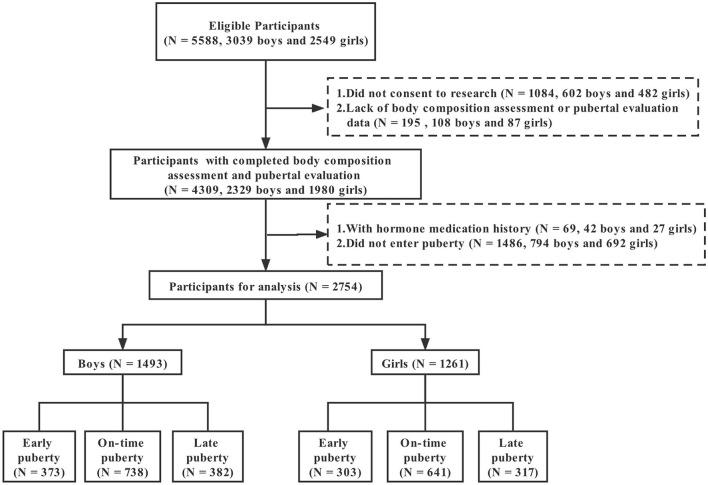
A total of 1,493 boys and 1,261 girls who entered puberty were enrolled in Guangzhou, China. Tanner stages were evaluated by examination of breast development for girls and testicular volume for boys. Fat mass (FM) and fat-free mass (FFM) were determined by bioelectrical impedance analysis. Parameters for body composition were transformed into age-and gender-specific -scores. The association of body composition with pubertal timing was examined using multinomial logistic regression with inverse probability weighting (IPW) based on the propensity score.
RESULTS
For boys, IPW analysis showed -scores of body fat percentage (BF%) and FM index (FMI) were negatively associated with early puberty (OR = 0.75, 95% CI = 0.64-0.87; OR = 0.74, 95% CI = 0.63-0.88). As for girls, in contrast to boys, positive associations were seen between BF% and FMI with early puberty (OR = 1.39, 95% CI = 1.19-1.64; OR = 1.59, 95% CI = 1.33-1.90). With respect to appendicular skeletal muscle mass index (ASMI), there was a positive association with early puberty and a negative one with late puberty in boys (OR = 1.26, 95% CI = 1.07-1.49; OR = 0.82, 95% CI = 0.69-0.99).
CONCLUSION
There is a positive association of FM with early puberty for girls while negative for boys. FFM yields a positive association with early puberty and a negative one with late puberty in boys, but not in girls. Our findings highlight the gender differences in the connection between body composition and pubertal onset.
目的
关于身体成分与青春期启动之间的关系,尤其是男孩,一直存在争议。本横断面研究旨在探讨儿童和青少年身体成分与青春期启动的关系。
方法
共纳入 1493 名进入青春期的男孩和 1261 名女孩,通过女孩乳房发育和男孩睾丸体积评估 Tanner 分期。通过生物电阻抗分析确定脂肪量(FM)和去脂体重(FFM)。将身体成分参数转化为年龄和性别特异的 -分数。采用基于倾向评分的逆概率加权(IPW)的多变量逻辑回归来检验身体成分与青春期启动的关系。
结果
对于男孩,IPW 分析显示体脂百分比(BF%)和 FM 指数(FMI) -分数与青春期提前呈负相关(OR=0.75,95%CI=0.64-0.87;OR=0.74,95%CI=0.63-0.88)。对于女孩,与男孩相反,BF%和 FMI -分数与青春期提前呈正相关(OR=1.39,95%CI=1.19-1.64;OR=1.59,95%CI=1.33-1.90)。对于四肢骨骼肌质量指数(ASMI),男孩中与青春期提前呈正相关,与青春期延迟呈负相关(OR=1.26,95%CI=1.07-1.49;OR=0.82,95%CI=0.69-0.99)。
结论
对于女孩,FM 与青春期提前呈正相关,而对于男孩则呈负相关。FFM 与男孩青春期提前呈正相关,与青春期延迟呈负相关,但在女孩中无此相关性。我们的研究结果强调了身体成分与青春期起始之间的关系存在性别差异。
 Zotero 插件