
新生儿皮肤成熟度医疗器械用于预测胎龄的验证:临床试验。
Newborn Skin Maturity Medical Device Validation for Gestational Age Prediction: Clinical Trial.
机构信息
Health Informatics Center, Universidade Federal de Minas Gerais, Belo Horizonte, Brazil.
Department of Gynecology and Obstetrics, Universidade Federal de Minas Gerais, Belo Horizonte, Brazil.
出版信息
J Med Internet Res. 2022 Sep 7;24(9):e38727. doi: 10.2196/38727.
BACKGROUND
Early access to antenatal care and high-cost technologies for pregnancy dating challenge early neonatal risk assessment at birth in resource-constrained settings. To overcome the absence or inaccuracy of postnatal gestational age (GA), we developed a new medical device to assess GA based on the photobiological properties of newborns' skin and predictive models.
OBJECTIVE
This study aims to validate a device that uses the photobiological model of skin maturity adjusted to the clinical data to detect GA and establish its accuracy in discriminating preterm newborns.
METHODS
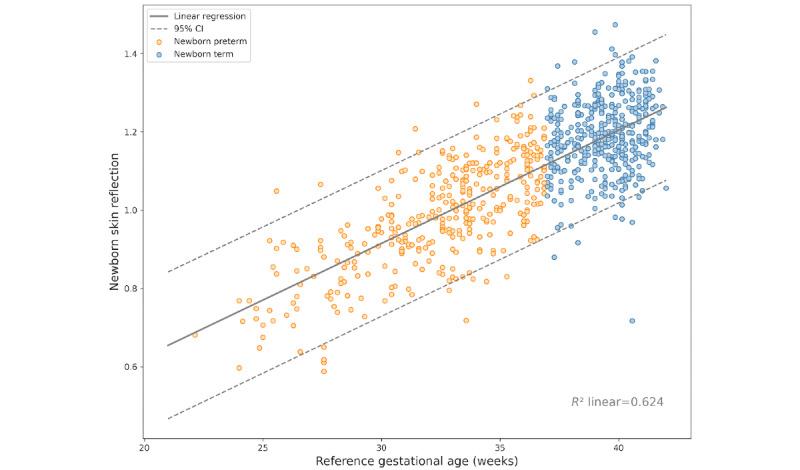
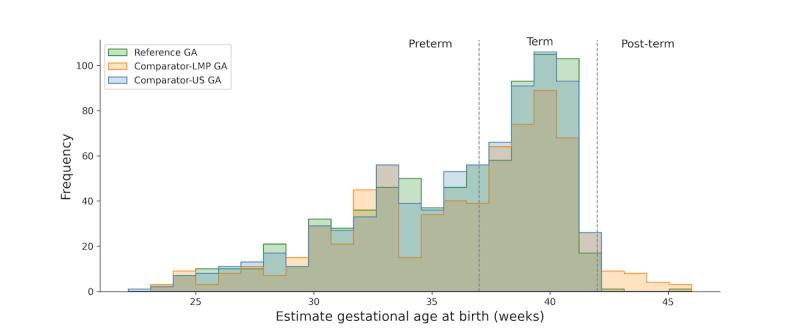
A multicenter, single-blinded, and single-arm intention-to-diagnosis clinical trial evaluated the accuracy of a novel device for the detection of GA and preterm newborns. The first-trimester ultrasound, a second comparator ultrasound, and data regarding the last menstrual period (LMP) from antenatal reports were used as references for GA at birth. The new test for validation was performed using a portable multiband reflectance photometer device that assessed the skin maturity of newborns and used machine learning models to predict GA, adjusted for birth weight and antenatal corticosteroid therapy exposure.
RESULTS
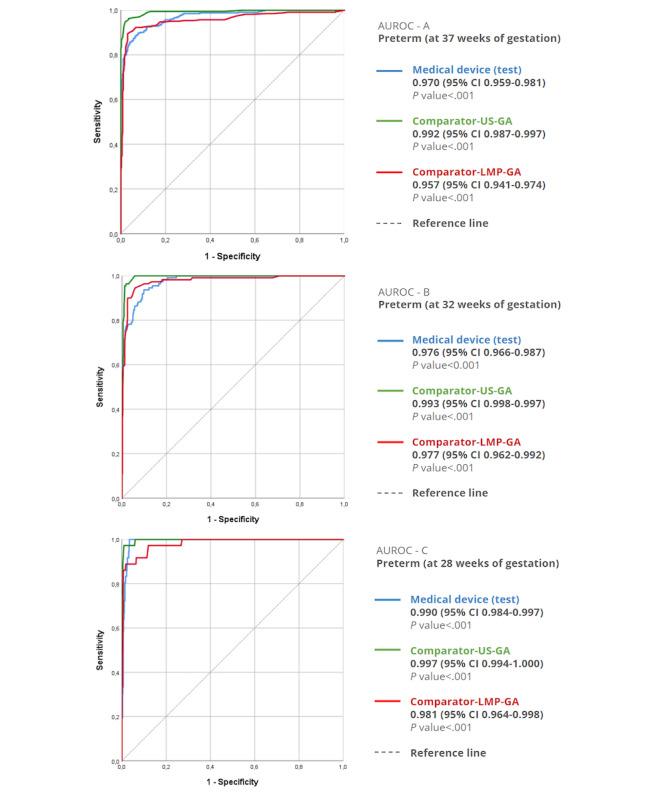
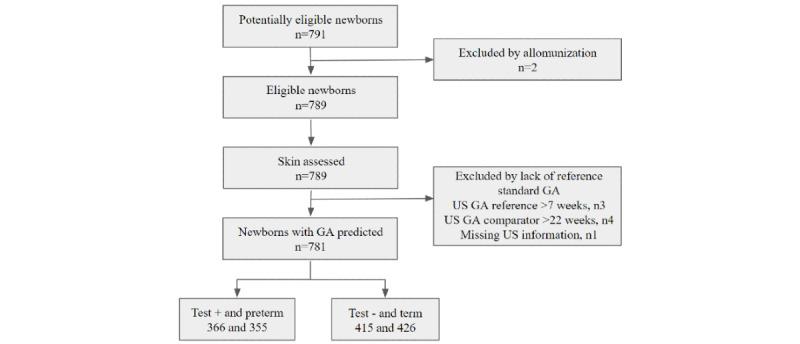
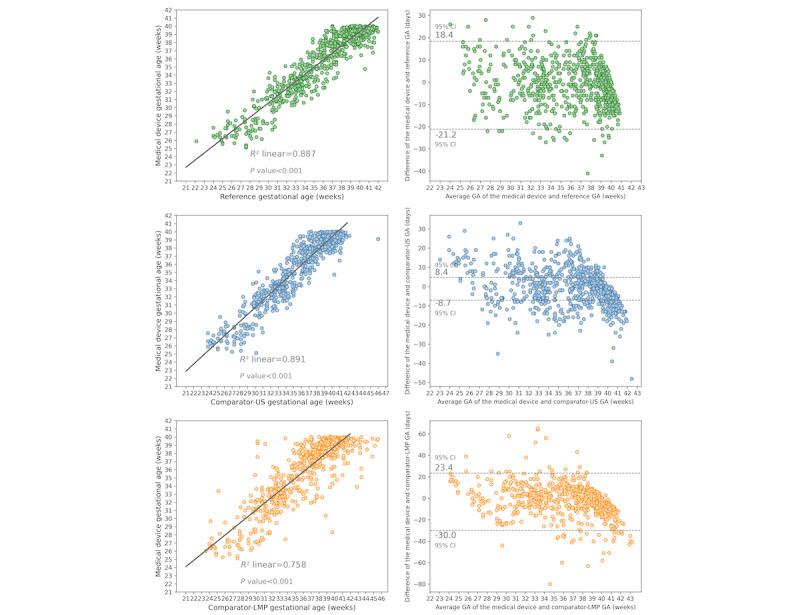
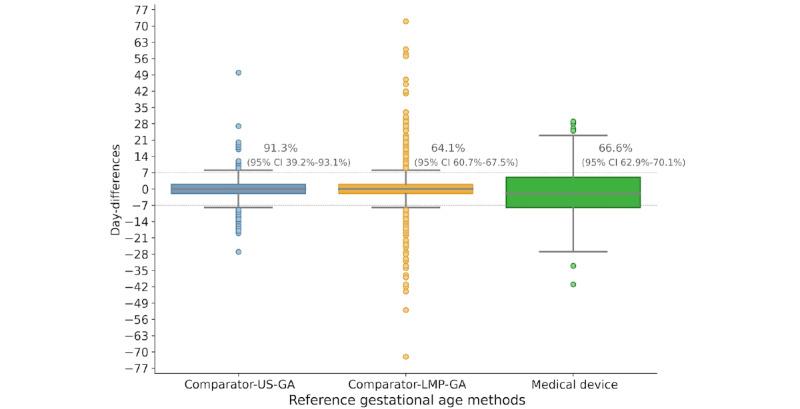
The study group comprised 702 pregnant women who gave birth to 781 newborns, of which 366 (46.9%) were preterm newborns. As the primary outcome, the GA as predicted by the new test was in line with the reference GA that was calculated by using the intraclass correlation coefficient (0.969, 95% CI 0.964-0.973). The paired difference between predicted and reference GAs was -1.34 days, with Bland-Altman limits of -21.2 to 18.4 days. As a secondary outcome, the new test achieved 66.6% (95% CI 62.9%-70.1%) agreement with the reference GA within an error of 1 week. This agreement was similar to that of comparator-LMP-GAs (64.1%, 95% CI 60.7%-67.5%). The discrimination between preterm and term newborns via the device had a similar area under the receiver operating characteristic curve (0.970, 95% CI 0.959-0.981) compared with that for comparator-LMP-GAs (0.957, 95% CI 0.941-0.974). In newborns with absent or unreliable LMPs (n=451), the intent-to-discriminate analysis showed correct preterm versus term classifications with the new test, which achieved an accuracy of 89.6% (95% CI 86.4%-92.2%), while the accuracy for comparator-LMP-GA was 69.6% (95% CI 65.3%-73.7%).
CONCLUSIONS
The assessment of newborn's skin maturity (adjusted by learning models) promises accurate pregnancy dating at birth, even without the antenatal ultrasound reference. Thus, the novel device could add value to the set of clinical parameters that direct the delivery of neonatal care in birth scenarios where GA is unknown or unreliable.
INTERNATIONAL REGISTERED REPORT IDENTIFIER (IRRID): RR2-10.1136/bmjopen-2018-027442.
背景
在资源有限的环境中,早期获得产前护理和用于妊娠时间的昂贵技术,对出生时的新生儿早期风险评估提出了挑战。为了克服产后胎龄(GA)的缺失或不准确,我们开发了一种新的医疗设备,用于根据新生儿皮肤的光生物学特性和预测模型来评估 GA。
目的
本研究旨在验证一种使用皮肤成熟度的光生物学模型来调整临床数据以检测 GA 的设备,并确定其在区分早产儿中的准确性。
方法
一项多中心、单盲、单臂意向诊断临床试验评估了一种新型设备检测 GA 和早产儿的准确性。通过超声检查确定的孕早期、作为第二比较器的另一次超声检查以及产前报告中关于最后一次月经周期(LMP)的数据,被用作出生时 GA 的参考。用于验证的新测试使用便携式多波段反射光度计设备进行,该设备评估新生儿的皮肤成熟度,并使用机器学习模型预测 GA,同时根据出生体重和产前皮质激素治疗暴露情况进行调整。
结果
研究组纳入了 702 名孕妇,其中 781 名新生儿,366 名(46.9%)为早产儿。作为主要结果,新测试预测的 GA 与使用组内相关系数(0.969,95%置信区间 0.964-0.973)计算的参考 GA 一致。预测 GA 与参考 GA 的差值为-1.34 天,Bland-Altman 界限为-21.2 至 18.4 天。作为次要结果,新测试与参考 GA 的一致性为 66.6%(95%置信区间 62.9%-70.1%),误差在 1 周内。这一一致性与比较器-LMP-GAs(64.1%,95%置信区间 60.7%-67.5%)相似。通过设备区分早产儿和足月儿的曲线下面积(AUC)也相似(0.970,95%置信区间 0.959-0.981),与比较器-LMP-GAs(0.957,95%置信区间 0.941-0.974)相似。在 LMP 缺失或不可靠的新生儿(n=451)中,新测试的意向性判别分析显示,正确区分早产儿和足月儿的准确率为 89.6%(95%置信区间 86.4%-92.2%),而比较器-LMP-GA 的准确率为 69.6%(95%置信区间 65.3%-73.7%)。
结论
即使没有产前超声参考,评估新生儿皮肤成熟度(通过学习模型调整)也能准确预测出生时的妊娠时间,因此,该新型设备可以为指导新生儿护理的临床参数提供额外价值,尤其是在 GA 未知或不可靠的分娩场景中。
国际注册报告标识符(IRRID):RR2-10.1136/bmjopen-2018-027442。

 Zotero 插件