
新辅助治疗后不同乳腺癌肿瘤免疫微环境表型的比较。
Comparison of the tumor immune microenvironment phenotypes in different breast cancers after neoadjuvant therapy.
机构信息
Department of Pathology, The Fourth Hospital of Hebei Medical University, Shijiazhuang, China.
出版信息
Cancer Med. 2023 Feb;12(3):2906-2917. doi: 10.1002/cam4.5207. Epub 2022 Sep 8.
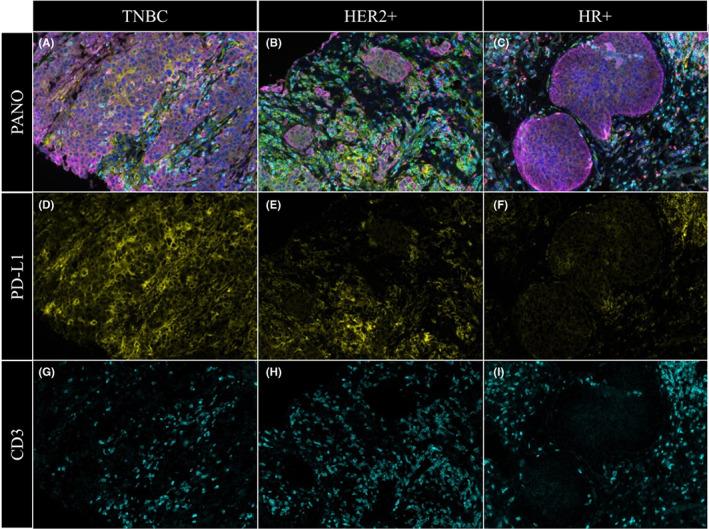
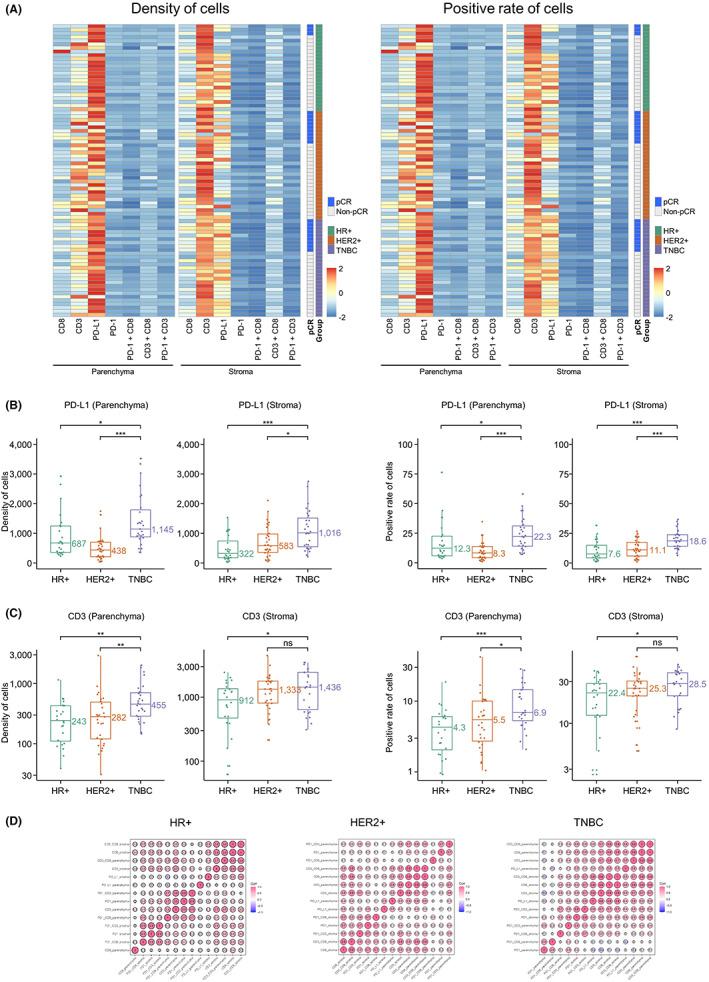
Neoadjuvant therapy (NAT) treats early-stage breast cancers, especially triple-negative breast cancers (TNBCs). NAT improves pathological complete response (pCR) rates for different breast cancer patients. Recently, immune checkpoint inhibitors that target programmed death 1 (PD-1) or programmed death ligand 1 (PD-L1) in combination with NAT have shown antitumor activity in patients with early breast cancer. However, the tumor immune microenvironment (TME) in different subtypes of breast cancers, like TNBC, hormone receptor-positive (HR+), and human epidermal growth factor receptor 2 amplified (HER2+) and its changes by NAT remain to be fully characterized. We analyzed pre-NAT tumor biopsies from TNBC (n = 27), HR+ (n = 24), and HER2+ (n = 30) breast cancer patients who received NAT, followed by surgery. The different immune makers (PD-1, PD-L1, CD3, and CD8) of tumor-infiltrating lymphocytes (TILs) were identified with immunofluorescence-based microenvironment analysis. TILs within cancer parenchyma (iTILs) and in cancer stroma (sTILs) were counted separately. We found that PD-L1+ cells in tumor and stroma were significantly higher in TNBC patients than in others. PD-L1+ sTILs were significantly higher in pCR than in non-pCR patients of all the subtypes. The infiltration scores of B-cell memory, T-cell CD4+ memory activated, T-cell follicular helper, and Macrophage M0 and M1 were relatively higher in TNBC patients, indicating immunoreactive TME in TNBC. Analysis of TCGA-BRCA RNA-seq indicated that PD-L1 was highly expressed in TNBC patients compared with HR+ and HER2+ patients. Higher PD-L1 expression in TNBC patients was associated with significantly longer overall survival (OS). Our results demonstrated that PD-L1 expression level of iTILs and sTILs is highest in TNBC among breast cancers. TNBC patients had significantly different immunoreactive TME compared with HR+ and HER2+ patients, suggesting potentially favorable outcomes for immunotherapy in these patients. Also, PD-L1+ could be a powerful predictor of pCR in TNBC patients after NAT.
新辅助治疗 (NAT) 用于治疗早期乳腺癌,尤其是三阴性乳腺癌 (TNBC)。NAT 可提高不同乳腺癌患者的病理完全缓解 (pCR) 率。最近,针对程序性死亡受体 1 (PD-1) 或程序性死亡配体 1 (PD-L1) 的免疫检查点抑制剂与 NAT 联合使用,已在早期乳腺癌患者中显示出抗肿瘤活性。然而,TNBC、激素受体阳性 (HR+) 和人表皮生长因子受体 2 扩增 (HER2+) 等不同亚型乳腺癌的肿瘤免疫微环境 (TME) 及其在 NAT 后的变化仍有待充分描述。我们分析了接受 NAT 治疗后接受手术的 TNBC (n=27)、HR+ (n=24) 和 HER2+ (n=30) 乳腺癌患者的术前肿瘤活检。采用免疫荧光基础的微环境分析方法鉴定肿瘤浸润淋巴细胞 (TIL) 的不同免疫标志物 (PD-1、PD-L1、CD3 和 CD8)。分别计数癌实质内 (iTILs) 和癌基质内 (sTILs) 的 TILs。我们发现 TNBC 患者的肿瘤和基质中的 PD-L1+细胞明显高于其他患者。所有亚型中 pCR 患者的 PD-L1+sTILs 明显高于非 pCR 患者。TNBC 患者的 B 细胞记忆、T 细胞 CD4+记忆激活、T 细胞滤泡辅助和巨噬细胞 M0 和 M1 的浸润评分相对较高,表明 TNBC 中有免疫反应性 TME。TCGA-BRCA RNA-seq 分析表明,与 HR+和 HER2+患者相比,TNBC 患者的 PD-L1 表达水平较高。TNBC 患者中 PD-L1 的高表达与总生存期 (OS) 的显著延长相关。我们的结果表明,在乳腺癌中,iTILs 和 sTILs 的 PD-L1 表达水平在 TNBC 中最高。与 HR+和 HER2+患者相比,TNBC 患者的免疫反应性 TME 有显著差异,提示这些患者的免疫治疗可能有较好的效果。此外,NAT 后 PD-L1+可能是 TNBC 患者 pCR 的有力预测因子。



 Zotero 插件