
将快速诊断检测添加到基于社区的疟疾治疗方案中。
Adding rapid diagnostic tests to community-based programmes for treating malaria.
机构信息
Division of Clinical Pharmacology, Department of Medicine, University of Cape Town, Cape Town, South Africa.
Cochrane South Africa, South African Medical Research Council, Cape Town, South Africa.
出版信息
Cochrane Database Syst Rev. 2022 Sep 8;9(9):CD009527. doi: 10.1002/14651858.CD009527.pub3.
BACKGROUND
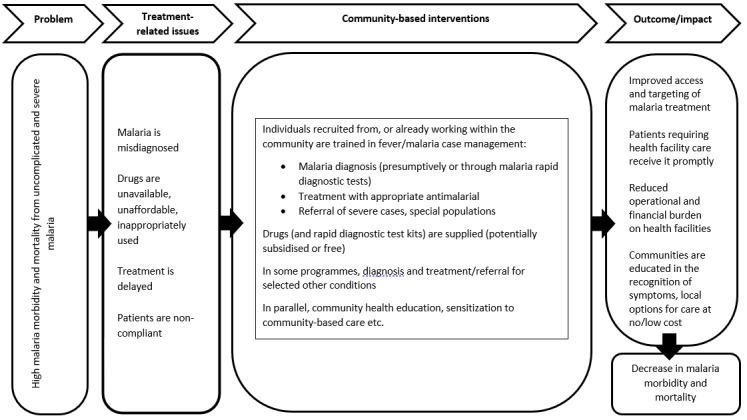
The World Health Organization (WHO) recommends parasitological testing of all suspected malaria cases using malaria rapid diagnostic tests (mRDTs) or microscopy prior to treatment. Some governments have extended this responsibility to community health workers (CHWs) to reduce malaria morbidity and mortality through prompt and appropriate treatment. This is an update of a Cochrane Review first published in 2013.
OBJECTIVES
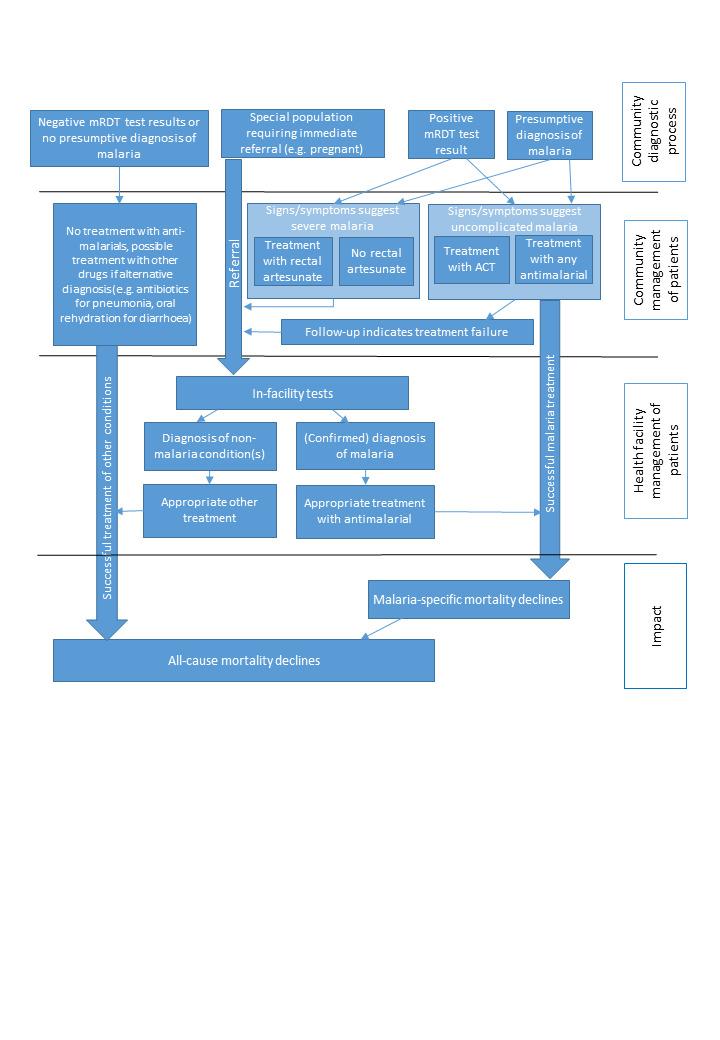
To evaluate community-based management strategies for treating malaria or fever that incorporate both a definitive diagnosis with an mRDT and appropriate antimalarial treatment.
SEARCH METHODS
We searched CENTRAL, MEDLINE, Embase, five other databases, and three trials registers up to 14 September 2021.
SELECTION CRITERIA
We included individually randomized trials and cluster-randomized controlled trials (cRCTs), controlled before-after studies, and controlled interrupted time series studies in people living in malaria-endemic areas, comparing programmes that train CHWs and drug shop vendors to perform mRDTs and provide appropriate treatment versus similar programmes that do not use mRDTs, and versus routine health facility care.
DATA COLLECTION AND ANALYSIS
We used standard Cochrane methods. For each dichotomous outcome, we extracted the number of participants with the event and the total number of participants in each group, unless studies presented results at a population level only. Primary outcomes were all-cause mortality, hospitalizations, and number of people receiving an antimalarial within 24 hours. Secondary outcomes were malaria-specific mortality, severe malaria, outcomes related to antimalarial treatments, antibiotic prescribing to people with a negative microscopy or polymerase chain reaction (PCR) result, parasitaemia, anaemia, and all adverse events.
MAIN RESULTS
We included eight studies from several African countries, Afghanistan, and Myanmar. Staff included CHWs and drug shop vendors. Community use of malaria rapid diagnostic tests compared to clinical diagnosis Compared to clinical diagnosis, mRDT diagnosis results in reduced prescribing of antimalarials to people who are found to be malaria parasite-negative by microscopy or PCR testing (71 fewer per 100 people, 95% confidence interval (CI) 79 to 51 fewer; risk ratio (RR) 0.17, 95% CI 0.07 to 0.40; 3 cRCTs, 7877 participants; moderate-certainty evidence). This reduction may be greater among CHWs compared to drug shop vendors. People diagnosed by mRDT are more likely to receive appropriate treatment; that is, an antimalarial if they are microscopy- or PCR-positive and no antimalarial if they are microscopy- or PCR-negative (RR 3.04, 95% CI 2.46 to 3.74, 3 cRCTs, 9332 participants; high-certainty evidence). Three studies found that a small percentage of people with a negative mRDT result (as read by the CHW or drug shop vendors at the time of treatment) were nevertheless given an antimalarial: 38/1368 (2.8%), 44/724 (6.1%) and 124/950 (13.1%). Conversely, in two studies, a few mRDT-positive people did not receive an antimalarial (0.5% and 0.3%), and one small cross-over study found that 6/57 (10.5%) people classified as non-malaria in the clinical diagnosis arm received an antimalarial. Use of mRDTs probably increases antibiotic use compared to clinical diagnosis (13 more per 100 people, 95% CI 3 to 29 more; RR 2.02, 95% CI 1.21 to 3.37; 2 cRCTs, 5179 participants; moderate-certainty evidence). We were unable to demonstrate any effect on mortality. Community use of malaria rapid diagnostic tests compared to health facility care Results were insufficient to reach any conclusion.
AUTHORS' CONCLUSIONS: Use of mRDTs by CHWs and drug shop vendors compared to clinical diagnosis reduces prescribing of antimalarials to people without malaria. Deaths were uncommon in both groups. Antibiotic prescribing was higher in those with a negative mRDT than in those with a negative clinical diagnosis.
背景
世界卫生组织(WHO)建议在治疗之前,使用疟疾快速诊断检测(mRDT)或显微镜对所有疑似疟疾病例进行寄生虫学检测。一些政府已将这一责任扩大到社区卫生工作者(CHW),以通过及时和适当的治疗来降低疟疾发病率和死亡率。这是 2013 年首次发表的 Cochrane 综述的更新。
目的
评估基于社区的疟疾或发热管理策略,这些策略结合了 mRDT 的明确诊断和适当的抗疟治疗。
检索方法
我们检索了 CENTRAL、MEDLINE、Embase、其他五个数据库和三个试验登记处,检索时间截至 2021 年 9 月 14 日。
选择标准
我们纳入了个体随机试验和群组随机对照试验(cRCTs)、对照前后研究和对照中断时间序列研究,研究对象为生活在疟疾流行地区的人群,比较了培训 CHW 和药店供应商进行 mRDT 并提供适当治疗的方案与不使用 mRDT 的类似方案,以及与常规卫生机构护理的方案。
数据收集和分析
我们使用了标准的 Cochrane 方法。对于每个二项结局,我们提取了有事件的参与者数量和每个组的总参与者数量,除非研究仅在人群水平上呈现结果。主要结局是全因死亡率、住院率和 24 小时内接受抗疟治疗的人数。次要结局是疟疾特异性死亡率、严重疟疾、与抗疟治疗相关的结局、对显微镜或聚合酶链反应(PCR)结果为阴性的人开抗生素处方、寄生虫血症、贫血和所有不良事件。
主要结果
我们纳入了来自几个非洲国家、阿富汗和缅甸的八项研究。工作人员包括 CHW 和药店供应商。社区使用疟疾快速诊断检测与临床诊断相比,mRDT 诊断结果导致抗疟药物的处方减少,对显微镜或 PCR 检测为疟原虫阴性的人(每 100 人减少 71 人,95%置信区间 79 至 51 人减少;风险比(RR)0.17,95%置信区间 0.07 至 0.40;3 个 cRCT,7877 名参与者;中等确定性证据)。与药店供应商相比,CHW 可能会有更大的减少。通过 mRDT 诊断的人更有可能接受适当的治疗,即如果显微镜或 PCR 阳性,则给予抗疟药物,如果显微镜或 PCR 阴性,则不给予抗疟药物(RR 3.04,95%置信区间 2.46 至 3.74,3 个 cRCT,9332 名参与者;高确定性证据)。三项研究发现,一小部分 mRDT 阴性结果(由 CHW 或药店供应商在治疗时读取)的人仍被给予抗疟药物:38/1368(2.8%),44/724(6.1%)和 124/950(13.1%)。相反,在两项研究中,少数 mRDT 阳性的人没有接受抗疟药物:0.5%和 0.3%,一项小型交叉研究发现,临床诊断组的 6/57(10.5%)人被归类为非疟疾患者接受了抗疟药物。与临床诊断相比,使用 mRDT 可能会增加抗生素的使用(每 100 人增加 13 人,95%置信区间 3 至 29 人增加;RR 2.02,95%置信区间 1.21 至 3.37;2 个 cRCT,5179 名参与者;中等确定性证据)。我们无法证明对死亡率有任何影响。社区使用疟疾快速诊断检测与卫生机构护理相比,结果不足以得出任何结论。
作者结论
与临床诊断相比,CHW 和药店供应商使用 mRDT 可减少对无疟疾患者的抗疟药物处方。两组的死亡人数都很少。与临床诊断阴性的人相比,mRDT 阴性的人开抗生素的比例更高。





 Zotero 插件