
针对卵巢癌女性的主流基因检测为患者做出关于基因检测的明智决定提供了坚实基础。
Mainstream genetic testing for women with ovarian cancer provides a solid basis for patients to make a well-informed decision about genetic testing.
作者信息
Bokkers Kyra, Bleiker Eveline M A, Hoogendam Jacob P, Velthuizen Mary E, Schreuder Henk W R, Gerestein Cornelis G, Lange Joost G, Louwers Jacqueline A, Koudijs Marco J, Ausems Margreet G E M, Zweemer Ronald P
机构信息
Department of Genetics, Division Laboratories, Pharmacy and Biomedical Genetics, University Medical Center Utrecht, Heidelberglaan 100, 3584 CX, Utrecht, the Netherlands.
Division of Psychosocial Research and Epidemiology, The Netherlands Cancer Institute, Plesmanlaan 121, 1066 CX, Amsterdam, The Netherlands.
出版信息
Hered Cancer Clin Pract. 2022 Sep 8;20(1):33. doi: 10.1186/s13053-022-00238-w.
BACKGROUND
There is a growing need for genetic testing of women with epithelial ovarian cancer. Mainstream genetic testing provides an alternative care pathway in which non-genetic healthcare professionals offer pre-test counseling themselves. We aimed to explore the impact of mainstream genetic testing on patients' experiences, turnaround times and adherence of non-genetic healthcare professionals to the mainstream genetic testing protocol.
METHODS
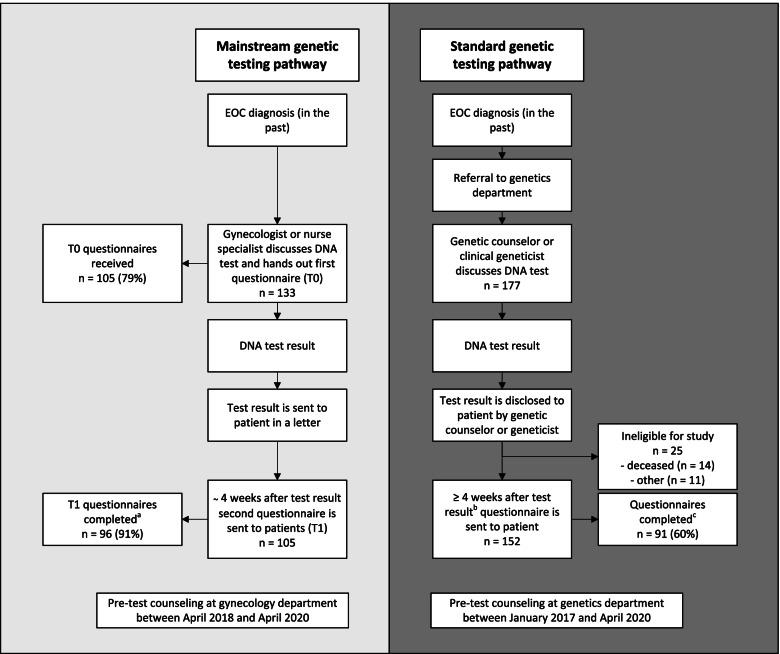
Patients receiving pre-test counseling at the gynecology departments between April 2018 and April 2020 were eligible to participate in our intervention group. Patients receiving pre-test counseling at the genetics department between January 2017 and April 2020 were eligible to participate in our control group. We evaluated patients' experiences with questionnaires, consisting of questions regarding knowledge, satisfaction and psychosocial outcomes. Patients in the intervention group were sent two questionnaires: one after pre-test counseling and one after receiving their DNA test result. Patients in our control group were sent one questionnaire after receiving their test result. In addition, we collected data regarding turnaround times and adherence of non-genetic healthcare professionals to the mainstream genetic testing protocol.
RESULTS
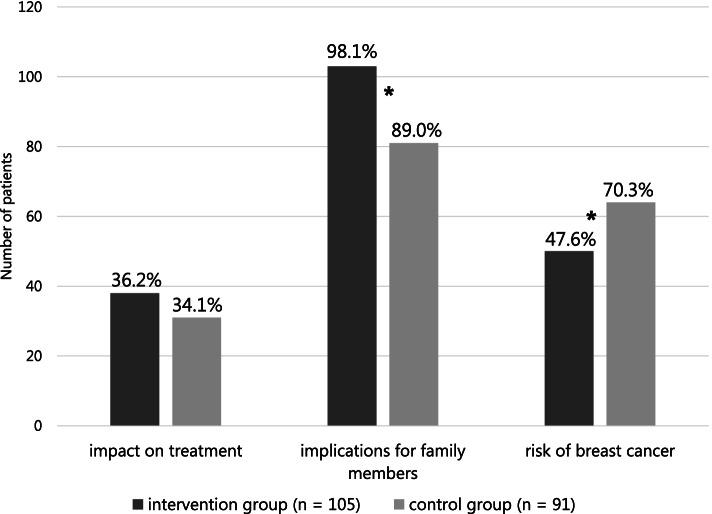
Participation was 79% in our intervention group (105 out of 133 patients) and 60% in our control group (91 out of 152 patients). Knowledge regarding genetics, decisional conflict, depression, anxiety, and distress were comparable in the two groups. In the intervention group, the risk of breast cancer in patients carrying a pathogenic germline variant was discussed less often (49% versus 74% in control group, p ≤ 0.05), and the mean score of regret about the decision to have genetic testing was higher than in the control group (mean 12.9 in the intervention group versus 9.7 in the control group, p ≤ 0.05), although below the clinically relevant threshold of 25. A consent form for the DNA test and a checklist to assess family history were present for ≥ 95% of patients in the intervention group.
CONCLUSION
Mainstream genetic testing is an acceptable approach to meet the increase in genetic testing among women with epithelial ovarian cancer.
背景
上皮性卵巢癌女性对基因检测的需求日益增长。主流基因检测提供了一种替代护理途径,即非基因医疗保健专业人员自行提供检测前咨询。我们旨在探讨主流基因检测对患者体验、周转时间以及非基因医疗保健专业人员对主流基因检测方案的依从性的影响。
方法
2018年4月至2020年4月在妇科接受检测前咨询的患者有资格参与我们的干预组。2017年1月至2020年4月在遗传学部门接受检测前咨询的患者有资格参与我们的对照组。我们通过问卷评估患者的体验,问卷包括有关知识、满意度和心理社会结果的问题。干预组的患者收到两份问卷:一份在检测前咨询后,一份在收到DNA检测结果后。我们对照组的患者在收到检测结果后收到一份问卷。此外,我们收集了有关周转时间以及非基因医疗保健专业人员对主流基因检测方案的依从性的数据。
结果
我们干预组的参与率为79%(133名患者中的105名),对照组为60%(152名患者中的91名)。两组在遗传学知识、决策冲突、抑郁、焦虑和痛苦方面相当。在干预组中,携带致病性种系变异的患者患乳腺癌的风险讨论较少(49% 对对照组的74%,p≤0.05),并且对进行基因检测决定的后悔平均得分高于对照组(干预组平均为12.9,对照组为9.7,p≤0.05),尽管低于临床相关阈值25。干预组中≥95%的患者有DNA检测同意书和评估家族史的清单。
结论
主流基因检测是满足上皮性卵巢癌女性基因检测需求增加的一种可接受的方法。
 Zotero 插件