
氨基葡萄糖联合透明质酸钠治疗骨质疏松症合并膝骨关节炎的临床疗效及其对关节功能和骨代谢标志物的影响。
Clinical Efficacy of Glucosamine plus Sodium Hyaluronate for Osteoporosis Complicated by Knee Osteoarthritis and Its Influence on Joint Function and Bone Metabolic Markers.
机构信息
Department of Endocrinology, The First People's Hospital of Huaihua, Huaihua, 418000 Hunan, China.
Department of Gastroenterology, The First People's Hospital of Huaihua, Huaihua, 418000 Hunan, China.
出版信息
Comput Math Methods Med. 2022 Aug 30;2022:6078254. doi: 10.1155/2022/6078254. eCollection 2022.
BACKGROUND
Osteoporosis (OP) associated with knee osteoarthritis (KOA) is common in older men and postmenopausal women, and it is important to find reliable and effective treatments for this disease to improve joint function and bone metabolism in this population.
OBJECTIVE
To clarify the clinical efficacy of glucosamine (GlcN) plus sodium hyaluronate (SH) for OP complicated by KOA (OP + KOA) and its influence on joint function and bone metabolic markers (BMMs).
METHODS
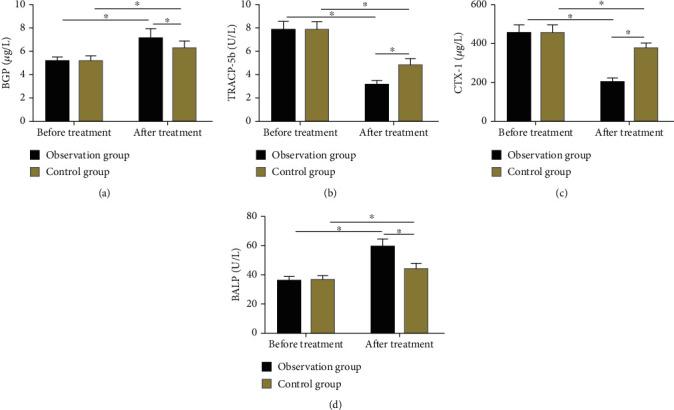
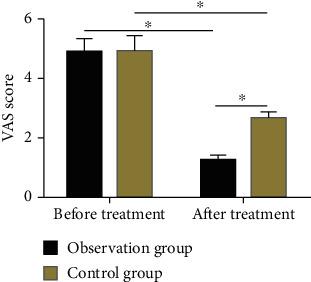
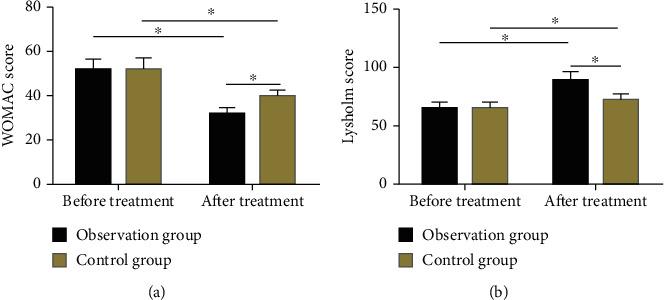
Admitted from July 2019 to July 2021, 126 patients with OP + KOA were selected, including 76 cases (observation group) treated with GlcN plus SH and 50 cases (control group) given GlcN alone. The pain, joint function, BMMs, and clinical efficacy were evaluated and compared. Pain and joint function assessments employed the Visual Analogue Scale (VAS) and the Western Ontario and McMaster Universities Osteoarthritis Index (WOMAC) plus Lysholm Knee Scoring Scale, respectively. BMMs mainly measured bone gla protein (BGP), serum tartrate-resistant acid phosphatase variant (TRACP)-5b, type I collagen cross-linked C-telopeptide (CTX-1), and bone-specific alkaline phosphatase (BALP).
RESULTS
Higher posttreatment VAS scores were determined in observation group as compared to control group; observation group showed lower WOMAC scores of joint function and higher Lysholm scores than control group; in terms of BMMs, TRACP-5b and CTX-1 were lower while BGP and BALP were higher in observation group; the curative effect was also higher in observation group. All the above differences were statistically significant.
CONCLUSIONS
GlcN plus SH has definite clinical efficacy in the treatment of OP + KOA, which can not only significantly improve patients' joint function and bone metabolism but also relieve pain, with high clinical popularization value.
背景
骨质疏松症(OP)与膝骨关节炎(KOA)相关,常见于老年男性和绝经后女性,寻找可靠有效的治疗方法对于改善该人群的关节功能和骨代谢非常重要。
目的
阐明氨基葡萄糖(GlcN)联合透明质酸钠(SH)治疗骨质疏松症合并膝骨关节炎(OP+KOA)的临床疗效及其对关节功能和骨代谢标志物(BMMs)的影响。
方法
选取 2019 年 7 月至 2021 年 7 月收治的 126 例 OP+KOA 患者,分为 GlcN 联合 SH 治疗的观察组 76 例和 GlcN 单药治疗的对照组 50 例。评估和比较两组疼痛、关节功能、BMMs 和临床疗效。疼痛和关节功能评估分别采用视觉模拟评分(VAS)和西安大略和麦克马斯特大学骨关节炎指数(WOMAC)加 Lysholm 膝关节评分量表。BMMs 主要测量骨钙素(BGP)、血清抗酒石酸酸性磷酸酶 5b(TRACP-5b)、I 型胶原交联 C 端肽(CTX-1)和骨碱性磷酸酶(BALP)。
结果
观察组治疗后 VAS 评分高于对照组;观察组关节功能 WOMAC 评分低于对照组,Lysholm 评分高于对照组;BMMs 方面,观察组 TRACP-5b 和 CTX-1 较低,BGP 和 BALP 较高;观察组疗效也较高,差异均有统计学意义。
结论
GlcN 联合 SH 治疗 OP+KOA 具有确切的临床疗效,不仅能显著改善患者的关节功能和骨代谢,还能缓解疼痛,具有较高的临床推广价值。
 Zotero 插件