
FF型ATP合酶分子马达机制。
FF ATP synthase molecular motor mechanisms.
作者信息
Frasch Wayne D, Bukhari Zain A, Yanagisawa Seiga
机构信息
School of Life Sciences, Arizona State University, Tempe, AZ, United States.
出版信息
Front Microbiol. 2022 Aug 23;13:965620. doi: 10.3389/fmicb.2022.965620. eCollection 2022.
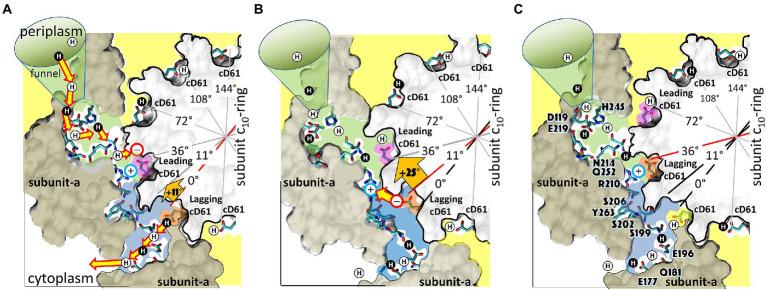
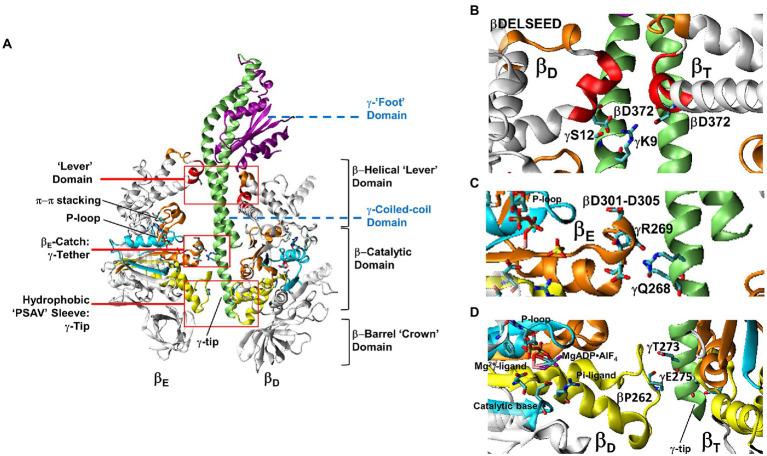
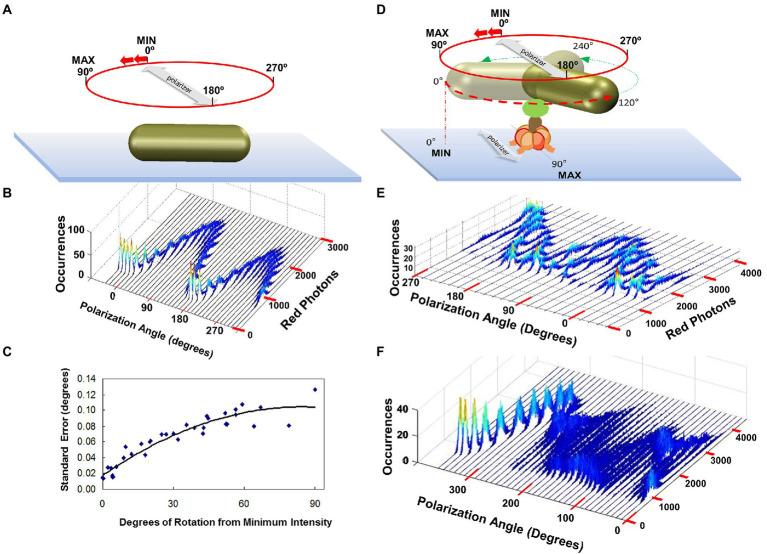
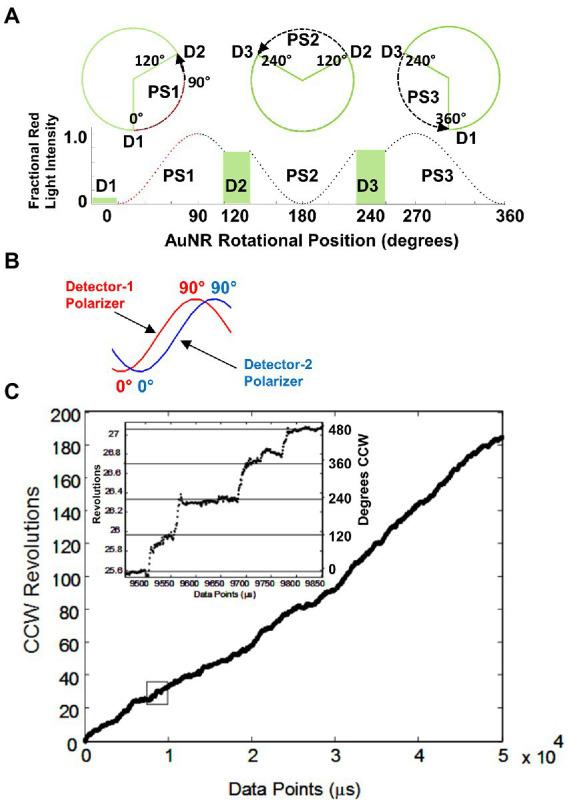
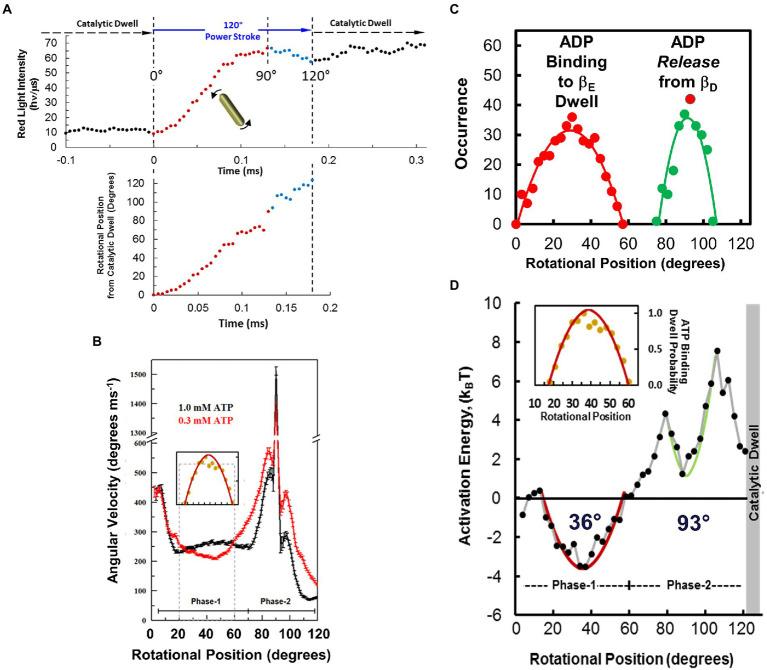
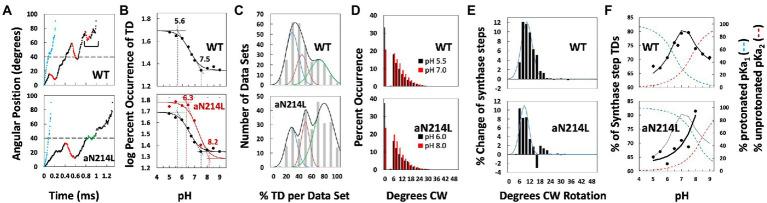
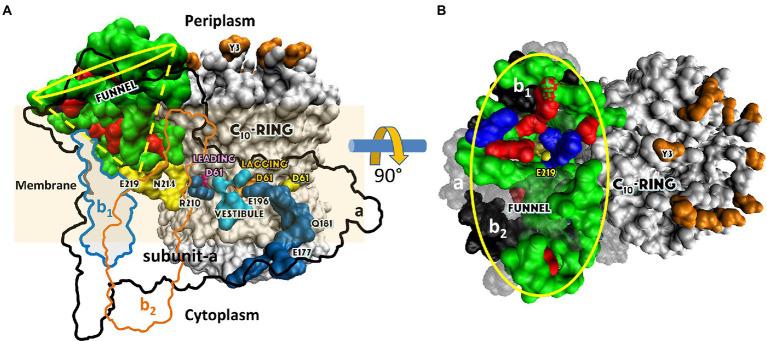
The F-ATP synthase, consisting of F and F motors connected by a central rotor and the stators, is the enzyme responsible for synthesizing the majority of ATP in all organisms. The F (αβ) ring stator contains three catalytic sites. Single-molecule F rotation studies revealed that ATP hydrolysis at each catalytic site (0°) precedes a power-stroke that rotates subunit-γ 120° with angular velocities that vary with rotational position. Catalytic site conformations vary relative to subunit-γ position (β, empty; β, ADP bound; β, ATP-bound). During a power stroke, β binds ATP (0°-60°) and β releases ADP (60°-120°). Årrhenius analysis of the power stroke revealed that elastic energy powers rotation unwinding the γ-subunit coiled-coil. Energy from ATP binding at 34° closes β upon subunit-γ to drive rotation to 120° and forcing the subunit-γ to exchange its tether from β to β, which changes catalytic site conformations. In FF, the membrane-bound F complex contains a ring of c-subunits that is attached to subunit-γ. This c-ring rotates relative to the subunit-a stator in response to transmembrane proton flow driven by a pH gradient, which drives subunit-γ rotation in the opposite direction to force ATP synthesis in F. Single-molecule studies of FF embedded in lipid bilayer nanodisks showed that the c-ring transiently stopped F-ATPase-driven rotation every 36° (at each c-subunit in the c-ring of FF) and was able to rotate 11° in the direction of ATP synthesis. Protonation and deprotonation of the conserved carboxyl group on each c-subunit is facilitated by separate groups of subunit-a residues, which were determined to have different pKa's. Mutations of any of any residue from either group changed both pKa values, which changed the occurrence of the 11° rotation proportionately. This supports a Grotthuss mechanism for proton translocation and indicates that proton translocation occurs during the 11° steps. This is consistent with a mechanism in which each 36° of rotation the c-ring during ATP synthesis involves a proton translocation-dependent 11° rotation of the c-ring, followed by a 25° rotation driven by electrostatic interaction of the negatively charged unprotonated carboxyl group to the positively charged essential arginine in subunit-a.
F-ATP合酶由通过中央转子和定子连接的F和F马达组成,是负责在所有生物体中合成大部分ATP的酶。F(αβ)环定子包含三个催化位点。单分子F旋转研究表明,每个催化位点(0°)处的ATP水解先于一个动力冲程,该动力冲程使亚基γ旋转120°,其角速度随旋转位置而变化。催化位点构象相对于亚基γ位置有所不同(β,空;β,结合ADP;β,结合ATP)。在动力冲程期间,β结合ATP(0°-60°),β释放ADP(60°-120°)。对动力冲程的阿累尼乌斯分析表明,弹性能量为旋转提供动力,解开γ亚基的卷曲螺旋。34°时ATP结合产生的能量使β在亚基γ上关闭,以驱动旋转至120°,并迫使亚基γ将其系链从β交换到β,这改变了催化位点构象。在FF中,膜结合的F复合物包含一个与亚基γ相连的c亚基环。该c环响应由pH梯度驱动的跨膜质子流相对于亚基a定子旋转,这驱动亚基γ向相反方向旋转以迫使F中合成ATP。对嵌入脂质双层纳米盘中的FF进行的单分子研究表明,c环每36°(在FF的c环中的每个c亚基处)短暂停止F-ATP酶驱动的旋转,并能够沿ATP合成方向旋转11°。每个c亚基上保守羧基的质子化和去质子化由亚基a残基的不同组促进,这些残基被确定具有不同的pKa值。来自任何一组的任何残基的突变都会改变两个pKa值,这相应地改变了11°旋转的发生率。这支持了质子转运的Grotthuss机制,并表明质子转运发生在11°步骤期间。这与一种机制一致,即在ATP合成过程中,c环每旋转36°涉及c环质子转运依赖性的11°旋转,随后是由带负电荷的未质子化羧基与亚基a中带正电荷的必需精氨酸的静电相互作用驱动的25°旋转。






 Zotero 插件