
外侧肋间肌阻滞的镇痛作用:3 种不同手术和 3 种显著效果的病例报告。
The analgesic contribution of external oblique intercostal block: Case reports of 3 different surgeries and 3 spectacular effects.
机构信息
VKV American Hospital, Anesthesiology, Istanbul, Turkey.
VKV American Hospital, Anesthesiology and Pain, Istanbul, Turkey.
出版信息
Medicine (Baltimore). 2022 Sep 9;101(36):e30435. doi: 10.1097/MD.0000000000030435.
INTRODUCTION
Abdominal wall blocks are frequently used due to the use of effective blocks, such as the transversus abdominis plane (TAP) block and the widespread use of ultrasound (US) imaging. A good knowledge of abdominal innervation is required for the use of abdominal wall blocks. We describe the extraordinary performance of external oblique intercostal (EOI) blocks in 3 different surgeries.
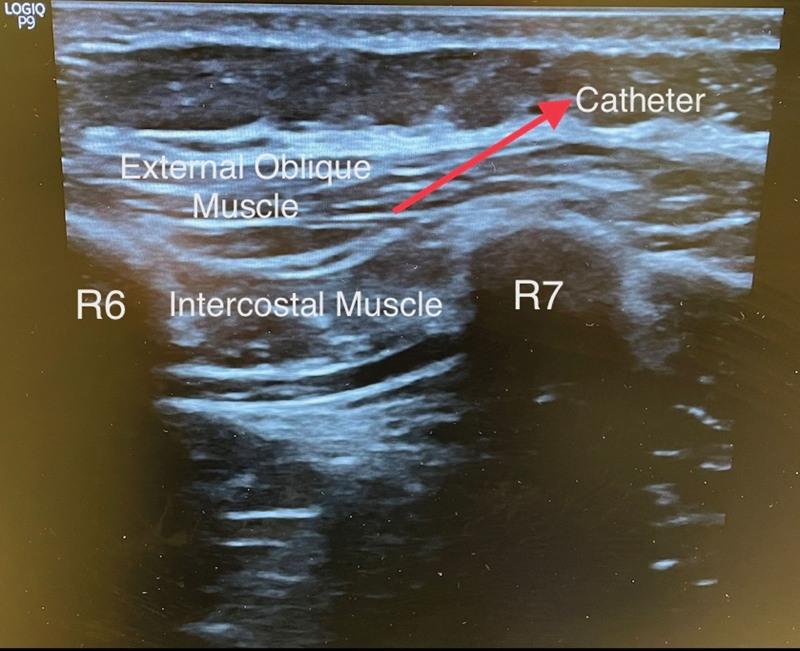
PATIENT CONCERNS, DIAGNOSIS AND INTERVENTIONS: Case 1: A man aged 30 to 35 was taken to the operating room for open liver surgery. After surgery, unilateral EOI block and bilateral TAP block were performed with the patient in the supine position, and a catheter was placed under the external oblique muscle. Postoperative analgesia was followed by patient-controlled analgesia (PCA) through the catheter. Case 2: A male patient aged 35 to 40 was taken to the operating room for laparoscopic liver surgery. After surgery, unilateral (EOI) block and bilateral TAP block were performed with the patient in the supine position. The patient received iv tramadol PCA (bolus dose 10 mg only, lockout 20 minutes). Case 3: A man aged 25 to 30 was taken to the operating room for laparoscopic bariatric surgery. After the surgery, bilateral EOI and bilateral rectal sheath blocks were performed with the patient in the supine position. The patient received iv tramadol PCA (bolus dose 10 mg only, lockout 20 minutes).
OUTCOMES
All patients had low NRS scores in the recovery unit and very low opioid consumption in the first 72 hours postoperatively. All were satisfied with the quality of analgesia.
CONCLUSION
We think that EOI block will come to occupy a significant place in upper abdominal analgesia, especially in obese patients, due to its wide innervation area and ease of application.
引言
由于横腹肌平面(TAP)阻滞等有效阻滞的应用以及超声(US)成像的广泛应用,腹部壁阻滞经常被使用。为了使用腹壁阻滞,需要对腹部神经支配有很好的了解。我们描述了在 3 种不同手术中外侧肋间腹肌(EOI)阻滞的出色表现。
患者关注、诊断和干预:病例 1:一名 30 至 35 岁的男性被送往手术室进行开放性肝手术。手术后,患者处于仰卧位进行单侧 EOI 阻滞和双侧 TAP 阻滞,并在外侧腹肌下放置导管。术后通过导管进行患者自控镇痛(PCA)。病例 2:一名 35 至 40 岁的男性被送往手术室进行腹腔镜肝手术。手术后,患者处于仰卧位进行单侧(EOI)阻滞和双侧 TAP 阻滞。患者接受 iv 曲马多 PCA(仅推注剂量 10mg,锁定 20 分钟)。病例 3:一名 25 至 30 岁的男性被送往手术室进行腹腔镜减肥手术。手术后,患者处于仰卧位进行双侧 EOI 和双侧直肠鞘阻滞。患者接受 iv 曲马多 PCA(仅推注剂量 10mg,锁定 20 分钟)。
结果
所有患者在恢复室的 NRS 评分均较低,术后 72 小时内阿片类药物的消耗量也非常低。所有患者均对镇痛质量感到满意。
结论
我们认为,由于 EOI 阻滞的广泛神经支配区域和易于应用,它将在腹部上部镇痛中占据重要地位,特别是在肥胖患者中。


 Zotero 插件