
脑龄与记忆门诊患者向痴呆的进展相关。
Brain-age is associated with progression to dementia in memory clinic patients.
机构信息
Department of Neuroimaging, Institute of Psychiatry, Psychology and Neuroscience, King's College London, SE5 8AF, UK; South London and Maudsley NHS Foundation Trust, UK; Centre for Medical Image Computing, Department of Computer Science, University College London, WC1V 6LJ, UK.
South London and Maudsley NHS Foundation Trust, UK.
出版信息
Neuroimage Clin. 2022;36:103175. doi: 10.1016/j.nicl.2022.103175. Epub 2022 Aug 30.
BACKGROUND
Biomarkers for the early detection of dementia risk hold promise for better disease monitoring and targeted interventions. However, most biomarker studies, particularly in neuroimaging, have analysed artificially 'clean' research groups, free from comorbidities, erroneous referrals, contraindications and from a narrow sociodemographic pool. Such biases mean that neuroimaging samples are often unrepresentative of the target population for dementia risk (e.g., people referred to a memory clinic), limiting the generalisation of these studies to real-world clinical settings. To facilitate better translation from research to the clinic, datasets that are more representative of dementia patient groups are warranted.
METHODS
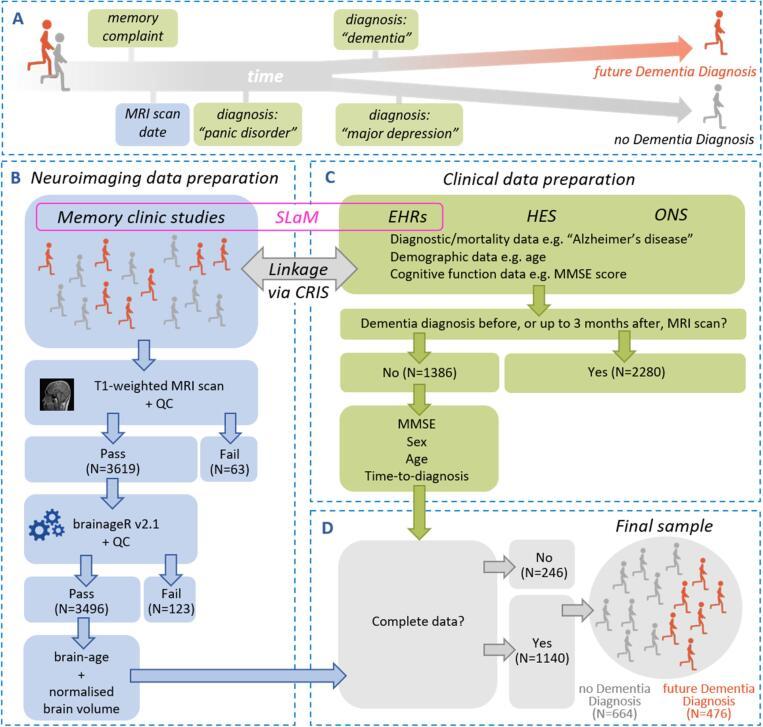
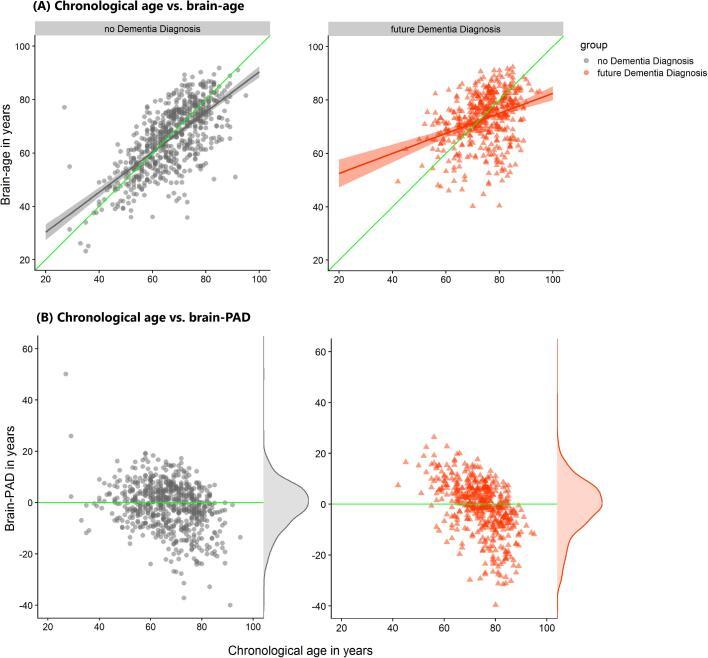
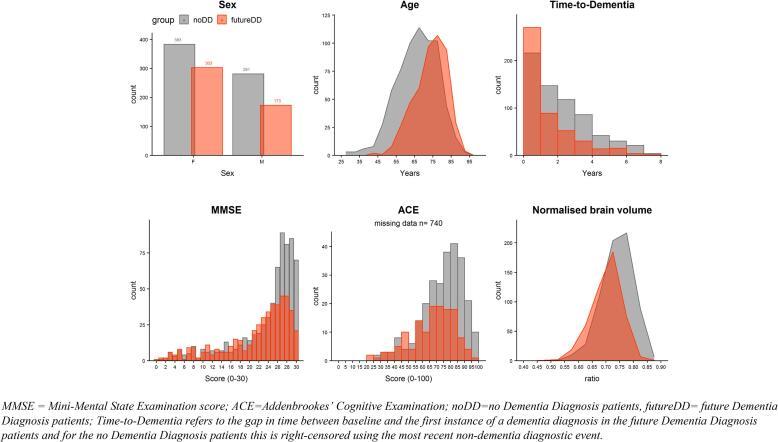
We analysed T1-weighted MRI scans from a real-world setting of patients referred to UK memory clinic services (n = 1140; 60.2 % female and mean [SD] age of 70.0[10.8] years) to derive 'brain-age'. Brain-age is an index of age-related brain health based on quantitative analysis of structural neuroimaging, largely reflecting brain atrophy. Brain-predicted age difference (brain-PAD) was calculated as brain-age minus chronological age. We determined which patients went on to develop dementia between three months and 7.8 years after neuroimaging assessment (n = 476) using linkage to electronic health records.
RESULTS
Survival analysis, using Cox regression, indicated a 3 % increased risk of dementia per brain-PAD year (hazard ratio [95 % CI] = 1.03 [1.02,1.04], p < 0.0001), adjusted for baseline age, age, sex, Mini Mental State Examination (MMSE) score and normalised brain volume. In sensitivity analyses, brain-PAD remained significant when time-to-dementia was at least 3 years (hazard ratio [95 % CI] = 1.06 [1.02, 1.09], p = 0.0006), or when baseline MMSE score ≥ 27 (hazard ratio [95 % CI] = 1.03 [1.01, 1.05], p = 0.0006).
CONCLUSIONS
Memory clinic patients with older-appearing brains are more likely to receive a subsequent dementia diagnosis. Potentially, brain-age could aid decision-making during initial memory clinic assessment to improve early detection of dementia. Even when neuroimaging assessment was more than 3 years prior to diagnosis and when cognitive functioning was not clearly impaired, brain-age still proved informative. These real-world results support the use of quantitative neuroimaging biomarkers like brain-age in memory clinics.
背景
用于痴呆风险早期检测的生物标志物有望更好地进行疾病监测和针对性干预。然而,大多数生物标志物研究,特别是神经影像学研究,分析的都是人为“干净”的研究组,没有共病、错误转诊、禁忌症和来自狭窄的社会人口群体。这些偏倚意味着神经影像学样本通常不能代表痴呆风险的目标人群(例如,被转介到记忆诊所的人群),从而限制了这些研究在真实临床环境中的推广。为了促进研究向临床更好地转化,需要使用更能代表痴呆患者群体的数据集。
方法
我们分析了来自英国记忆诊所服务的实际患者队列的 T1 加权 MRI 扫描(n=1140;60.2%为女性,平均[标准差]年龄为 70.0[10.8]岁),以得出“大脑年龄”。大脑年龄是基于结构神经影像学的定量分析得出的与年龄相关的大脑健康指数,主要反映脑萎缩。脑预测年龄差(brain-PAD)的计算方法是大脑年龄减去实际年龄。我们通过与电子健康记录链接,确定了在神经影像学评估后 3 个月至 7.8 年内发展为痴呆的患者(n=476)。
结果
使用 Cox 回归的生存分析表明,每增加一个 brain-PAD 年,痴呆风险增加 3%(风险比[95%置信区间]为 1.03[1.02,1.04],p<0.0001),调整了基线年龄、年龄、性别、简易精神状态检查(MMSE)评分和标准化脑容量。在敏感性分析中,当痴呆发生时间至少为 3 年(风险比[95%置信区间]为 1.06[1.02,1.09],p=0.0006)或基线 MMSE 评分≥27 时(风险比[95%置信区间]为 1.03[1.01,1.05],p=0.0006),brain-PAD 仍然具有显著性。
结论
大脑年龄较大的记忆诊所患者更有可能被诊断为痴呆。脑年龄可能有助于改善痴呆的早期检测,在初始记忆诊所评估期间做出决策。即使神经影像学评估是在诊断前 3 年以上进行的,并且认知功能没有明显受损,脑年龄仍然具有信息性。这些真实世界的结果支持在记忆诊所中使用脑年龄等定量神经影像学生物标志物。


 Zotero 插件