
认识到与年龄相关的得失作为中老年人日常压力反应性的调节因素。
Awareness of age-related gains and losses as moderators of daily stress reactivity in middle- and older-adulthood.
作者信息
Wilton-Harding Bethany, Weber Nathan, Windsor Tim D
机构信息
College of Nursing and Health Sciences, Flinders University, Adelaide, SA, Australia.
College of Education, Psychology and Social Work, Flinders University, Adelaide, SA, Australia.
出版信息
Front Psychiatry. 2022 Aug 26;13:929657. doi: 10.3389/fpsyt.2022.929657. eCollection 2022.
OBJECTIVES
Associations between awareness of one's own aging and wellbeing have received increasing attention in the field of gerontology over the last decade. The current study examines how between-person differences and within-person fluctuations of awareness of age-related change (AARC) relate to daily negative affect and vitality. Of key interest was the extent to which fluctuations in AARC moderated reactivity to stressor exposure. We predicted that higher positive perceptions of aging (AARC-gains) would buffer the relationship between daily stressors and negative affect/vitality. Conversely, we expected that higher negative perceptions (AARC-losses) may exacerbate the relationship between daily stressors and the outcome variables.
METHODS
Data were collected from a community-based sample of 152 Australian adults aged 53-86 ( = 69.18, = 5.73). For 10 consecutive days, participants completed surveys on their smartphones measuring daily stressors, AARC, and affect (positive and negative). Bayesian hierarchical linear models were used to examine whether AARC-gains and AARC-losses moderated within-person associations of daily stressors and affect (i.e., stress reactivity).
RESULTS
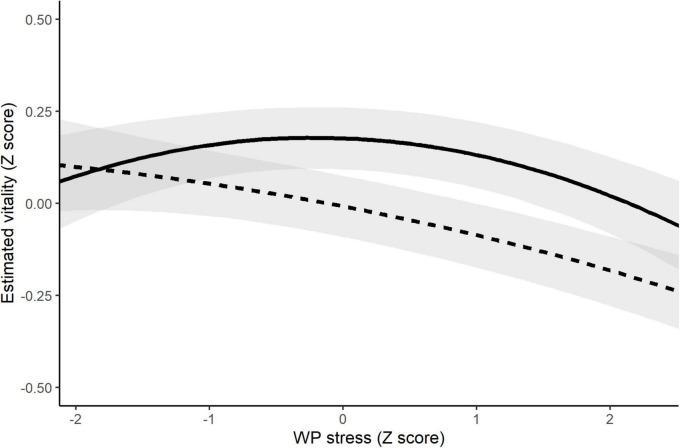
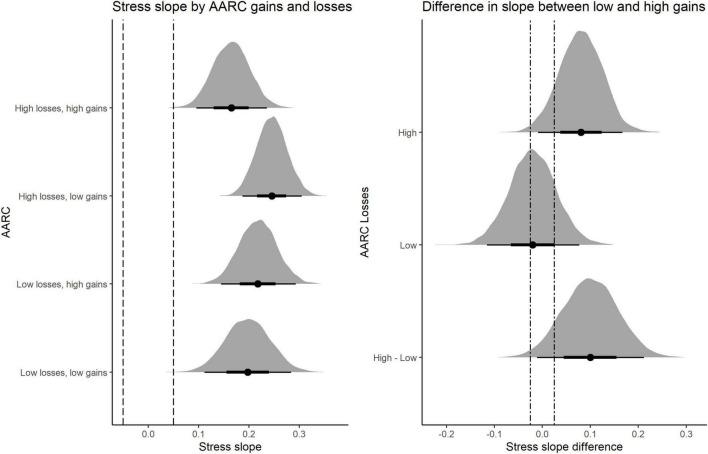
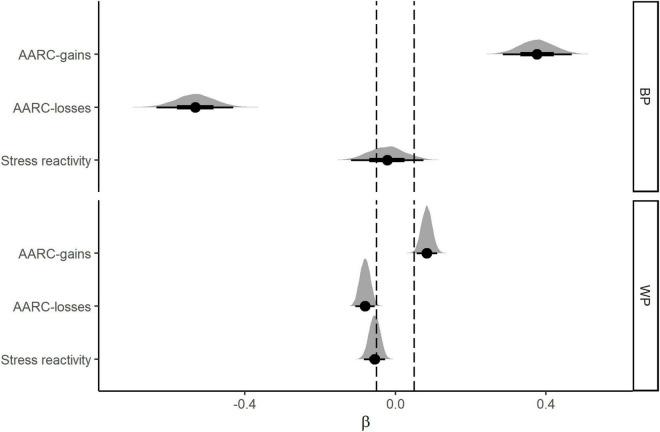
At the between-person level, higher AARC-gains was associated with lower negative affect and higher vitality, whereas those reporting higher AARC-losses scored higher on negative affect and lower on vitality. Within-person variables revealed that on days when AARC-gains was higher and AARC-losses was lower, this corresponded with lower negative affect and higher vitality. There was no evidence in support of individual moderating effects of within-person AARC-losses or within-person AARC-gains on stress reactivity. A trend was evident in support of a three-way WP Stress severity × WP AARC-gains × WP AARC-losses interaction in the prediction of negative affect, indicating that on days when AARC-losses was higher, the association of stress severity with negative affect was weaker if AARC-gains was higher. Follow-up analyses modeling quadratic stress severity revealed a trend suggesting an interaction of within-person stress severity and within-person AARC-losses.
DISCUSSION
Results indicate that both individual differences and short-term fluctuations in AARC are associated with daily negative affect and vitality. The results provided qualified support for a possible protective role of AARC-gains in the context of stress reactivity.
目标
在过去十年中,对自身衰老的认知与幸福感之间的关联在老年学领域受到了越来越多的关注。当前的研究考察了与年龄相关变化的认知(AARC)在个体间差异和个体内部波动如何与日常消极情绪和活力相关。关键的关注点在于AARC的波动在多大程度上调节了对应激源暴露的反应性。我们预测,对衰老的更高积极认知(AARC增加)会缓冲日常应激源与消极情绪/活力之间的关系。相反,我们预期更高的消极认知(AARC减少)可能会加剧日常应激源与结果变量之间的关系。
方法
数据收集自152名年龄在53 - 86岁之间的澳大利亚成年人(平均年龄 = 69.18,标准差 = 5.73)的社区样本。连续10天,参与者通过智能手机完成关于日常应激源、AARC以及情绪(积极和消极)的调查。使用贝叶斯分层线性模型来检验AARC增加和AARC减少是否调节了日常应激源与情绪的个体内部关联(即应激反应性)。
结果
在个体间水平上,更高的AARC增加与更低的消极情绪和更高的活力相关,而那些报告更高AARC减少的人在消极情绪上得分更高,在活力上得分更低。个体内部变量显示,在AARC增加更高且AARC减少更低的日子里,这对应着更低的消极情绪和更高的活力。没有证据支持个体内部AARC减少或个体内部AARC增加对应激反应性的调节作用。在预测消极情绪方面,支持三元个体内部应激严重程度×个体内部AARC增加×个体内部AARC减少交互作用的趋势很明显,这表明在AARC减少更高的日子里,如果AARC增加更高,应激严重程度与消极情绪之间的关联就会更弱。对二次应激严重程度进行建模的后续分析显示出一种趋势,表明个体内部应激严重程度与个体内部AARC减少之间存在交互作用。
讨论
结果表明,AARC的个体差异和短期波动都与日常消极情绪和活力相关。研究结果为AARC增加在应激反应性背景下可能的保护作用提供了有限的支持。

 Zotero 插件