
¹⁸F-FAPI、¹⁸F-FDG PET/CT及MRI在评估肝外转移及局部复发性肝细胞癌(HCC)中的不同特征:1例病例报告及文献复习
Different Features of F-FAPI, F-FDG PET/CT and MRI in the Evaluation of Extrahepatic Metastases and Local Recurrent Hepatocellular Carcinoma (HCC): A Case Report and Review of the Literature.
作者信息
Chen Donghe, Chang Chengdong, Zhang Yafei, Yang Shuye, Wang Guolin, Lin Lili, Zhao Xin, Zhao Kui, Su Xinhui
机构信息
Department of Nuclear Medicine, The First Affiliated Hospital, Zhejiang University School of Medicine, Hangzhou, People's Republic of China.
Department of Pathology, The First Affiliated Hospital, Zhejiang University School of Medicine, Hangzhou, People's Republic of China.
出版信息
Cancer Manag Res. 2022 Sep 5;14:2649-2655. doi: 10.2147/CMAR.S374916. eCollection 2022.
BACKGROUND
Recurrence and metastasis are important causes of postoperative death in most HCC patients. Conventional imaging modalities such as F-FDG PET/CT and enhanced MRI are still unsatisfactory in evaluating these patients in the clinical setting. PET/CT imaging with a radiolabeled fibroblast activation protein inhibitor (FAPI) has emerged as a new imaging technique for the diagnosis and radiotherapy of malignant tumors. While many studies have focused on the diagnostic accuracy of intrahepatic primary HCC, the evaluation of recurrent and metastatic HCC remains only poorly investigated.
CASE PRESENTATION
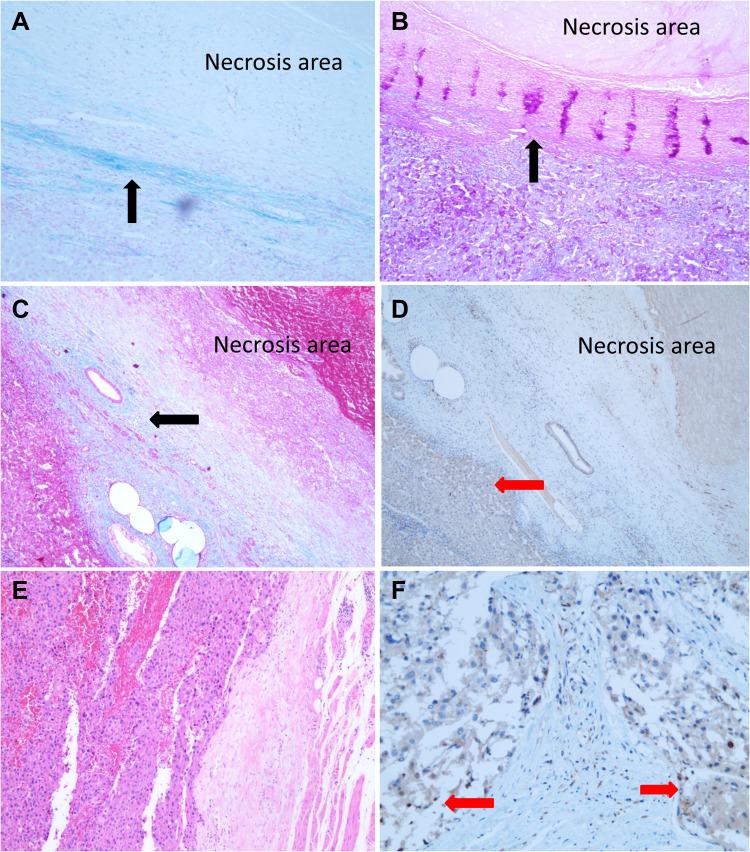
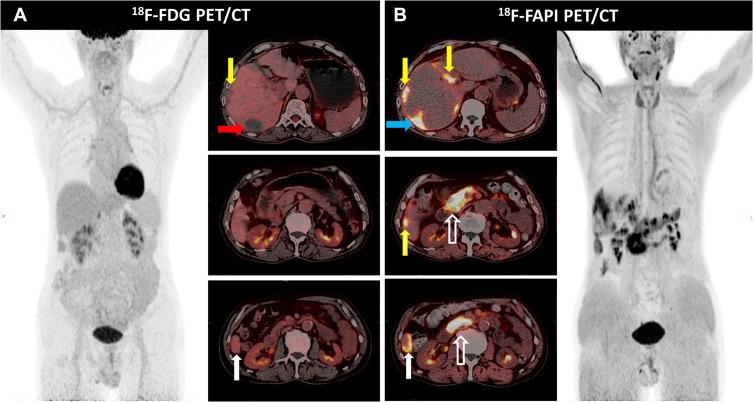
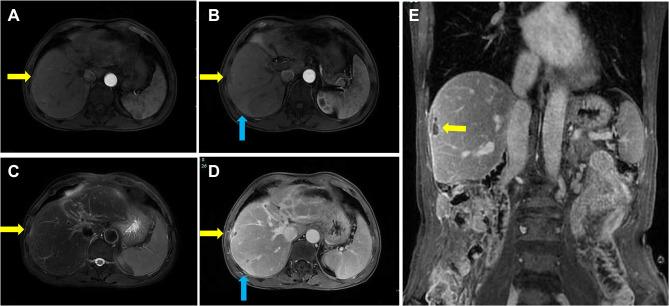
A 71-year-old man with a five-year history of HCC after radical resection underwent F-FDG PET/CT due to further surgery for tumor recurrence, which revealed two iso-metabolic lesions in the right peritoneum and a hypo-metabolic lesion in the right liver. F-FAPI PET/CT was performed to further complement F-FDG PET/CT in the detection of these suspected metastatic lesions. Importantly, multiple diffuse intense radioactivity was shown in the hepatic capsule, suggesting metastatic lesions, but a wedge-shaped elevated F-FAPI uptake disorder around the FDG-unavid necrotic lesion after radiofrequency ablation (RFA) demonstrated benign stromal fibrosis.
CONCLUSION
This case suggested that F-FAPI may have an advantage over F-FDG in detecting peritoneal metastasis even in tiny or early hepatic capsules of HCC, but its false positives due to postoperative stromal fibrosis should be noted. Wedge- or strip-shaped FAPI-avid lesions with sharp edges may be post-treatment stromal fibrosis.
背景
复发和转移是大多数肝癌患者术后死亡的重要原因。在临床环境中,诸如F-FDG PET/CT和增强MRI等传统成像方式在评估这些患者时仍不尽人意。使用放射性标记的成纤维细胞活化蛋白抑制剂(FAPI)进行PET/CT成像已成为一种用于恶性肿瘤诊断和放疗的新成像技术。虽然许多研究聚焦于肝内原发性肝癌的诊断准确性,但对复发性和转移性肝癌的评估仍研究较少。
病例介绍
一名71岁男性,肝癌根治性切除术后有5年病史,因肿瘤复发需进一步手术而接受F-FDG PET/CT检查,结果显示右腹膜有两个等代谢病灶,右肝有一个低代谢病灶。进行F-FAPI PET/CT以在检测这些疑似转移病灶方面进一步补充F-FDG PET/CT。重要的是,肝包膜显示多处弥漫性强烈放射性,提示转移病灶,但射频消融(RFA)后FDG不摄取的坏死病灶周围出现楔形F-FAPI摄取升高紊乱,提示为良性间质纤维化。
结论
该病例表明,F-FAPI在检测肝癌微小或早期肝包膜的腹膜转移方面可能优于F-FDG,但应注意其因术后间质纤维化导致的假阳性。边缘锐利的楔形或条形FAPI摄取病灶可能是治疗后的间质纤维化。
 Zotero 插件